

Do women play a role in Sri Lanka’s ‘reconciliation’?: Gender dynamics in the transition from war to peace

Groundviews
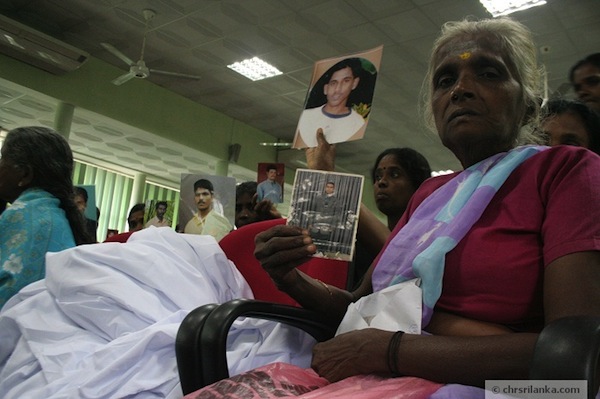
A mother displaying the photographs of her sons who are missing during the Lessons Learnt and Reconciliation Commission (LLRC) session in Trincomalee, December, 3-5, 2010. Photo courtesy Centre for Human Rights
Introduction
In order to understand the ‘role’ of women in such a vital process of social transition, we have to understand the place of women in our society – their position, their status, their condition. This conference is being held at a time when the country is shaken by a spike in reports of sexual violence against women and girls in the South of the country. Over the past few years there has been a phenomenal rise in civilian acts of violence specifically against women:-
- Incidents of ‘grease yakkas’ that sexually terrorised women were reported from right across the country, including the supposedly heavily controlled North and East;
- Half-burnt bodies of raped and battered and murdered women are being found mostly in one district alone, Ratnapura;
- Adolescent girls are being raped allegedly by persons who have been elected into governing office in Tangalla and Akuressa in the Southern Province;
- Girls as young as 6 or 7 years are being raped and murdered in Colombo in the Western Province.
To date, there has been a remarkably muted responses from society in general, whether from the politicians or from key sectors of policy implementation. There are, admittedly, strong laws in place in the country; those who are outraged by the repetition of these horrendous acts of sexual violence on a nation-wide scale, are demanding why these laws are not being implemented in relation to this serious social challenge.
When we examine the State response to other equally significant social challenges, such as poverty, for example, we can see that huge efforts have been made – institutions set up, distribution networks spread across most of the country through Poverty Alleviation Programmes, mobilizing low-income women and men through various programmes for economic empowerment of the poor. Similarly, the challenge of insurgency, both North and South, has been met with a massive, hugely costly, State and societal response. However, we are yet to see any significant level of concerted national focus of policy or political action when it comes to ensuring protection from violence of all kinds for women and girls through effective implementation of laws or operational institutional structures and programmes.
The response to this social violence has to come not only from women and girls to protect themselves (in whatever way they can) but more importantly, from larger society and, especially from the institutions and officials with powers to deal with such violations. In the case of the increase in violence against women, the perpetrators are found to be men. This reality is key to our understanding of the gendered nature of social relations: violence against women is not only a women’s issue; it is a societal issue that stems from differences in power and status between women and men in society and, also the perceptions of power and access to power among women and men.
