

Handling disasters: The man-made disaster of July 1983 (Part 2)

Groundviews
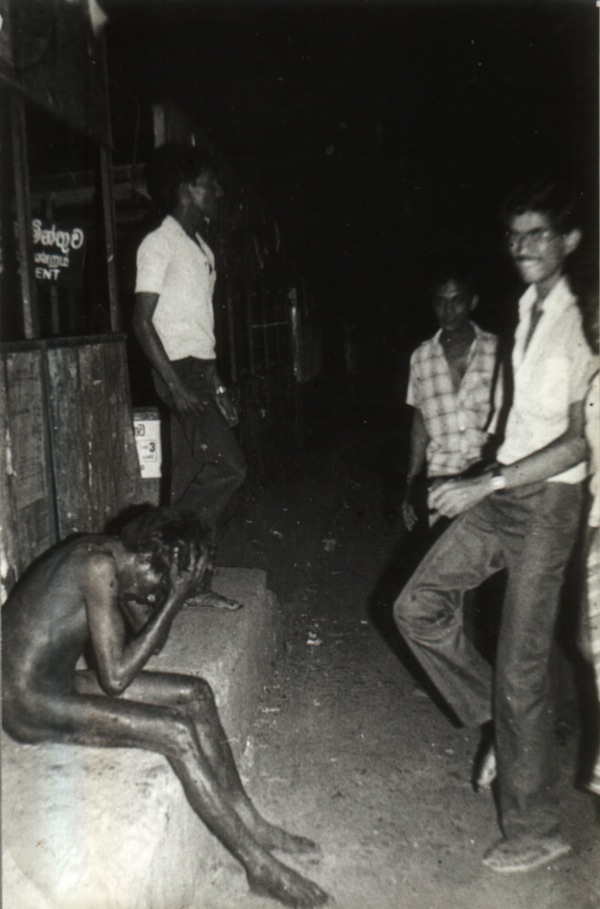
Photograph by Chandragupta Amarasinghe, courtesy Thuppahi’s Blog
[Editors note: Continued from Part 1, which you can read here. The author was at the time of the 1983 anti-Tamil pogrom Secretary to the Prime Minister and Commissioner-General of Essential Services from July 1983 to April 1984.]
Prioritization of Needs
Taking stock
An early activity of the CGES management team was the prioritization of displaced persons ‘needs’. This was based on an assessment of personal requests, complaints and, sometimes, fervent pleas by the ‘displaced’, now virtual refugees, in the hastily set –up welfare centres.
The senior management Team[1], consisted mainly of the eight Deputy Commisioners supplemented by other staff members as required. It met daily with the CGES during the first five days and then weekly on a regular basis to assess and compile lists of needs. Numerous telephone calls with Officers – in – Charge of the Centres (which were set up in the outstations too as the disturbances spread outward from Colombo to other main towns with mixed populations) and discussion with NGO’s active in the field (prominent among them Sarvodaya, the Sri Lanka Red Cross and Saukyadana) highlighted and sharpened specific urgent needs. Information supplied by the News media which quickly swung into action and the frequent Press meetings set up by the Press Relations and NGOO Director (Wilfred Jayasuriya) helped in the inevitably rough and ready assessment of needs which was all the circumstances permitted. Later on, a structured detailed survey of family and individual members needs – education, employment, etc was carried out with the help of voluntary observers (mainly retirees and University students). But in the very early stages of displacement the stock-taking was based mostly on verbal information and on an adhoc basis.
Out of this welter of information it was clear that what the involuntarily displaced (100,000 in Colombo Municipality area alone, and growing in numbers outside) chiefly needed was the assurance of personal safety for the family, information about, and where appropriate, reunion with those family members who had presumably fled to other points of safety, clothing – since many had escaped from their homes with barely the clothes on their backs- and urgent medical attention, (very often burns), for those who had suffered injury during the attacks. Shelter of some kind, food and water and immediate additional sanitation at the temporary centres were also high in priority. Evacuation, back to Jaffna, Trincomalee, Batticaloa, the Vanni and Mannar also figured high especially where the displaced had been living as weekly ‘boarders’ in the city. Concern for material belongings – houses, business establishments, vehicles, jewellery, household equipment and books/documents which had been lost to arson and pillage took, not unexpectedly, a secondary place and was therefore left to be dealt with by the CGES subsequently. Security and ‘relief and rehabilitation’ of the person, being of primary interest. However the question of personal belongings and hard – earned livelihoods and businesses ranging from the ‘corner plantain – boutique’, the roadside cobbler, to hundreds of small and medium sized shops and large industrial units which had also been looted and set on fire, could not be long delayed. The issue of material belongings lost and destroyed assumed great importance as the extent of damage inflicted became known. It was clear that the CGES could not, with its given powers, address this need as well. The Cabinet was advised to establish a separate institution to manage affected property, businesses and industry and Emergency Regulations were promulgated under the Public Security Ordinance to handle the many issues which had arisen in this area. I have dealt with this under the sub-heading REPPIA – (Rehabilitation of Persons, Property and Industries Authority.)
Family Reunion Continue reading »
