

The Tamil torture case has exposed Britain's flawed deportation policy
Asylum seekers are not
being given the protection they need in the UK, as the torture of 'Hari'
returned to Sri Lanka has shown
 Donna Covey
guardian.co.uk,
Donna Covey
guardian.co.uk,
'Hari' was deported back to Sri Lanka, where he claims he was
beaten with electrical wire and burned with cigarettes. Photograph: Teri
Pengilley for the Guardian
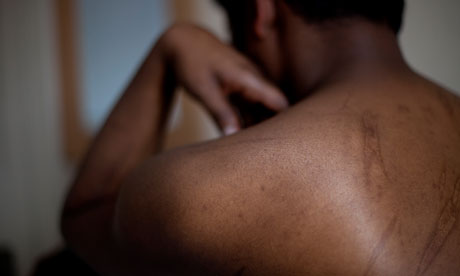
 The horrifying
testimony of Hari, a Tamil man tortured
by Sri Lankan officials after the UK sent him back to his country, is one
more shameful example of how this country currently treats people who seek
safety here. Given the distressing description of Hari's 17-day torture ordeal
and the methods used, who can blame him for holding the UK government
responsible for the scars on his back?
The horrifying
testimony of Hari, a Tamil man tortured
by Sri Lankan officials after the UK sent him back to his country, is one
more shameful example of how this country currently treats people who seek
safety here. Given the distressing description of Hari's 17-day torture ordeal
and the methods used, who can blame him for holding the UK government
responsible for the scars on his back?
Evidence
that shows it is unsafe to return people to Sri Lanka grows by the day. Just
last week, the UK's high court stopped the removal of 40 refused asylum seekers
to Sri Lanka on the grounds that their human rights would be violated. Human
Rights Watch have this year alone reported 13
cases of refused asylum seekers who have been tortured on return to the
country, and have called for the UK to halt all returns. The charity Freedom From Torture has
consistently raised this as a serious issue, with a "steady stream" of clients
who have been recently tortured, including individuals who were forcibly removed
to Sri Lanka from the UK.
The
human cost of sending people back to Sri Lanka can no longer be ignored, and
it's clear the UK government should stop removals without delay. Yet the message
does not seem to be getting through. The Home Office's response to this
appalling story – that it will continue to return people "who do not have a
genuine need for our protection" – is simply unacceptable. By this it means it
will not only continue to return people to Sri Lanka, but also to other
countries where torture and human rights abuses are well documented, such as
Afghanistan and the Democratic Republic of the Congo. Why can't the government
acknowledge the situation in these countries and halt returns, offering some
form of protection to people who have been refused asylum until it is safe to go
back?
Like
many of the asylum seekers we see at the Refugee Council, Hari gave
evidence to show he had been tortured and beaten in his own country, but he was
still refused asylum. Every day we work with women who, despite surviving sexual
violence in their own country, are refused asylum here. Of the women accessing
our therapeutic services in 2010-11, more than 30% were from Sri Lanka, the vast
majority had been tortured or raped, and just under half had been refused asylum
in the UK.
The Home
Office's own statistics show that it is often very difficult for people
seeking asylum here to get the protection they need. In 2011, out of 17,496
decisions made on asylum applications, 68% were refusals. Of those that
appealed, 26% were overturned, showing that at least a quarter of people were
given a wrong decision in the first instance. Refusal rates are also higher for
women – in particular, 80-89% of women's claims from Sri Lanka were rejected
each year between 2006 and 2010. It is clear that too many people are being
wrongly refused asylum in the first place.
While
the UK Border Agency (UKBA) has made some steps in recent years to ensure the
right decisions are made first time round, a number of flaws remain. In
particular, a lack of access to good-quality legal representation throughout the
asylum process means people are not supported to give all the information they
need to back up their claim, and this is getting worse following recent cuts to
legal aid. Vulnerable groups face particular problems in getting their claims
recognised because the system is not set up for their specific needs: women, for
example, who need to disclose traumatic and personal information to support
their claims, often struggle to access female interviewers and interpreters.
There is often a lack of awareness about the situation for women in their
countries of origin. Many of our clients also cite being met with a culture of
disbelief by immigration officials, which puts them at an immediate
disadvantage.
As
a result, the UKBA is failing to identify people who are at risk of torture,
persecution or worse, on return to their own country, and are wrongly refusing
people the protection they need. We want the UKBA to urgently develop policies
and practices that reflect the reality of the situation in the country of origin
for all asylum seekers, and to recognise that the situation in some countries is
particularly dangerous for women.
On
Friday, more than 100 refugees came together in Brixton to celebrate the
protection offered to refugees over the last 60 years, as part of the jubilee
celebrations. It was a moment to be proud of Britain. However, Hari's story
today reminds us that, if we want to maintain this proud tradition, we still
have a long way to go.
