


Tamil deportee blames Britain for repeat of Sri Lanka torture ordeal
'I had to suffer again. They are responsible. If I was not sent back, I was not deported, I would not have these scars.'
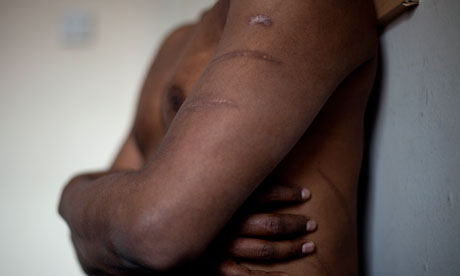
'Hari' describes being tortured in a hall
he said had been designed for the purpose, including tables and chairs adapted
for beatings and whippings. Photograph: Teri Pengilley for the
Guardian
When
a representative from the British high commission waiting at Colombo airport
went up to Hari and offered him his business card, thetorture victim, now 32, says it
gave him hope.
The
official told him to get in contact if anything happened to him and that the
card was a sign that he might live.
Hari
had just disembarked from the worst flight of his life. On the plane, privately
chartered by the UK Border Agency in June last year, were 24 Sri Lankans, 12 of
whom were Tamils. All had failed in their claim to stay in the UK. Despite
documentary evidence, seen by the Guardian, from the International Committee of
the Red Cross, Hari was unable to demonstrate to the British government he had
been tortured by Sri Lankan authorities in the late 1990s.
Watched
over by more than 70 UK border security staff, men and women wept as the plane
took off from Stansted.
"We
were in a panic. We were expecting they would cancel the removal [flight] at the
last minute and most of them were crying … I thought, this was the end of my
life," said Hari.
Disregarding
the presence of British high commission officials, Sri Lanka's security
services subjected Hari on arrival to lengthy questioning. Fearing for his life,
he took off, fleeing to a relative's home away from his family in Jaffna, in the
north of the war-torn island.
For
six months Hari hid with his aunt until he thought it was safe to return to his
family but on the way to them on 10 December, he was stopped at a checkpoint and
taken to the capital.
In
what he described as a "torture hall" on the fourth floor of the criminal
investigation department building in Colombo, Hari, who had already served time
for being an intelligence agent for the Tamil Tigers (LTTE), was accused of
campaigning and raising funds for the organisation while in the UK and also of
undermining diplomatic relations by complaining to the UK government of the
abuses he had previously suffered.
Brought
from his cell, he said the hall was "designed" for torture. On the walls were
sticks and poles, tables and chairs adapted for beatings and whippings. The
floor was splattered and stained with blood. When he denied the accusations,
Hari was beaten, whipped with electric cables, suffocated with a plastic bag
containing petrol, hung by his ankles by nylon rope and "again burned with
cigarettes".
His
back is now a welter of scars and the cigarette burns are still prominent on his
chest. The Guardian has also seen medical reports supporting his claims of
torture.
"Due
to the unbearable pain, I finally admitted all the allegations and I was made to
sign a document and was asked to work for them as an informer," he says. But
Hari says his release only came 17 days later after his uncle bought his freedom
by bribing the guards. He fled the country and escaped by plane to Russia on 1
January. From there, hiding inside a truck shipping furniture, he made his way
across Europe for 10 days and finally arrived at Dover.
Two
scars on his body are not from Sri Lanka's torture hall. They seem to follow the
line of his tendons from his wrists and up his arms and they date from March
when Hari was in Britain.
Despondent
after hearing that security services had threatened his family after he fled
prison, Hari said he decided to end his own life by slitting his forearms and
taking an overdose.
"I
began to feel guilty [about my family's situation]. I lost all hope and thought
my only solution was to end my life," he said. He recovered and now he says he
is angry at the British government as well as his captors.
"I
am extremely disappointed by the way they have treated me. I came here with a
hope. I believed that the UK authorities would consider my case reasonably but
regardless of all my history and the evidence they sent me back and I had to
suffer again. They are responsible. If I was not sent back, I was not deported,
I would not have these scars."
