

Sri Lanka's Frontline Denial
It isn't rocket science to see that Sri Lanka needs outside monitoring.
 May-18-2012
It isn't rocket science to see that Sri Lanka needs outside monitoring.
 |
(LONDON) - The room was packed. The panel, consisting of journalists, activists and relatives of the victims, were speaking to an audience made up mainly of Sri Lankans. I was there too, partly because I admire the work of the film maker Callum Macrae and partly because this kind of bunfight is worth watching, however painful.
The representative of the Government of Sri Lanka, Rajiva Wijesinha, in fine pudding-basin style haircut, was fighting the corner for the ruling party. In a long and rambling discourse, part stream of consciousness, part shaggy-dog story, he unravelled the contents of his mind. Well some of it, at least.
Sitting next to him was a Sri Lankan victim of the LTTE whose testament of horror from the reign of Tiger terror (he was abducted and tortured at the age of thirteen before his parents were killed) was being shamelessly mis-used by Our Man From Sri Lanka for its own ends.
There was also Jan Jananayagam, spokesperson for Tamils Against Genocide, Callum Macrae of course, Yolander Foster, Amnesty International's excellent Sri Lankan researcher and the Chair, Stephen Sackur from the BBC's programme Hardtalk.
Pudding Basin had brought a few books for which he wanted one pound. The reason for this nominal sum, he informed the audience, was because he knew British fellows respected anything they paid for. The title of one of them.
The Road to Reconciliation & its Enemies [Documented Evidence & Logical Arguments against Emotional Exaggeration & Soundbites.]
The Road to Reconciliation & its Enemies [Documented Evidence & Logical Arguments against Emotional Exaggeration & Soundbites.]
The Road To Urbino
Roma Tearne is currently working on a short film Letter from Urbinoto be shown at the National Gallery, London, on June 15th. The film is based on an idea taken from her latest novel The Road To Urbinothat was then developed into an independent narrative. Shot in an unusual location in Italy to give the appearance of a hand-tinted postcard it combines a personal view of the paintings of Piero della Francesca with the Italian landscape.
Further details will be posted shortly.
|
Huh?
What with his slender grasp of anything much, his denial of the authenticity of Callum Macrea's Sri Lanka's Killing Field and his generally vague logorrhea, Pudding Basin was giving the Chair a hard time of it. I thought he did rather well, considering. The Chair, I mean, not PB, whose deathless oratory lulled me into gentle slumber only to find myself woken up with a start when the gushing, 1940's pre-Empire prose, finally stopped. This man was a member of the Sri Lankan government?
The audience, those one removed from the sorrow and the pity of Sri Lanka's genocide, tittered. What else could they do in the face of such stupidity? At one point I marvelled at the way in which the other panelist, victim of the Tamil terrorist group, was being so shamelessly used for government propaganda. Why was it that this man's terrible loss could not be treated with objective understanding? And then, because there was nothing else I could do, because the discussion had reached its most formless stage, I opened my sketchbook and began to draw instead.
I noticed one or two murderous looks, coming from the Singhala side of the audience, present undoubtedly to defend their assets in their homeland.
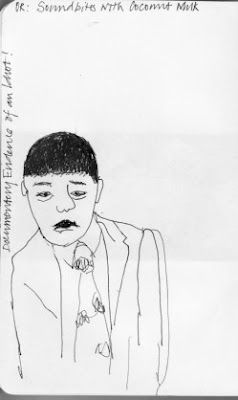 Finally the woman lost it and began to shout. And had to be told to sit down. Grief, it was. Her voice was that of Grief held in check for years and years.
I noticed too for the first time how some younger, middle class Singhala and Tamil were uniting now in their desire (at least) for a kind of peace. Don't talk about the war, seemed to be the slogan. Move on, use the word peace, rebuild. Fine words, great sentiments. I agree.
But what of those who cannot move on, who do not have closure for their grief, whose loved ones are dead, disappeared, without a grave or in one with masses?
A lone woman stood up; beautiful, elderly, small. I had heard her say earlier that she would not cry tonight as she had spent the whole day crying. In a voice that rose like the waters of a tsunami she talked about the underlying causes of the civil war, the discrimination, the loss of life that had gone on for years. Since British Crown Rule had ended in fact. Brava, I wanted to shout. For hadn't I myself, in 1958 aged only four, seen a Tamil man burnt to death?
So what of this voice? Who will treat her grief as a sacred thing, give it dignity, rock it to sleep? Pudding Head closed his eyes and tilted his head back. The audience rumbled, agreeing and disagreeing, If grief and denial and greed and violence could coexist so seamlessly in an upstairs room in London imagine what it must be like, unchecked, in Sri Lanka itself.
It isn't rocket science to see that the country needs outside monitoring and that both victims and perpetrators need help in order to stop this terrible cycle.
The comedian Eddie Izzard once joked that the international community was happy to turn a blind eye on those countries engaged in killing their own people. It is only when they go next door, as Hitler did with Poland, do they intervene. If that is indeed still the case, Pudding Head and his henchmen will be just fine for the foreseeable future. Helped by those young middle class Sri Lankans who simply want to move on, whatever that means.
 |
Roma Tearne is a Sri Lankan born artist and writer. Her first novel, Mosquito, has been shortlisted for the 2007 Costa Book Awards first Novel prize.
Currently a Fellow at Oxford Brookes University, she has had many exhibitions including "Nel Corpo delle cittá" at the prestigious MLAC ( Museo Laboratorio Arte Contemporanea ) in Rome.
She became the artist in residence at the Ashmolean Museum Oxford in 2002 and while there, worked on "Happenings in a Museum"
Salem-News.com is extremely pleased to work with this esteemed author, and to be able to utilize her approach in communicating stories about war and ethnic strife that cross all boundaries; those things that make the very soul of our earth bleed needlessly.
