

Postwar Domination By Other Mean: Militarism, Buddhism & Tourism In The North Of Sri Lanka


Dr. Nimanthi Perera-Rajasingham
Jaffna in the postwar context remains a troubled space. Yes indeed, there is no longer an embargo, and one can take the train, bus or fly easily. Yes, there are new super markets and people can walk around more freely. However, the scenario of domination and oppression continues in other ways. During a recent visit, forms of violence and domination were clear not only in the large number of Navy and military camps still there, in the ways they have become permanent installations in the North, but also in the ways in which new forms of postwar Buddhism and Tourism function with close ties the military apparatus. The first example is the Sangamitta Buddhist Temple built in Madagal at Dambakola Patuna in 2009, right by a Navy camp. Here, new histories are produced to penetrate the North as belonging to Buddhists. If Tamils have claimed the Jaffna Peninsula as the traditional homeland for Tamils, then erecting temples such as this is a way of rebutting this claim. The second example is the Hammenhiel Resort, a Dutch forte now run by the Navy for profit. In both locations, the local populations have been either evicted from those spaces, or are not allowed to fish in those seas, while the military-Buddhist-tourist complex functions to serve the South.
Sangamitta Temple: the Invention of Tradition and History
The Sangamitta Temple was built and opened in 2009 in the postwar period. Despite the devastating end of the war, the Navy and the state did not hesitate to construct the temple and claim it as a Sinhala Buddhistspace. One would imagine that the end of war would have drawn the state’s attention to more urgent matters such as humanitarian assistance for Tamil civilians killed in the Vanni. However, the Sangamitta temple was built immediately after the war, close to an enormous Navy base because supposedly Sangamitta landed there (approximately 250 BC) bringing with her a Boe sapling. The sapling is said to be the same as the one found in Anuradhapura today. While this area is not a High Security Zone, it might as well be, as the Navy dominates the landscape. The proximity of the Navy camp and the temple locate how Sinhala Buddhism and militarism are integrated formations.
The creation of a temple here is part of an invention of tradition done in the Tamil heartland so that Sinhala Buddhism can claim a place for itself there, even though no Buddhists live in the area, and no temple existed there until 2009. There are two large statues of Sangamitta: one inside the temple and the other just outside by a lake. These large statues claim: Buddhism entered the country from this point and so the North too belongs to the Buddhists.
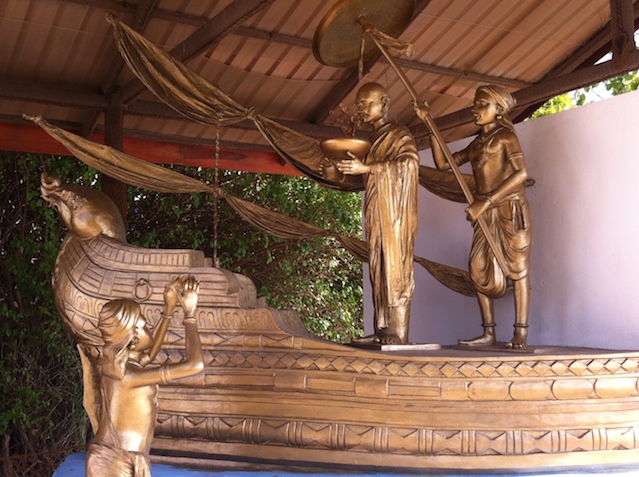
There are two other additional claims that tell us about colonial penetration into Tamil areas. One is that the temple was opened by Shirani Rajapaksa, as if she is the modern day Sangamitta or a continuation of Buddhism in modern form. She places herself as the continuation of an ancient lineage, a formation that Joseph Roach has called “surrogation,” in his work The Cities of the Dead. The second is that the military’s claim that this temple was made possible because brave military personnel defeated a terrorist threat. So, there are signs celebrating military victory and prowess. Here, the trauma of the final war, and the suffering of Tamils in the North at the hands of the state and the Tamil Tigers are erased and retold as a glorious victory for Buddhism. The overall message of the signs and the temple is loud and clear: this land belongs to Buddhists, and the military is here to stay.
