

Hong Kong protests: government leader Carrie Lam condemns 'blatant riot'
Lam denies she is ‘selling out’ to Beijing as Chinese state media say protests are pushing the city ‘towards backwardness’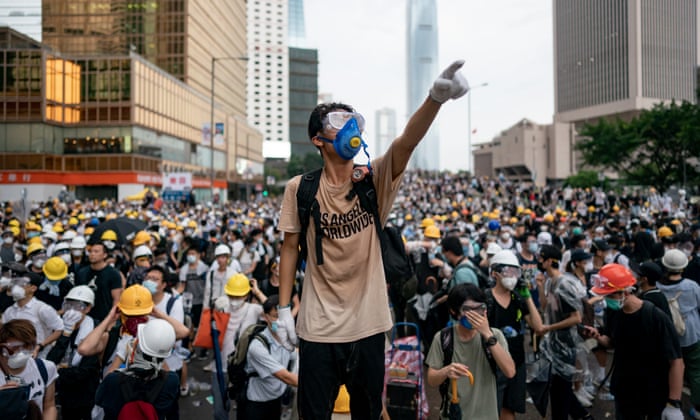
A protester makes a gesture during protests against a controversial extradition bill in Hong Kong Photograph: Anthony Kwan/Getty Images

Lily Kuo -
Hong Kong’s chief executive Carrie Lam has condemned protesters for “dangerous and life-threatening acts” during a mass demonstration over a controversial bill that allows extradition to the Chinese mainland. Only a handful of protestors remained on the streets on Thursday as Chinese state media said demonstrators were pushing the city “towards backwardness”.
Lam, who is championing the proposed law’s passage, noted that some young people in the crowd had expressed their views peacefully, but said the protest had devolved into a “blatant, organised riot.”
“Since this afternoon, some people have resorted to dangerous, or even potentially fatal, acts. These include arson, using sharpened iron bars and hurling bricks to attack police officers, as well as destroying public facilities,” she said.
Her comments came after riot police used rubber bullets, batons and teargas against people in Hong Kong protesting against the bill that would tighten Beijing’s grip on the semi-autonomous territory.
 Hong Kong chief executive Carrie Lam speaks at a press conference in Hong Kong Photograph: Jérôme Favre/EPA
Unable to drive away the crowds paralysing the central business district on Wednesday, authorities were forced to delay a debate over the bill. A new date for the debate has not been set.
On Thursday morning a handful of protesters remained, milling about as a widespread cleanup around the city’s legislature took place. Many roads had reopened around the central business district, but Pacific Place mall next to the legislature remained closed. Government offices in the financial district were closed and would be for the rest of the week.
Ken Lam, a protestor in his 20s who works in the city’s food and beverage industry said he would remain on strike until the bill was scrapped.
“I don’t know what the plan for protesters is today, we will just go with the flow, but we think the turnout will be smaller than yesterday and it will be peaceful, after what happened yesterday,” he said.
Banks based in the central district – the financial heart of the city – emphasised it was “business as usual” but many offered staff, where possible, the option of working from home.
HSBC, whose ground-level public space at its headquarters had previously been a focal point for protests, said it was operating as normal, but gave staff the option of working remotely.
“As a precaution, we shut two outlets early where the protests were taking place. Our priorities are the safety of our employees and supporting our customers,” the bank said in a statement.
On Thursday, Chinese state media said in editorials the protests were “hammering” the city’s reputation, with outbreaks of “lawlessness” undermining the rule of law.
The English-language China Daily said the new amendments were in line with international conventions but “the opposition camp and its foreign masters seem willing to oppose it for their own purposes at the expense of the city’s rule of law, public safety and justice”.
“It is lawlessness that will hurt Hong Kong, not the proposed amendments to its fugitive law,” it said.
The state-owned tabloid The Global Times blamed “radical opposition forces” and “the western forces behind them” for hyping up and politicising the amendments. “Playing with uncontrolled street politics is to push Hong Kong to backwardness and disturbance,” it said. “This is not a wise direction for Hong Kong.”
Protesters worry Beijing will exploit the law to extradite political opponents and activists to the mainland, where they would be subject to a Chinese justice system criticised by human rights activists.
The violence marked an escalation in the biggest political crisis to hit the city in years. After the police crackdown, a group of protesters made a failed attempt to storm government offices. In several cases, crowds charged at armed officers, throwing bottles and other debris.
Hospital authorities told broadcaster RTHK that 72 people had been taken to hospital and two were in a serious condition. Pictures and videos on social media appeared to show people wounded by rubber bullets or bean-bag rounds, which police fired from shotguns.
Police chief Stephen Lo defended his officers, saying they had shown restraint until “mobsters” tried to storm parliament.
“These violent protesters kept charging at our line of defence, and used very dangerous weapons, including ... throwing metal barricades at us and throwing bricks,” he said.
But Amnesty International said police “took advantage of the violent acts of a small minority as a pretext to use excessive force against the vast majority of peaceful protesters.”
Activists have vowed to keep up the pressure against the extradition bill. College student Louis Wong said the demonstrations had so far been a success.
“This is a public space and the police have no right to block us from staying here,” Wong said. “We’ll stay until the government drops this law and (Chinese President) Xi Jinping gives up on trying to turn Hong Kong into just another city in China like Beijing and Shanghai.”
Lam said she had never “felt guilty” over the issue and believed she was doing the right thing. She said she felt “worried and sad” about the young protesters.
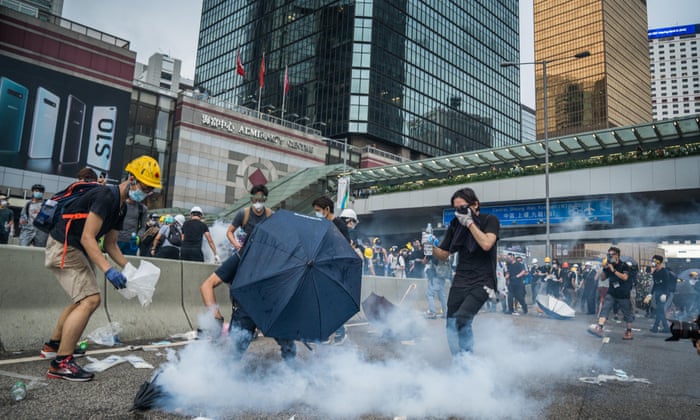 Protester try to use water to put out tear gas which the police used against them in Hong Kong Photograph: Geovien So/SOPA Images/REX/Shutterstock
“To use a metaphor, I’m a mother too, I have two sons,” she said. “If I let him have his way every time my son acted like that, such as when he didn’t want to study, things might be OK between us in the short term.
“But if I indulge his wayward behaviour, he might regret it when he grows up. He will then ask me: ‘Mum, why didn’t you call me up on that back then?’”
In an interview with Hong Kong broadcaster TVB, Lam denied she was “selling out” the city.
“It’s time to let lawmakers with different opinions express their views under the legislative process,”
she said. “On whether to retract or push it through ... our consideration is this: There is no doubt this issue is controversial. Explanation and dialogue are useful but perhaps that has not entirely dispelled worries.”
