

Omnibus Cabinet & Opulent Ministers

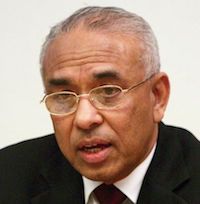
Dr. Ameer Ali
 After weeks of no government, Ranil Wickremesinghe has legally secured his right to form one, to an embarrassing humiliation of President Maithiripala Sirisena, who was adamant in preventing RW from coming back. A president who vowed not to remain in his position even for ‘one hour’ if RW were to return as PM is now set to remain at least until the end of the rest of the term of this government. Mr. President! Never say never in politics.
However, the RW government is really on life support, and it can lose its parliamentary majority at any time if one or more of its supporters, like TNA and JVP, decide to pull the rug under RW’s feet. Already a new tussle between the PM and President has emerged in relation to the formation and size of the cabinet. While the President wants three ministries for himself and dictating who should and should not be in the 30 member cabinet, PM and his party are trying to work out a plan to be approved by parliament, which could increase the size of the cabinet to more than thirty. Even if it remains at thirty can the nation afford an omnibus cabinet?
From just 18 ministers in the 1947 DS Senanayake cabinet, the number of ministers swelled to nearly seventy under Rajapaksa, before coming down to thirty, and again is about to blow out if RW government’s plan goes through the parliament. To put this under some perspective, let us look at the number of ministers in few of our neighbouring governments. Modi’s government in India, ruling over a giant of an economy and country, has a cabinet of only 25 ministers. India’s neighbour Pakistan under Imran Khan has a cabinet of only 21 ministers. Malaysia, with almost the same demographic size as Sri Lanka but far more affluent has a cabinet of 25 ministers. Singapore, the wealthiest nation in South East Asia has a cabinet of just 9 ministers. In the light of these figures what is the logic and rationale for the RW government, with an economy that is teetering on the verge of bankruptcy, especially after the recent constitutional crisis, to wantonly enlarge the size of its cabinet and worsen an already adverse budget situation. Doesn’t the ruling philosophy of neoliberalism advocate for leaner governments?
The most lucrative job in Sri Lanka at the moment, even for one with the least educational qualification, seems to become a parliamentarian and get a ministership or at least a deputy ministership. The opulence enjoyed by some of these ministers and deputies compared to their predecessors is shocking. The current crop of ministers, deputies and ordinary MPs are part of the rising new leisure class in the country. Can the nation afford to sustain this ballooning bourgeoisie with a precarious economy? There are nevertheless a few of them who are dedicated, honest and hardworking, but several are simply charlatans and wealth seekers. In the absence of any mechanism to measure the performance of ministers and their deputies, how does one reward the good, warn the bad and punish the ugly?
Cabinet positions have become a source of bribing crooks and cronies for their allegiance to the PM and President. This is where corruption originates, right at the top, and spreads like cancer to debilitate the entire public domain. What Sri Lanka really needs is not a large quantity but better quality of ministers. A ministry is what a minister makes of it. An able minister is an asset to the country and there had been many in the past who delivered the most at the lowest cost. Corruption in Sri Lanka is not a birth trait but an acquired one through inept politics.
In spite of all other evils accredited to British colonialism, the country is in debt to the British for three important legacies: one, parliamentary democracy, the other, a first class civil service, and a third cricket. The country just saved democracy from the brink of disappearance, and no doubt Sri Lankans will fight to their death to keep it alive and robust. The nation has also shown that it can beat the British in cricket on their own turf. However, it is in the area of civil service that local politicians have done the most damage. Over the last few decades we have allowed that institution to lose its original stature and quality. There had been a planned easing in the standards of selection to the present administrative and overseas services. The significance of this institutional dereliction should not be underestimated.
In the past, while cabinet ministers took care of policies and macro-management it was public servants from the permanent secretaries to government agents and to ordinary clerks who did the micromanagement. When minsters were honest and impartial those worked in departments under those ministries were automatically expected to set high standards. There were several instances in the past when top class, able and dedicated civil servants resigned their positions and went into academia or left the island, simply because they could not yield to unfair pressures from incompetent ministers. Today, ministers are virtually micromanaging public administration. With omnibus cabinets, incompetent ministers and deputies, public service has become the politicians’ playground for winning influence and prestige. Corruption, no doubt, has become rampant. Ultimately it is the quality of the cabinet that determines the quality of public administration.
