

Back To Square One: The Cycle Continues


Aravinth Kumar
1958, 1977, 1983, 1990’s, 2000’s, 2014 and now 2018; a continuing long list of dates with no end in sight. Since gaining independence from the British, Sri Lanka has experienced significant racial violence in every decade expect for the 1960’s. The reason behind this is purely down to the political system that has been in place since independence; multi-party democracy.
I wrote an article which was published in the Colombo Telegraph, “Democracy with Sri Lankan Characteristics”. In it, I explained that Sri Lanka is stuck in a continuous cycle. I have reproduced the cycle which was noted in the article below:
 *An election is called. All political parties issue their mandate of what they wish to achieve if given power. Usually, these political parties offer a populist manifesto completely disregarding the impact on the economy (or national unity). During the campaign, political parties provide all thoughts of tangible goodies to entice the citizens to vote for them. As Lee Kuan Yew famously stated, Sri Lanka’s elections are an “auctions of non-existent resources”.
*The people vote in a party which is usually either an UNP or SLFP led alliance. The party forms a government for a period of 5 years.
*Once in power, the UNP/SLFP looks to pay back those who helped with their election win, as well as help family and friends. This is usually through providing jobs in the public sector thus depriving the state of competent individuals. Unaffordable populist measures as stated in their manifesto are enacted, such as public sector pay rises or fuel subsidies, requiring the government to borrow high interest loans creating economic instability e.g. balances of payment crises, increasing inflation and currency collapses.
*In the rare case that a government does attempt meaningful development, be it from a change in law or a physical infrastructure project, the opposition parties will block it just to prevent their “enemy” taking credit for helping the nation to develop. In doing so, the opposition can then claim that the current government has done nothing of benefit and the people should vote them into power.
*With the economy suffering and the next set of elections around the corner, the government of the day starts scapegoating and trying to turn people’s attention away from their poor mismanagement by stroking nationalistic/ethnic/religious sentiment and/or (further) offering economically damaging policies.
*With the government not having made any meaningful action to improve the country, come the next election, the people usually turn to the opposition (i.e. if it’s an UNP backed government then power shifts to a SLFP backed government and vice versa).
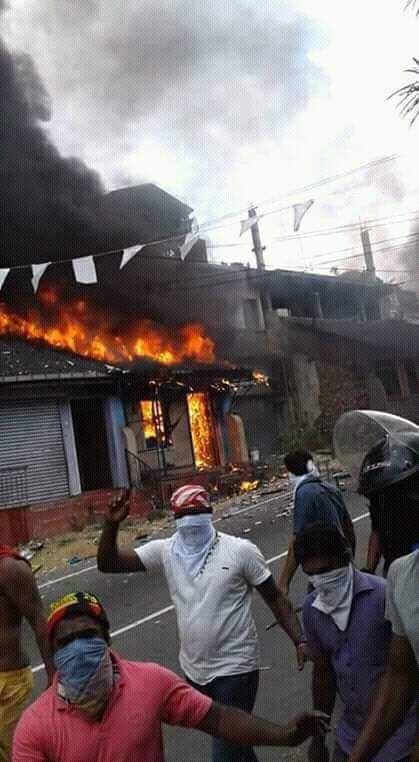
The recent racial incidents experienced in Ampara and Digana have been created and caused by politicians. There’s no denying it. The question we need to ask is which political party started these incidents. This writer believes that while it is difficult to put blame on a particular party for promoting the violence, all of the parties have been complicit in keeping the violence going for their own sick motives.
The Government
The shaky coalition of the UNP and the splintered SLFP, which joined together after the 2015 elections, are soon approaching the next round of parliamentary and presidential elections. The major problems faced by the people such as the rising cost of living and the general poor economic conditions have made people weary and disillusioned. It has not helped that corruption is seen to be at the same level, if not worse, than that of the previous government (which was a major contributor to removing the prior government from power).
As noted in the 5th bullet point of the cycle, the government needs to divert attention from their poor handling of the country as well as the instability circus that occurred after being humiliated at the local government elections. There are protests in all corners of the country and the political dreaded “hot potato”, Geneva is back on the plate. To save face, the government seems to have fallen down the same path of previous government by creating and/or promoting and/or allowing ethnic violence to rise. It’s a perfect way of turning the masses attention away from the poor governance.
Having the Muslims being attacked is politically less of an issue. The Tamils community is seen as weakened and can’t be scapegoated for economic issues like in the 1950’s by saying they have all the government jobs. It is also a risky issue with the international community already breathing down Sri Lanka’s neck around the Tamil issue. With the Muslims however, they are an easier target. Internationally, the western countries are having their own issues with individuals who practise Islam. Muslims are also highly entrepreneurial and have historically been major business owners in the country. With the cost of living and poor economic environment, it’s easy to blame the Muslims and state they are taking all the money.
