

US Veto: Palestine Torn Between Trump’s Arrogance & Arab Indifference
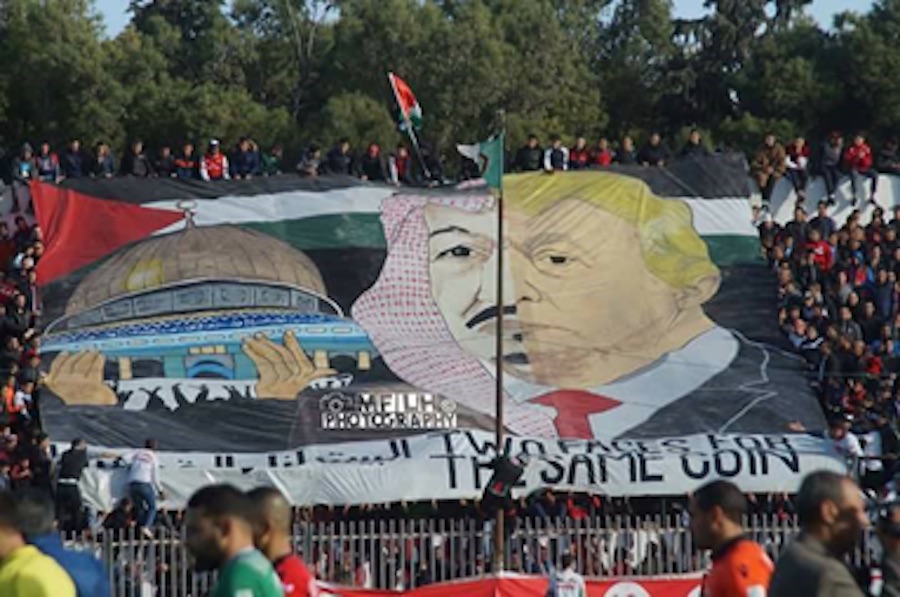
Algiers Rally

 “People who call themselves supporters of Israel are actually supporters of its moral degeneration and ultimate destruction.” ~ Noam Chomsky
It was an irony of fate that after two weeks, Trump’s unilateral decision on Jerusalem was dumped into the dustbin by the rest of the UN Security Council. The US was left isolated and forced to use its veto after all other 14 members of the UN Security Council, including US’ allies, voted unanimously for a Resolution condemning this high-handed decision. The Resolution called Trump’s declaration “null and void” under international law, but the measure ultimately failed after the US exercised its veto power. Nevertheless ,the unanimity of the rest of the Council was a stark rebuke to the Trump administration over its unilateral move, which upended decades of international consensus and which illustrated how the US position on Jerusalem was far outside the international consensus.
This whole episode sadly highlights how the power of one arrogant veto can undermine the consensus among the rest even within the UN Security Council (UNSC) itself, let alone global consensus. Incidentally, in the past this curse of the veto has been haunting the world at large due to the self-centered policies of the big 5 veto wielding powers- the US, UK, France, China and the USSR, which enables them to withhold UN Security Council authorisation when it affects them, thus paralysing the very purpose of the UNSC. Particularly like in this case, it also clearly showcases the arrogance of the US which calls itself the sole global super power to act at will ,seeing itself as having little regard for international consensus or need for the UN and international law, like the invasion of Iraq by Bush on flimsy grounds of WMD along with his poodle Blair. During this sitting of the UNSC on the Jerusalem issue, the US ambassador to the UN, Nikki Haley who felt like a cornered animal, too used arrogant language to stress that no-one can dictate terms to them, describing the resolution as “an insult” and warning that it would not be forgotten.
The world had to bear the brunt and the risk of the Cold War, on the heels of the WWII. John Lewis Gaddis concludes in his book ‘The Cold War’, ‘it began with a return of fear and ended in a triumph of hope’, an unusual trajectory for great historical upheavals’. Regretfully this expectation of hope remains unfulfilled to this day, as the world had to deal with an arrogant sole super power the US in the Post-Cold War era, whose sense of ‘American Exceptionalism’ has made the world a much worse place to live in, of course with the threat of consequential terrorism and their intervention in affairs of other countries in their assumed role as the ‘global policeman’. However, America seldom realizes that the age of their exceptionalism is over, as being time and again proved in the Trump era and as stated in an article on ‘Time for a New Destiny’ by Godfrey Hodgson. (15/11/2010), ‘In a world of car-bombs and improvised explosive devices (IEDs), of globalization and wage competition, of asymmetrical campaigns and multi-polar relationships, of transforming identities and rising ambitions, Americans have as yet understood even less than their fellow westerners the emerging strength of the weak and the weakness of the strong’. No longer is there much appetite for America playing its long-standing role of global policeman, even in the face of the rise of terrorist groups like ISIS.
Tom Engelhardt in an article on ‘Donald Trump Might Set a Record—for the Biggest Decline of American Power in History’(The Nation-13/06/2017) asks the question: When the Trump years come to an end, will the United States be a pariah nation? and says, President Trump, in real time, tweet by tweet, speech by speech, sword dance by sword dance, intervention by intervention, act by act, in the process of dismantling the system of global power—of “soft power,” in particular, and of alliances of every sort—by which the United States made its will felt, made itself a truly global hegemony.
World leaders nowadays seem prepared to provoke the wrath of the White House, confident that it will never rain down on them. Nor America’s both allies like the EU/ NATO and adversaries including North Korea’s little rocket man Kim (as Trump calls him), Syrian President Bashar al-Assad, or even Tehran , no longer fear them. Galtung’s in his 2009 book, ‘The Fall of the American Empire—and then What?’ sets out a whopping 15 “synchronizing and mutually reinforcing contradictions” afflicting the US, which he says will lead to US global power ending by 2020—within just four years. Galtung warned that during this phase of decline, the US was likely to go through a phase of reactionary “fascism”. For Galtung, Trump’s incoherent policy proposals are evidence of the deeper structural decline of US power.
