

Amaradeva – Only Comparables Are Sunil Santha & Jothipala!
 “Past the near meadows, over the still stream,
Up the hill-side; and now ’tis buried deep
In the next valley-glades:
Was it a vision, or a waking dream?
Fled is that music: – Do I wake or sleep?”
~John Keats, Ode to a Nightingale
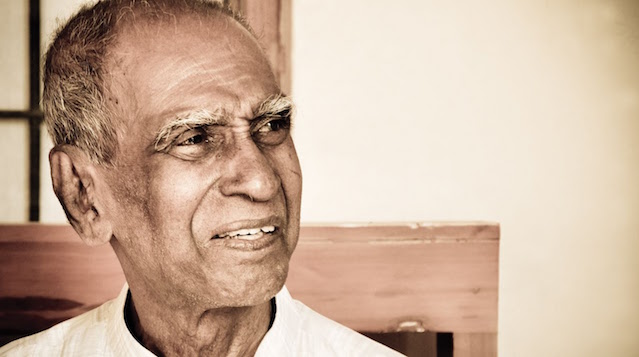
Pundit W.D. Amaradeva [Photo courtesy Sandra Mack]
Quintus Horatius Flaccus known in the English-speaking world as Horace was the leading Roman lyric poet during the time of Augustus. Contemplative about art in general and painting in particular, he is recorded to have said as follows: “A picture is a poem without words”. A song well rendered by a master is “a drama enacted without a depiction”. Amaradeva’s every song belongs in that rare category. It is not an easy task to talk about Amaradeva and his unmatched contribution to Sinhalese culture and art without referencing the times and events of his era and his peers, if any, and other artists who happen to crowd a fairly challenging field. Amaradeva entered the field of music and song at a time when the standards of singing and music were deplorable. It was either Nadagam or dramatic style singing and straight copies from India, both Northern and southern. The singers too, except a very few like Devar Surya Sena and Ananda Samarakoon, were of South Indian origin. They wrote the lyrics in Tamil and sang out in Sinhala. What a travesty of culture!
The socio-cultural environment that prevailed at the time did demand a pioneering voice, so to speak, to speak out, to throw away the rut and furrow of Sinhala-pretenders whose allegiance was not to a new culture of Sinhala song and music, but to a livelihood that earned them an income far below the level of their brethren in India, yet bragged that they were the pioneers of Sinhalese music and song. The backdrop was wretched yet hopeful and dreaming. It was dotted with scarce emergence of one or two genuine sounding artists who had the misfortune of disappearing from the milieu of the art for lack of listener-following and sponsors. Ananda Samarakoon was one such pioneer who made a very valiant effort at creating a tradition of Sinhalese art of music and song, yet he fell far short of a ‘pioneering’ character.
It was into this scene Amaradeva set his footsteps as Albert Perera. His voice was without match; his discipline of rendering a tune without breaking a single note and his attention to the minutest detail of lyrics and melody was coolly secured and deeply rooted in the construction of the totality of the song. Such discipline and attention to detail in the industry at the time was absent. With the initiation of Albert Perera, another artist of superior value and quality stamped his own creed on the scene of art and culture. That was Professor Ediriweera Sarachchandra. Considered Sri Lanka’s premier playwright, he was a senior lecturer at the University of Peradeniya. His influence on Amaradeva, including changing the very persona from Albert Perera to Amaradeva, was fundamental and the subsequent rise of Amaradeva as the leading singing voice of Ceylon a logical evolution. Not only of the singer-musician Amaradeva but the expansion of Sri Lankan folk cum indigenous music and song was inevitable.
