

Tony Blair: ‘We were wrong to boycott Hamas after its election win’
Former prime minister says international community should have tried to pull militant Islamic faction ‘into a dialogue’ over its refusal to recognise Israel
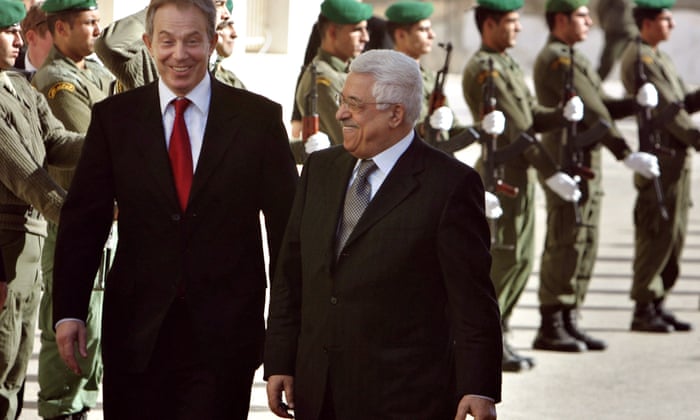
Tony Blair and then Palestinian president Mahmoud Abbas in 2006, as violence raged in Gaza between Hamas and Fatah. Photograph: Muhammed Muheisen/AP

Blair did not elaborate on subsequent “informal” dealings with Hamas but he appears to be referring to clandestine contacts between MI6 and Hamasrepresentatives during and possibly after the kidnap of BBC journalist Alan Johnston by an extreme fundamentalist group in 2007. The kidnappers eventually released Johnston after heavy pressure from the Hamas de facto government.
Since leaving his Quartet post, Blair has held at least six lengthy private meetings with Khaled Meshaal, the Hamas political bureau chief until earlier this year, and his successor Ismail Haniyeh, partly to explore a possible long-term ceasefire between Israel and Hamas. But the international block on official contacts with Hamas has eroded western leverage in the region, increased the isolation and suffering of the Gaza public, and helped to drive the faction into the arms of Iran – all without dislodging it from its dominance of Gaza, say critics.
Blair’s rare rethink of a key foreign policy issue has surfaced as Hamas and Fatah embark on a new Egypt-brokered effort to end the schism between the two factions after a preliminary reconciliation agreement signed in Cairo last week. The split was triggered by the brief but bloody 2007 civil war in Gaza which left a victorious Hamas in charge of the coastal enclave and President Mahmoud Abbas running the West Bank-based, Fatah-dominated Palestinian Authority
Also interviewed in the book, Jonathan Powell, Blair’s former chief of staff at Downing Street, goes further, saying the Quartet strategy was “a terrible mistake”. Negotiations with Fatah alone – long promoted by the US – meant that “you have to make a concession to Fatah, then you have to make a new concession to Hamas afterwards. You want to have one negotiation, not two … If you got a united Palestinian team to negotiate with, then life would have been a whole lot easier.”
The book also cites internal Whitehall documents from January 2006, obtained under the Freedom of Information Act, which warned immediately after the Palestinian elections against ostracising the new Hamas-led authority. A heavily edited minute from the Department for International Development points out that Israel and Hamas were already co-operating at a municipal level, and suggested it would be difficult in the short-term for Hamas to renounce “its commitment to the destruction of Israel and its support for terrorism”. Instead, it suggested that “ultimately Hamas’s participation in the realities of political responsibility might bring about Hamas’s transformation to a political rather than terrorist organisation”.
A Foreign Office “e-gram” from Brussels quotes a senior European commission official saying that a million Palestinians relied directly and indirectly on EU funding. The report added: “To withdraw it would have dramatic consequences and could lead to violence. The EU was under no obligations to align its position on financial support with that of the US and Israel. The EU had not done so in the past. The wider region was watching the EU response to these elections. If we seemed, by our actions, to be rejecting the results then our claims to promoting democracy would be undermined.”
