

A “Tenth Province” Or Coastal Authority To Deal With Climate Change
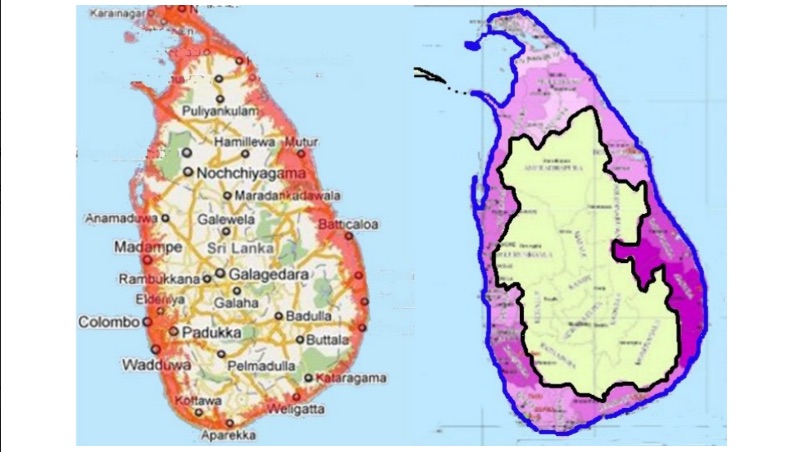
Fig. 2 – The map on the left shows the inundation from the floods due to rain storm in Jan 2011. The right panel shows the extent of the area affected by the 2004 December Tsunami to varying degrees.

Dr. Chandre Dharmawardana
A “Tenth province” or Coastal authority to deal with climate change – A must for a 21st century constitution of Sri Lanka
 The proposed constitution has provoked much debate, but mainly within the framework of traditional thinking with emphasis on the usual issues, i.e., “Unitary and Devolved power, the place of Buddhism, or the Executive Presidency. Whether devolution should be district-based or province-based has been debated for at least 50 years, with the same arguments being brought out. While the demand for devolution originally came from the Tamil Nationalist politicians, the majority ethnic group has not supported this, as has been the case all over the world. The ensuing violence between the government and the Tamil minority led to the entry of India into the fray. Rajeev Gandhi kept two Indian armed frigates in the Colombo harbour to impose its solution in terms of provincial devolution. But, given the first opportunity, even Prabhakaran rejected the Indian solution, fought the Indian army and assassinated Rajeev Gandhi to show his capacity for vengeance. India failed to keep its side of the agreement, making it null and void. But Sri Lanka is still in labour with the fetus of a 13A , her legs held apart by international agents and NGOs, while the mistrust between communities has long snuffed out the fetus.
The two communities are still licking their war wounds and angling to wound the other with international tribunals and sanctions. They invent new words like “Aekeeya Rajya”, and “Orumitta Nadu” but threaten each other under their breath, and over their breath, hurling accusations of genocide or of creating terrorism to break up the country. They fail to see that a major threat of global scale has completely changed the stakes.
Climate change and its dramatic effect on the maritime region.
Just after the defeat of the LTTE, in 2009 I presented a talk to a gathering of officials at the Presidential secretariat, entitled “Four Challenges to Sri Lanka and their Technological solutions”. One of the challenges was the looming danger of global warming and the rising sea level. This is a national tragedy requiring a concerted national effort. The North and a good part of the East are the most affected, and will indeed go under water even if preventive steps are launched right now.
But politicians and constitutional pundits are oblivious to the harsh reality of global warming and the rising sea levels all over the world. Sri Lanka, being at the equator will face a larger increase in the sea level than off-equitorial latitudes. Current constitutional debates ignore the most urgent issues that Sri Lanka will face in the next decade due to climate change as well as the on-going technological tsunami. I discussed how we may harness the digital revolution to our advantage in a previous article (Island, 25 September 2017) entitled “Unit of Devolution – look in cyberspace”. Someone will ask, what has climate change to do with the constitution? Here I try to show that it has everything to do with the constitution in enabling us to deal with the inundation of large parts of the country that will occur in the coming decades. The creation of an over-arching supreme authority that transcends districts, provinces, and even religious monuments since the choice is between saving the maritime region of Sri Lanka, or letting it become part of the sea.
The inter-governmental panel for climate change (IGPP) and other bodies studying climate change have published predictions of the expected rise in sea level due to global warming. Figure 1 shows the predictions done in 2013 (these documents are available at: dh-web.org/place.names/posts/CD-long-10thProv.pdf). Today it is believed that the more dangerous prediction (i.e., higher sea levels, marked RCP8.5) is most likely to hold, as most nations have defaulted in cutting down on carbon and green-house gas emissions. The rise in sea level may be as high as 0.5 to 0.8 meters within the next 15 years. This occurs with the warming of the oceans and melting of the polar caps. This is accompanied by increased humidity in the air. According to a law in chemical physics, the increase in humidity follows an exponential law, i.e., it is proportional to exp{-H/T} where H is the heat of evaporation and T is the temperature. Hence even a few degrees of heating can have a dramatic effect. The excess water and heat powers up tornadoes and torrential rain where precipitation is not in rain drops, but sheets of down pour! The world has already seen this intensified catastrophic weather events of recent times. Sri Lanka too has seen unprecedented floods, earth slips and inundation. 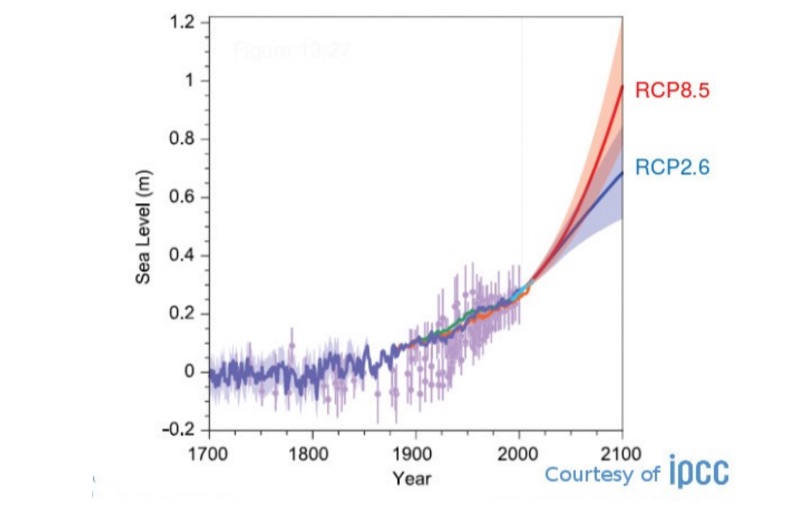
Fig.1 – Rise in sea level with time
The flooding pattern from recent storms are a guide to how much inundation can occur. Topographical maps show the extent of Sri Lanka’s coastal low-lying areas that go under with a one meter sea rise. In fact, the Tsunami inundation gives an extreme measure of what could happen when the sea flows in. In figure 2, the left panel shows the region inundated in the January 2011 floods, while the right panel shows the areas affected by the 2004 Tsunami, adapted from an official emergency response map issued at the time. Waves varying from one to twelve meters in height hit the shores of Sri Lanka, with the bigger waves hitting the Eastern province and the Northern province.
