

Thomas More On Religious Freedom In The Island Of Utopia (Ceylon?): Part X


Dr. Laksiri Fernando
“This is one of their most ancient laws, that no man ought to be punished for his religion.” – Thomas More
In the context of Sri Lanka’s current debates on religion and religious freedom, it is interesting to relate what Thomas More said about religious practices and freedoms in the Island he called ‘Utopia.’ As this book, Thomas More’s Socialist Utopia and Ceylon (Sri Lanka), has continuously argued, there are strong indications that More was not just writing a Plato’s type utopia (Republic), but basing himself on information he had received from a Portuguese traveler about Ceylon. What is published here is Chapter 8 of that book to allow free access to anyone. The publication link to the original book is: https://www.createspace.com/4688110
Among his descriptions about religions, religious practices, and most importantly, religious freedoms in that Island, there is a story that he relates which would not have come in a usual description of an ideal society. That was about a newly converted Christian abusing the traditional religions going against the religious freedoms that was accorded in that Island. It was with praise that Thomas More talked about religions and religious freedoms in that Island (Ceylon).
While leaving the readers to go through the following chapter for that story and other religious matters, it is important to note the existence of religious freedom and tolerance when the Portuguese came to Ceylon in early 16th century related by a prominent historian, P.V.J. Jayasekera, in his new book, Confrontations with Colonialism. As he says, the “Buddhists initially extended their support to the Portuguese missionaries to set up their churches and maintain their priests…the attitude of the Sangha was that the Catholic missionaries were also teachers of people, like themselves, and saw no harm in their preaching a different faith” (pp. 185-186, quoted by Liyanage and Herath).
Such a religious freedom, freedom of conscience and tolerance should be the ideal for Sri Lanka today.
RELIGIONS OF UTOPIANS
“One should not honor only one’s own religion and condemned of others, but one should honor other’s religions.” – Emperor Asoka[1]
AS THOMAS MORE depicts, Utopia is a multi-religious society with several religions. “There are several sorts of religions, not only in different parts of the island, but even in every town,” he says. This looks like Ceylon in the 15th century.[2] However, he emphasizes that the greater and wiser sort worships a supreme deity as the father of all and “the beginnings, the increase, the progress, the vicissitudes, and the end of all things come only from him.” This supreme god is called Mithras, quite reminiscence of Brahman in Hinduism. According to Isha Upanishad, “Om – That supreme Brahman is infinite, and this conditioned Brahman is infinite and the infinite proceeds from infinite.”[3]
It is interesting to note that More relates a story through Raphael. When Raphael and others were in the island, they introduced Christianity to the Utopians and they were inclined to receive it after hearing the story of Christ, and his sacrifices for the truth. They were obviously not near Christiany before, and Mithras was not the like the Christian god. They were newly converted and baptized by the visitors. According to the story, the natives even selected one among them as a Priest. But what is important is the following. “Those among them that have not received our religion, do not fright any from it, and use none ill that goes over to it; so that all the while I was there, one man was only punished on this occasion,” Raphael had said. This means that the natives were tolerant, and only one occasion they opted to punish one of the newly converts. Why? The following is the description of the matter.
“He being newly baptized, did, notwithstanding all that we could say to the contrary, dispute publicly concerning the Christian religion with more zeal than discretion; and with so much heat, that he not only preferred our worship to theirs, but condemned all their rites as profane; and cried out against all that adhered to them, as impious and sacrilegious persons, that were to be damned to everlasting burnings.”
Then what happened was, “he was seized, and after trial he was condemned to banishment.” This was done “not for having disparaged their religion, but for his inflaming the people to sedition.” Then More says, “This is one of their most ancient laws, that no man ought to be punished for his religion.”[4]
Religious Freedom
It was ‘religious freedom’ that was characteristic of religions in Utopia according to More. It was guaranteed in the first constitution that Utopus apparently introduced. Before his coming into the scene, the original inhabitants were divided and fought against each other on the issues of religion. That was one reason why he could easily subdue them. After doing so “he made a law that every man might be of what religion he pleased, and might endeavor to draw others to it by force of argument, and by amicable and modest ways, but without bitterness against those of other opinions.” No one could use force to convert no another, neither reproach nor violence, anyone who does otherwise “were to be condemned to banishment or slavery.”
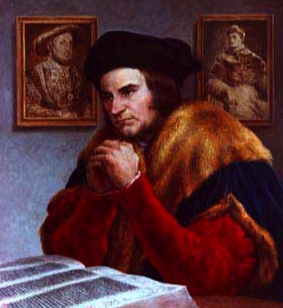
Thomas Moore the Thinker
On behalf of the Utopians, More argued that “it [is] indecent and foolish for any man to threaten and terrify another to make him believe what did not appear to him to be true.” They are left for their freedom of belief and conscience. Nevertheless, he argued that “they all formerly believed that there was a state of rewards and punishments to the good and bad after this life,” something like Karma. There can be some who think otherwise who do not believe anything after life but they are not punished in Utopia unlike in Europe during the same period, “so that men are not tempted to lie or disguise their opinions; which being a sort of fraud, is abhorred by the Utopians.”
More explained different religious beliefs that existed in Utopia. One was related to the belief of rebirth. “They think that the souls of beasts are immortal, though far inferior to the dignity of the human soul,” he said. “They are almost all of them very firmly persuaded that good men will be infinitely happy” or in another life. “So that though they are compassionate to all that are sick, yet they lament no man’s death,” he further added.
