

Philippines: Condoms in schools necessary to prevent HIV, group says as protests mount
 (File) A Filipino health worker shows condoms that are given for free to the public by the Health Department in Manila, Philippines, on Thursday, Dec 8, 2016. Source: AP/Aaron Favila
ANY attempt to block the distribution of condoms in schools would inadvertently lead to higher chances of HIV (human immunodeficiency virus) infections among the Philippine youth, a global rights watchdog said.
Human Rights Watch (HRW) pointed out that the Philippines already faces one of the fastest growing epidemics of HIV in the Asia-Pacific region, and should be focused on combating the problem.
“Officials who try to block condom access in schools will needlessly increase the likelihood of more HIV transmissions among young people,” it said in a statement.
HRW was responding to several objections raised last week by Philippine officials to the Health Department’s plan to start distributing condoms to students as part of its efforts to stem the spread of HIV.
The officials reportedly expressed fear that the initiative would promote promiscuity, which conservatives in the Catholic-majority nation regard as a social ill.
The objections, however, appear to contradict President Rodrigo Duterte’s national policy on contraception. The president had earlier in the week signed an executive order (EO) to intensify access to modern family planning.
Quezon City Mayor Herbert Bautista reportedly told city health officials they would only be permitted to use public health facilities to distribute condoms and not public schools. Quezon City is said to have the highest number of HIV infections in the country.
Another official, Senator Vicente “Tito” Soto III vowed to block the free condom drive.
According to Inquirer, the Senate majority leader claimed he was not opposing Duterte’s EO but said the order did not justify the plan to distribute condoms.
“Why? Because high school students are underaged and it’s a crime to [encourage them to] indulge in sex,” he was quoted saying.
The EO signed on Jan 10 seeks the full implementation of the Responsible Parenthood and Reproductive Health Act (RPRH), which has been under a temporary restraining order (TOR) issued in 2014 by the Supreme Court.
The court blocked the law from going into effect after finding evidence that the country’s Food and Drug Administration had violated certain protocols on a number of contraceptive drugs. It also raised concern that some of the contraceptives approved for use under the Act were abortifacient in nature. This is said to contravene the Philippine Constitution, which protects life from the moment of conception, according to Life News.
According to Tito, the TRO was not issued on the entire law but merely on abortifacients.

Senator Vicente Sotto III. Image via @VicenteSotoIII.
“There is no TRO on the (RP)RH Law,” he reportedly said.
HRW, however, said Tito’s clear opposition to the distribution of condoms in school effectively demonstrated his “willingness to derail the implementation of a much-needed public health measure”.
The group also recalled how the senator had in the past attempted to block the passage of the landmark RPRH Act on religious grounds and how he scuttled a harm reduction programme in Cebu City that was aimed at reducing the increase of new HIV infections caused by intravenous drug use.
As such, HRW said Tito’s latest objections “comes as no surprise”.
It, however, reminded detractors of its latest research on HIV prevalence in the Philippines, which showed an alarming rise in recent years.
In the 46-page report titled, “Fueling the Philippines’ HIV Epidemic: Government barriers to condom use by men who have sex with men”, HRW documented the alleged failure of past and present governments to address the growing HIV prevalence among those of the group they dubbed the “MSM” (men who have sex with men).
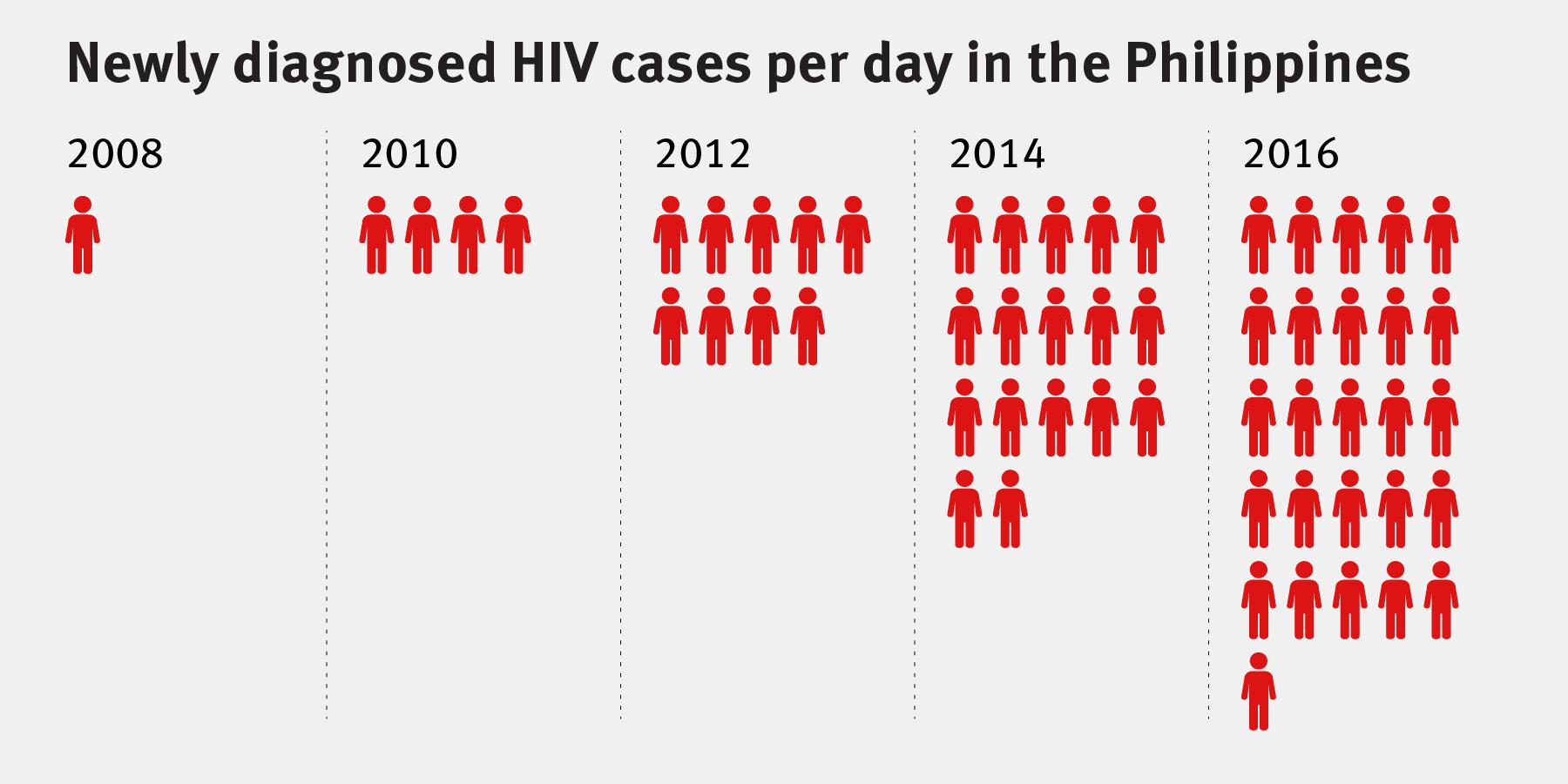
The report said Philippines has outstripped its Asia Pacific neighbours in terms of HIV prevalence, with statistics showing a tenfold increase in cases recorded over the last five years. It said in 2015, the Philippine Health Department reported that at least 11 cities recorded high HIV prevalence rates of more than 5 percent among the MSM, with Cebu City – the country’s second-largest city – recording a staggering 15 percent prevalence rate.
Source: Human Rights Watch
The numbers were markedly higher than the overall prevalence rate for the Asia Pacific region, which was just 0.2 percent, as well as the rate in Sub-Saharan Africa, which has the most serious HIV epidemic in the world but has a rate of 4.7 percent for those in that group.
Official data from the government show that those living with HIV rose from just two in 1984 (the year HIV was first reported in the country) to 835 by 2009. From 2009 to 2010, the number doubled to 1,591 people, as more MSM contracted the virus, before it surged to more than 35,000 cases as of June 2016. Health records show that of the 35,000, 81 percent were MSM cases.
Among the reasons behind the cause, said HRW, are conservative elements in the government; laws that prohibit condom access and HIV testing to those below 18 years of age without parental consent; and “nonexistent” national education on effective HIV prevention methods. These failures, the group said, along with the social stigma that comes attached to those who engage in same sex practices, have contributed greatly to the worsening epidemic among the MSM.
