

Are Religious Conversions Taking Place In Sri Lanka?

By Muttukrishna Sarvananthan –November 4, 2016

Dr. Muttukrishna Sarvananthan
The ascendance of polarising faith-based organisations, ostensibly to protect their respective religions from poaching by other religions, in Sri Lanka after the end of the civil war in May 2009 adds to the complexity of peace building and nation building. The Bodu Bala Sena (Buddhist Power Force in English) in Sri Lanka was established in 2012 following the footsteps of the anti-Muslim campaign of the 969 movement in Myanmar. The founder of the 969 movement, Ashin Wirathu, visited Sri Lanka on the invitation of the BBS in 2014; the BBS was close to the then President Rajapaksa who is suspected to have instigated its establishment. The Siva Senai (Shiva’s Force in English) was established in October 2016 following the footsteps of Shiv Sena of Mumbai / Maharashtra in India. Though Siva Senai denies any formal affiliation to Shiv Sena, the choice of similar name for the new organisation in Sri Lanka casts doubt on such denial. In the same way as Shiv Sena doubles-up as a Hindu cum Marathi nationalist organisation, the Siva Senai also appears to be a Hindu cum Tamil nationalist organisation. The founder of the Siva Senai had told the The Hindu and New Indian Express newspapers of India that they are concerned about “Sinhala-Buddhist colonisation” and religious “conversion” taking place in the country. The key objective of both the BBS and Siva Senai faith-based organisations is to clamour for the enactment of an anti-conversion law in Sri Lanka.
The common complaint or grievance of both the Bodu Bala Sena (BBS) and Siva Senai (SS) is that Buddhists and Hindus are being converted to Christianity through material and spiritual inducements. It has been alleged that the mushrooming of western-funded Non-Governmental Organisations (NGOs) in Sri Lanka during the course of the civil war has intensified such religious conversions both in the conflict-affected Eastern and Northern Provinces as well as elsewhere. The BBS also carries-out a hate campaign against the people of Islamic faith due to their relatively higher birth rate, among other reasons. While the birth rates of Buddhist, Christian, and Hindu Sri Lankans have declined to the levels of developed countries in the past three decades, the birth rate of Sri Lankans following the Islamic faith remains significantly higher. The BBS has instigated violence against Muslims in Aluthgama town in June 2014, which resulted in the death of two young Muslim men and burning down of an up-market clothing store owned by a Muslim in Panadura (a suburb of Colombo), and was probably behind scores of attacks on Churches and Mosques in various parts of the country.
However, the BBS has negligible public support among the Buddhist population in the country. The BBS is a registered political party, which contested the parliamentary elections in few districts in August 2015 and secured just 135 votes in the Colombo District (if I remember correctly). This should be a lesson to the Siva Senai if at all it has any political aspirations in the future.
The objective of this op-ed is to find out whether there have been religious conversions taking place in Sri Lanka during the course of the civil war. There are four major religions practiced in Sri Lanka, viz. Buddhism, Christianity, Hinduism, and Islam (in alphabetical order).
After the Census of 1981, the latest Census of 2012 was the only one which covered the entire country. Between 1981 and 2012 Census could not be undertaken in all parts of the country due to the civil wars in the southern as well as the eastern and northern parts of the country. The 1991 Census was cancelled by the then government because the country was undergoing two insurgencies during the 1980s; the southern insurgency between 1987 and 1989 and the eastern and northern insurgency from 1983 onwards. The 2001 Census was undertaken in seventeen out of twenty-five districts, except the eight districts in the Eastern and Northern Provinces. Therefore, after 1981, only the 2012 Census has comparable data for the entire country. It is important to be aware that the Census 2012 was in fact undertaken only in March 2013 because of printing errors in the original Census form; probably because of other political reason/s as well.
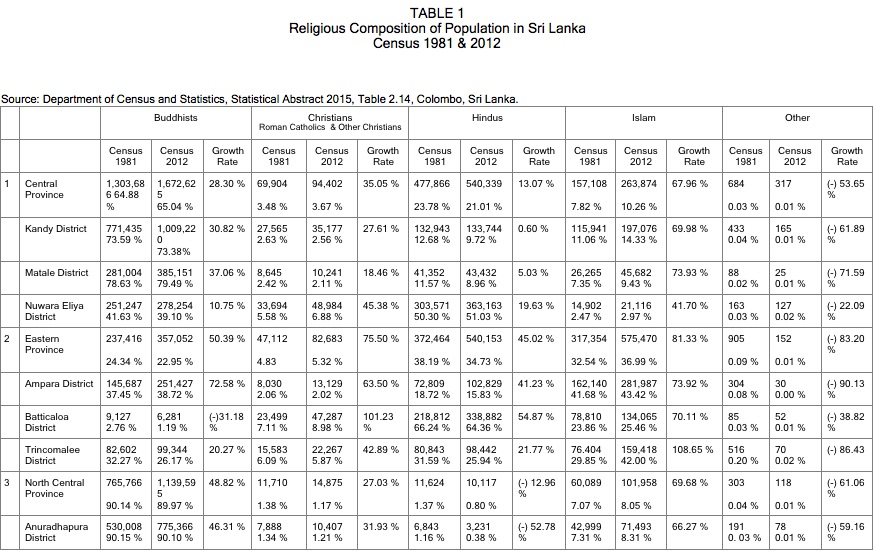 The growth rate of the population following the Islamic faith in the country has been the highest between 1981 and 2012, followed by Buddhists, Christians, and the Hindus in descending order. The growth rate of the Buddhist population was 38.72% from 10,288,328 in 1981 to 14,272,056 in 2012; the growth rate of Christian population was 37.29% from 1,130,567 in 1981 to 1,552,161 in 2012; the growth rate of Hindu population was just 11.47% from 2,297,806 in 1981 to 2,561,299 in 2012; and the growth rate of Islamic population was the highest 75.41% from 1,121,715 in 1981 to 1,967,523 in 2012. (See Table 1)