

Plantation Labour & Their Labour To Obtain A Decent Wage

By K. Balendra –October 16, 2016

K. Balendra
It is true that the plantation labour was brought to Ceylon (Sri Lanka) by the British Rulers during the early 19th Century. Both countries were under the British Rule. At that time, none of the Ceylon politicians made any tangible effort to protest against the influx of the Indian labour. The Ceylonese labour was not willing to fall a prey to the designs of the British. They were aware of the immense hardship one has to undergo in preparing the land to plant Tea, Rubber and Coconut.
This situation was successfully exploited by the British government by bringing in cheap Indian Labour. Nevertheless, this exploitation benefited not only Ceylon but Sri Lanka too. In that, Sri Lanka would not have been able to earn the much needed foreign exchange after the independence, if not for the plantation industry and the Indian labour. Srilanka would have suffered immensely without adequate foreign exchange earnings.
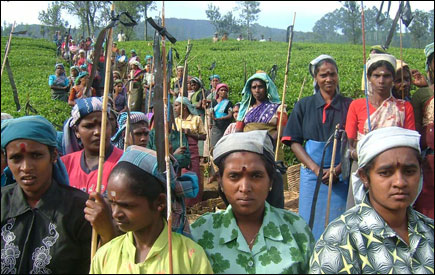 Indian, labour was exploited by the British prior to independence, but Sri Lankan Government, together with the Plantation trade Unions exploited them after the independence. They were like babes in the wood- Nowhere to go – No one to lead-No one to follow.
Without dwelling into the past too much, I would confine myself to a few years prior to the independence and thereafter.
Mr. A.E.Goonesinghe, who was considered a prominent labour leader with leftist leanings, commenced a tirade against the Indian labour in 1942. The so called Indian labourers were deprived of the government lands occupied by them and prevented from farming by law. This law affected the Indian labourers in general and particularly the labourers living in Nuwara-eliya and Kandapola, where vegetables were cultivated in plenty. Further in 1942, the lands occupied by the labourers of Indian origin were confiscated by the Government and were left at lurch. These lands so confiscated were given to the Sinhala Villagers. MR. DS Senanayke, in his capacity as the Minister of Lands in the State Council in 1946, delightfully supported the move made by A.E. Goonesinghe.
The Ceylonese/Sri Lankan government was not bothered about the Indian Businessmen who were exploiting and remitting money to India in a big way. They were concerned only about the physical number of workers living here, despite the fact, they seldom remitted money to India.
In 1949, Mr.DS .Senanayake-the Prime Minister of Ceylon in a very communal manner stated that although the labourers of Indian origin has contributed for the development, they came over to Ceylon to make a living and did not contribute for the welfare of the people. Thus he exhibited his true character with regard to the labourers of Indian origin. The so called father of the nation did not want to be even a ‘step father’ to the plantation labour.
