

Uduvil Girls’ College, Politics Of Education & The Challenges Facing Private Schools

Images of the week-long protest held by the Students of Uduvil Girls’ College (UGC), filling the news last week, have spread beyond the community of Uduvil. The issue is now of wider social concern and has led to a debate about the role of private schools and future of education in Sri Lanka.
The students’ protest and demands received support from parents, and UGC alumni, although they were disregarded by the school’s Management Board. As tension mounted, other groups including the Ceylon Teachers Union expressed concern and condemned violent actions to suppress student dissent. Subsequently, the students appealed to various actors including President Sirisena himself, while he was on a visit to Jaffna.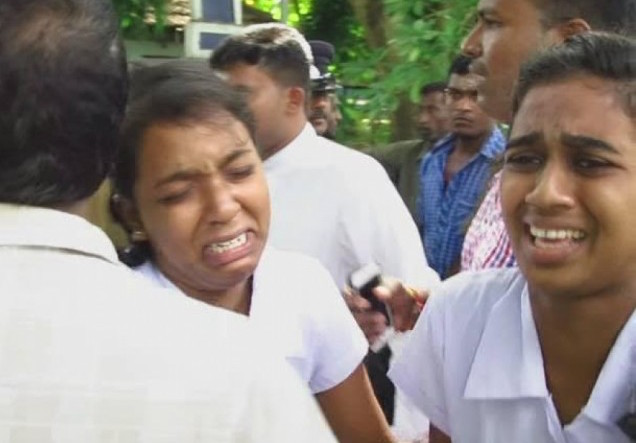
In the highly politicised and sensationalised reporting of the events, the concerns of the parents and students who are most impacted by the school were drowned out. Parents and students are concerned about the quality of education, of accountability for abuses against students, curtailing the interference of church politics, and democratising the management of the school.
At a time during which the reports of the event involve a focus on factional Tamil politics and political groups attempted to use these incidents for their own gain, we would like to bring into the discussion the demands of the students and parents, and situate the UGC students’ act of resistance amidst broader social concerns. The students’ courageous protests have created a moment for public reflection on the politics of education, privatisation, and the challenges of women’s education.
Uduvil Girls’ College and the church
Many Christian missionary schools were established in Jaffna in the 19th century. Among them, the American Ceylon Mission (AMC) was the first to establish missionary schools and an institution for higher studies in Jaffna. Such institutions became the centres from which individuals and communities emerged with strong institutional loyalties and commitment to communities. They served as educationists, government servants, priests and medical officers, as well as scholars and writers in the Tamil and English languages.
Stories of unforgettable personalities and admirable leaders are often recalled by the generations who have passed through these institutions. Although battered by the war, migration and multiple displacements, many of these institutions continue to survive, adapting themselves to socioeconomic and political conditions.
UGC was established in 1824 by the AMC, and became the first boarding school for girls in Asia. Institutions set up by the AMC later became affiliated with the Church of South India. Currently, both Jaffna College and UGC are managed by separate Boards of Directors that include members of the Jaffna Diocese of the Church of South India (JD CSI), although funding for the school is provided by the parent body of the AMC in Boston.
The split within the church which occurred due to conflicts over the appointment of the present Bishop and the formation of another church (Church of the American Ceylon Mission), further complicates the structure and management of the school. Indeed, the history of missionary schools has had its share of strife and controversies. This is the context for the current crisis at UGC.
The issue has emerged in the public eye as one of disagreement over the decision to appoint a new Principal by the Board which argues that the current Principal has reached her retirement age, and a plea to reappoint her by those who are protesting this decision. However, the real problems of the school are deeply rooted in the structure and management of the institution. Behind the request for the extension of the term of the former Principal, in addition to acknowledging her valuable contribution, is the fear of a further deterioration of the school.
