

 Wednesday, 8 June 2016
 There are burning issues in higher education in Sri Lanka, but the notion that “state universities are good - others are bad” has been allowed to dominate the discourse in the mainstream without adequate counter arguments. The result is an obliteration all other issues, except for perhaps the problem of ragging in universities. If the country is to go forward, some clarity in definitions is badly needed to resolve the public v. private or state v. non-state debate.
At a recent symposium on higher education which LIRNEasia co-organised with the University of Sri Jayewardenepura, the Prime Minister made an appearance, and he indeed gave a very practical definition. He defined public universities as all Higher Education Institutions (HEIs) that are not-for-profit in their mode of operation, and by implication private institutions as those that are for-profit. This is a useful distinction which breaks the current self-serving arguments by the state sector for a continuation of their monopoly, thwarting competition from other entities be they public or private.
In countries in the Western world where universities came to be nearly millennium ago, almost all universities are public institutions. They can be owned by either the state or a non-state entity, with varying levels of fees charged to students to cover some or most of costs. The practice of calling prominent non-state universities such as Harvard, Princeton, etc. and the smaller liberal arts colleges as private universities is established in the US, but this categorisation is proving to be problematic as private for-profit universities started emerging in earnest in the last few decades all across the world, with Asia and Latin America taking the lead. At times, the term ‘private non-profit’ is used to distinguish these traditional private universities from the emerging ‘private for-profit’ institutions, but the terminology can be long and clumsy.
Therefore, breaking form the US tradition and taking a leaf for our PM, I propose we should talk about only two kinds of universities, public and private. These public institutions can be state owned or owned by other non-state entity such as a religious establishment or a foundation. They offer higher education at varying level of student contributions, but strictly on a non-profit basis. Private institutions are non-state entities which are for-profit.
The PM rightfully avoided the issue of ‘private’ or ‘for-profit’ universities in his vision. He envisions a public university system where state-owned universities take more responsibility for their performance and behave more like public institutions in developed countries. They can charge fees, but they would give merit based or need-based scholarships. Government would provide loans on easy terms to all qualifying students. Other non-state owned institutions could exist, though he did not elaborate. This is true free education he said, though not in those exact words.
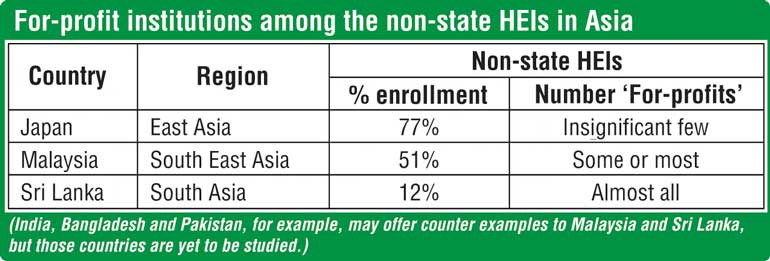
As I elaborate later in the article, for-profit institutions could be an essential component in the tertiary education landscape in developing countries, as they struggle to meet the demand for higher education of adequate quality. The co-presence of public and private entities may provide the environment for innovations by private institution, which in turn would force public institutions to innovate also. In fact, countries in Asia are allowing the emergence of different models. Sri Lanka is perhaps is the exception where vociferous elements in state institutions thwart competition. It is a politically astute decision by the government not to openly promote or deny right to private higher education, but it is a sad one.
However, as policy analysts we have the freedom to explore. What is the best way to balance public-private investments in higher education in Sri Lanka and the developing world? In this column I present an initial exploration carried out at LIRNEasia.
