

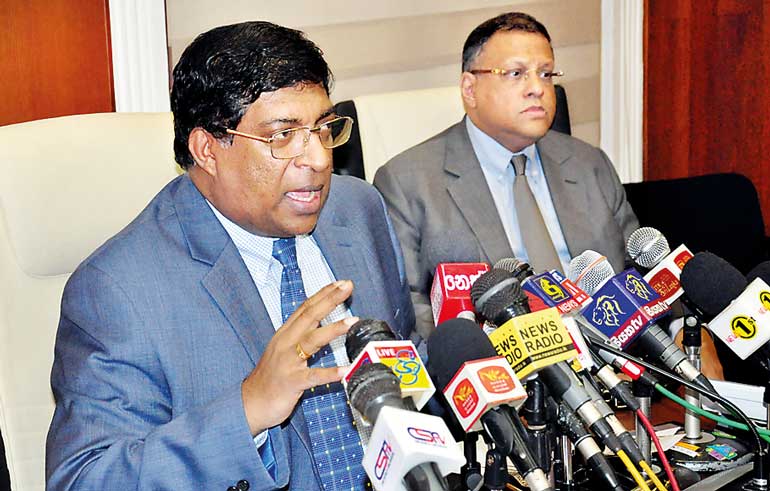
Finance Minister Ravi Karunanayake and Central Bank Governor Arjuna Mahendran – File photo
 Move to change exchange control into exchange management
Monday, 9 May 2016
 Prime Minister Ranil Wickremesinghe, in presenting the Economic Policy Statement or EPS of his Government in Parliament in November 2015, announced that the Government would repeal the age-old Exchange Control Act or ECA.
Instead, he said that the Government would enact a new Foreign Exchange Management Act or FEMA. The main difference between the two legislations is that ECA treats exchange control violations as criminal offences, while FEMA would make them civil offences. Two weeks later, Finance Minister Ravi Karunanayake reconfirmed the Prime Minister’s pledge when he presented Budget 2016 in Parliament. The business community welcomed this move because ECA had the notoriety of being abused by those in power at the Central Bank as well as in the Government to persecute their political or personal enemies.
Even architect of exchange control has been victimised
One of the best known victims of ECA was its own architect, the late N.U. Jayawardena, the first Ceylonese Governor of the Central Bank.
In the early 1990s, one of the companies in his conglomerate had made some foreign deals without getting the prior approval of the Exchange Controller. An inquiry was held and a thumping fine was imposed on N.U. by the controller. N.U. maintained that he was persecuted by the then Governor of the Central Bank who had fallen out with him. However, on appeal, the thumping fine imposed by the controller was compounded by the then Minister of Finance to a nominal sum but not before the Governor in question had lost his job.
Architect being victimised for a second time
He became a victim of his own ECA for a second time in the mid-1990s. That was when the Merc Bank, which he set up in the mid-1990s, was denied a foreign exchange dealership by the Minister of Finance, though it had had the Central Bank’s sanction to operate as a commercial bank.
Under ECA, it is the Minister of Finance who has the discretionary authority to grant approval to authorised dealers in foreign exchange. In the Merc Bank’s case, this approval was not granted by the Minister to enable it to handle foreign exchange transactions.
Hence, without profitable foreign exchange business, the Merc Bank soon became bankrupt and had to be sold to another bank which had the foreign exchange dealership. N.U. later confided in this writer that one of the mistakes he made in his professional career was to make ECA a permanent law with draconian powers given to those in the Central Bank and the Ministry of Finance.
There are many such instances where ECA was selectively used by those in power to target those whom they did not like. Hence, it is quite natural for the business community to treat it as a draconian law.
