

Understanding our youth

 Wednesday, 20 April 2016
Beginning this decade, Sri Lanka will experience a decreasing youth population and the dividend potential will decrease accordingly. The window is expected close in around 2037. A comprehensive human capital strategy for youth is needed if Sri Lanka to reap the full benefits of this narrow window of opportunity
Wednesday, 20 April 2016
Beginning this decade, Sri Lanka will experience a decreasing youth population and the dividend potential will decrease accordingly. The window is expected close in around 2037. A comprehensive human capital strategy for youth is needed if Sri Lanka to reap the full benefits of this narrow window of opportunity
 During Avurudu, the cities are emptied as people head ‘home’ to the outstations. Some of us city folks who visit relatives in those areas get to see our youth relaxed and happy in their natural habitat as they take the lead in Avurudu uthasavas, cross-village runs and other Avurudu activities. How many of them are home for the holidays from work or study in the city? How many never left and have been just hanging out?
The much-quoted story of ‘140,000 or so youth qualify at GCE (A/L) but only 22,000 gain entrance to universities’ does not give a true picture of our youth, because the numbers do not refer to a cohort of the same age. In fact, these numbers grossly exaggerate the pass rates because those sitting for the A/L often use all three attempts allowed and 50% or more never sit for the examination.
 National surveys conducted by Sri Lanka Department of Census and Statistics give a better picture of our youth population. By international convention, the youth population in a country is defined as those in the 15-29 age group. The 2011 Census of the population estimates this youth population to be at 4.5 million.
A 2014 report from the Ministry of skills Development titled ‘Youth and Development’ brings together data from the population Census and the 2009/2010 Higher Education Income and Expenditure Survey (HIES) to give a more complete picture of the 20-24 age group of youth in Sri Lanka. For the purposes of this column, the author added and the data from Quarterly Labour force Survey (QLFS) from the third quarter of 2010 to further complete the picture.
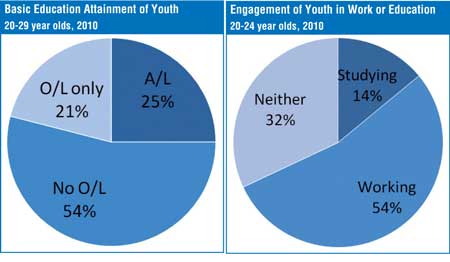
Of the 1.5 million youth in the 20-24 age bracket, 3% are in ‘Universities’, 4% in ‘Technical and Vocational Education and Training (TVET)’ and another 7% in ‘Other’ institutions for total of 14% saying they study at some institution. This leave an 86% of the population as not attending an education or training institution (Youth & Development, 2014). The labour force participation data for 2010 the quarter tells us that 54% of this age group participated in the labour force, leaving 32% as not attending or not working.
 Wednesday, 20 April 2016
 During Avurudu, the cities are emptied as people head ‘home’ to the outstations. Some of us city folks who visit relatives in those areas get to see our youth relaxed and happy in their natural habitat as they take the lead in Avurudu uthasavas, cross-village runs and other Avurudu activities. How many of them are home for the holidays from work or study in the city? How many never left and have been just hanging out?
The much-quoted story of ‘140,000 or so youth qualify at GCE (A/L) but only 22,000 gain entrance to universities’ does not give a true picture of our youth, because the numbers do not refer to a cohort of the same age. In fact, these numbers grossly exaggerate the pass rates because those sitting for the A/L often use all three attempts allowed and 50% or more never sit for the examination.
 National surveys conducted by Sri Lanka Department of Census and Statistics give a better picture of our youth population. By international convention, the youth population in a country is defined as those in the 15-29 age group. The 2011 Census of the population estimates this youth population to be at 4.5 million.
A 2014 report from the Ministry of skills Development titled ‘Youth and Development’ brings together data from the population Census and the 2009/2010 Higher Education Income and Expenditure Survey (HIES) to give a more complete picture of the 20-24 age group of youth in Sri Lanka. For the purposes of this column, the author added and the data from Quarterly Labour force Survey (QLFS) from the third quarter of 2010 to further complete the picture.
Of the 1.5 million youth in the 20-24 age bracket, 3% are in ‘Universities’, 4% in ‘Technical and Vocational Education and Training (TVET)’ and another 7% in ‘Other’ institutions for total of 14% saying they study at some institution. This leave an 86% of the population as not attending an education or training institution (Youth & Development, 2014). The labour force participation data for 2010 the quarter tells us that 54% of this age group participated in the labour force, leaving 32% as not attending or not working.
