

Slump in oil prices drives green energy takeup in top exporting nations
With oil at below $30 a barrel, countries such as Saudi Arabia, Russia, Iran and Kuwait are looking to curb fossil fuel use at home to maximise export profits
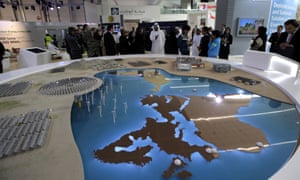
Visitors at Abu Dhabi Sustainability Week 2016 where global leaders in policy, technology and business discuss new ways of shaping the future of renewable energy and sustainable development. Photograph: Ali Haider/EPA
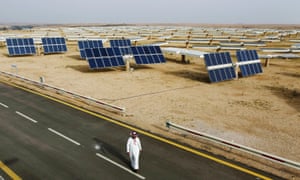
A field of solar panels at the King Abdulaziz city of Sciences and Technology, Al-Oyeynah Research Station in Saudi Arabia. Photograph: Fahad Shadeed/Reuters

The oil price slump below $30 barrel is spurring some of the world’s biggest oil exporters to curb domestic consumption of fossil fuels and invest in wind and solar power, according to government officials meeting in Abu Dhabi.
A month after the historic climate agreement in Paris, Saudi Arabia, Russia, Iran, Kuwait, the United Arab Emirates and other oil exporters are in the midst of overhauling domestic energy policies and seeking alternatives to oil and gas for electricity.
The main motive is not reducing greenhouse gas emissions, but cutting back on domestic energy demand that is taking up a rising share of production. Oil exporters would rather sell their fossil fuels abroad than burn them at home, government officials attending meetings of the International Renewable EnergyAgency (Irena) said.
Since oil prices began their precipitous slide, Saudi Arabia, Iran, Kuwait, the UAE and other big oil producers have cut electricity and water subsidies, imposed energy conservation measures, and encouraged homeowners to install solar panels in an effort to cut back on domestic consumption.
Speaking on the sidelines of Irena’s annual meetings and Abu Dhabi’s sustainability week, officials said the slide in prices offered further incentive to get off oil – at least as a source of electricity.
“It is just common sense in my opinion,” said Saad Salem Al Jandel, a research scientist at the Kuwait Institute for Scientific Research and a delegate to the Irena meeting.
“We are spending so much, something like $8bn (£5.6bn) to $10bn on fuel and power stations, so we want to replace part of it with renewables, and we can also do better with energy conservation and energy efficiency.”
More Story>>>
More Story>>>
