

Refer Sri Lanka To The Security Council: North And East Priests Tell UN Human Rights Boss
 September 16, 2015
170 priests and religious from North and East have today urged the UN Human Rights Council to refer Sri Lanka to the Security Council taking into account of the gravity of the crimes committed including during the last phase of war and begin the process that is available within the UN structure.
Writing to the UN High Commissioner for Human Rights they said; “that the accountability mechanism to investigate the crimes committed, including the last phase of war, should be an international mechanism”
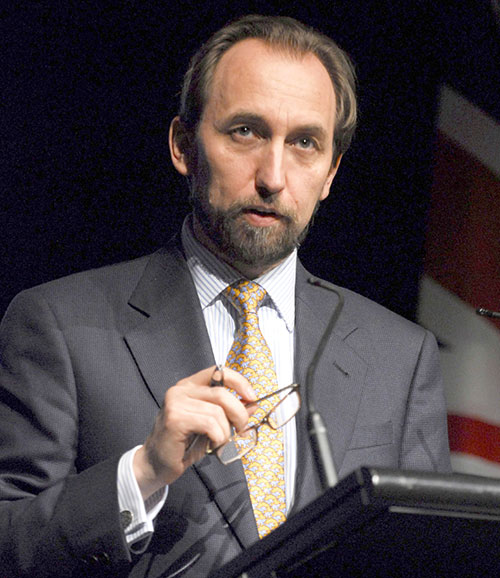
Zeid Ra’ad Al Hussein – The HR Chief
We publish below the letter in full;
Vavuniya,
16th September, 2015
16th September, 2015
His Excellency Zeid Ra’ad Al Hussein
UN High Commissioner for Human Rights
Palais des Nations
CH-1211 Geneva 10,
Switzerland
Your Excellency,
UN High Commissioner for Human Rights
Palais des Nations
CH-1211 Geneva 10,
Switzerland
Your Excellency,
We the priests and religious from North and East would like to express our concern that the accountability mechanism to investigate the crimes committed, including the last phase of war, should be an international mechanism. And we believe only an international mechanism can address the crimes committed. Backing a domestic mechanism instead of an international one is a reversal of the stand taken in 2014 by the USA and it is based on the misguided myth that after the two elections held in the island the UN feels confident that the national government can deliver justice to the victims. The victims however feel that there is little capacity or political will to investigate, try and punish the perpetrators of war crimes and crimes against humanity.
Since the end of the armed conflict many of the structural causes of the conflict remain intact and indeed, have been exacerbated under this period of ‘victor’s peace’. A diverse range of actors have begun to advance the language and practices of ‘transitional justice’ as a process or toolkit to address the legacy of violent past. If the root causes are not addressed, transitional justice will not bring about genuine and lasting improvements but a performative function.
Sri Lanka has a dismal history of seeking justice for the victims via appointing commissions of inquiry and there has been no accountability of any kind domestically for any past violations. Neither has there been any successful domestic initiative that involved an international component – the Independent International Group of Eminent Persons (IIGEP)- was a failure because of its lack of independence and witness protection and the climate of impunity that prevails in the island. This climate of impunity was reinforced when former Army Chief General Sarath Fonseka was awarded Field Marshal – the highest award possible – given to him for his gallantry and service during the last phase of war. Also with the recent appointment of Major General Jegath Dias to chief of staff, Sri Lanka Army despite the allegations against Major General Dias which have been in the public domain for several years. In 2011, human rights groups informed the German and Swiss prosecutors of Dias’s alleged responsibility for war crimes. At the time, Dias was serving as Deputy Ambassador to Germany, Switzerland, and Vatican State. Later that year, in September 2011, the Office of the Attorney General in Switzerland announced that it would launch a criminal investigation against Dias if he returned to Switzerland*, by which time Dias had been recalled to Sri Lanka. Further, in 2013, the United States rejected Dias’s application to participate in a joint military training held in Australia, due to “accountability issues.” Read More
