

Sri Lanka’s JVP: Political Prospects & Challenges
By Chaminda Weerawardhana –July 22, 2015

Dr. Chaminda Weerawardhana

The 2015 parliamentary election in Sri Lanka is marked by the rejuvenated presence of the Janatha Vimukthi Peramuna (‘People’s Liberation Front’, known nationally and internationally as the JVP, its Sinhala abbreviation). At this election, the JVP is striving to increase its headcount in parliament, and consequently, emerge as the principle parliamentary opposition. Over the last two decades, the JVP has played a non-negligible role in electoral politics, entering a coalition government with former President Chandrika Bandaranaike in 2004-2006. In the 2014-2015 quarter, the JVP has witnessed special awakening, especially with the appointment of Anura Kumara Dissanayake, a forty-six year-old Physics graduate, as party leader in 2014. As a highly vocal MP, Dissanayake played a frontline role in parliament and beyond lobbying against the excesses of ex-President Rajapaksa’s government, thereby laying the foundation of the political changes of January 2015. As the August 2015 general election campaign intensifies, what follows is an effort to outline several salient factors that characterise the JVP’s present-day developments, policy orientation and persistent challenges. This article is not intended to be a comprehensive appraisal of the present-day JVP. Instead, it is an effort to provide a brief überblick of several salient elements that characterise the JVP’s present and future political evolution.
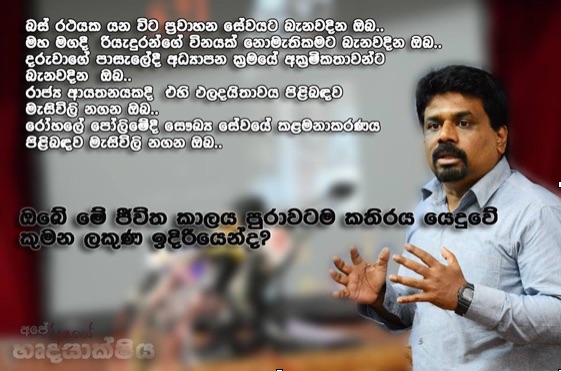
*Above: Anura Kumara Dissanayake (Source: JVP social media campaign at #gesl2015)
The Syriza analogy: limits and lessons Read More
