

Anti Muslim Sentiment In Sri Lanka: Hate Incidents – January To April 2015

June 19, 2015
The outcome of the presidential election of January 2015 created expectations of change, hope and reform among considerable sections of Sri Lankan society. For Muslim communities, who played a pivotal role in the election, the change in Government was willed into being in part due to the insecurity and violence suffered by Muslims particularly in the South of the country over the last two years. As indicated by the compilation of incidents carried out by the Secretariat for Muslims (SFM) from 2013 onwards, Muslims faced a hate campaign that has resulted in violence and tension, including damages to mosques and private properties, harassment and injuries to individuals and even deaths. This campaign that was carried out through a variety of methods, including direct violence, demonstrations, speeches, social media and the mainstream media had multiple impacts not just for Muslim communities but the country at large, raising serious concerns relating to the equality before the law, the lack of law enforcement, impunity and national identity. Above all it questioned the commitment of the then Government to both arrest the violence and perpetrators of the hate campaign such as the Bodu Bala Sena (BBS), and deal with the underlying culture of hate. The hate campaign played a significant role in mobilizing the Muslim community, including many of the Muslim members in Parliament, to vote for Maithripala Sirisena, in the expectation that his Government would bring about positive change. The election of January 8th created a palpable sense of security for the Muslims, especially in flashpoint areas which had seen violence in past months and had become the focus of Sinhala Buddhist extremist groups.
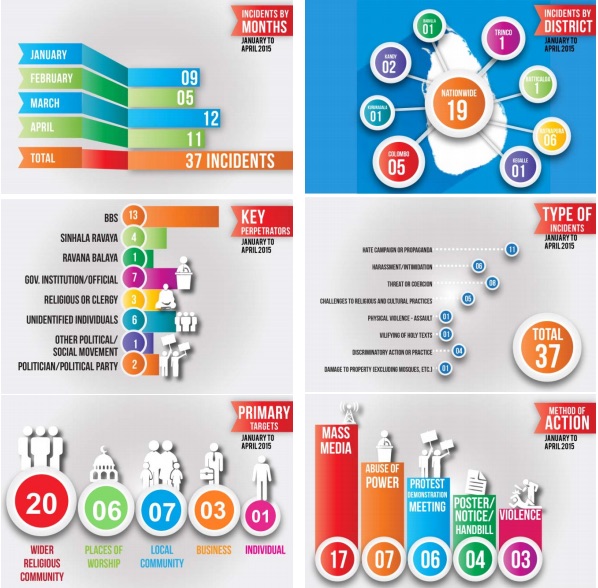 Over the last four months the Government has made a number of symbolic gestures and statements as to how this new Government differentiates itself from its predecessor, not just with regards to the hate campaign but also the ethnic conflict. President Sirisena has made repeated pledges and requests for a shift in the politics of this country, including at the SLFP convention on March 17 where he stated that the SLFP was “not a Sinhala Buddhist party” and for its members not to engage in racist politics. While the Government has yet to announce frameworks for addressing critical post-war issues, it has acknowledged the need for reconciliation. At the Independence Day celebrations, the President pointed out that “the biggest challenge we face today, is that of bringing together the minds of the people of the North and South, and through a process of reconciliation bring about co-existence and national understanding.”[1] Read More