

Are we safe? No escape for Europe as terrorism on the rise

TUESDAY 18 NOVEMBER 2014
Terrorist incidents are much higher in European OECD countries than North American and Latin American countries in 2013, according to new figures.
Terrorist incidents are much higher in European OECD countries than North American and Latin American countries in 2013, according to new figures.

The Global Terrorism Index 2014 report says the number of fatalities from terrorism increased by over 60 per cent to 17,958 in 2013.
Turkey and Mexico had the highest number of deaths from terrorism within the Organisation for Economic Co-operation and Development (OECD) forum, losing 57 and 40 lives respectively.
However, the UK recorded the highest number of incidents at 131, of which 88 per cent occurred in Northern Ireland.
Other countries which suffered fatalities were the United States, Greece, Israel, Chile and the Czech Republic, collectively losing a total of 16 lives.
'State-sponsored violence'
Steve Killelea, chairman for the Institute for Economics and Peace, attributed the growing number to state-based policies. He said: "Terrorism doesn't arise on its own; by identifying the factors associated with it, policies can be implemented to improve the underlying environment that nurtures terrorism.
"The most significant actions that can be taken are to reduce state-sponsored violence such as extra-judicial killings, reduce group grievances and hostilities, and improve effective and community-supported policing."
According to a study from the International Centre for the Study of Radicalisation and Political Violence (ICSR), of the 34 OECD countries, 20 are believed to have citizens fighting in Syria against the Assad government.
At the same time, over 80 per cent of the deaths were said to have been recorded in just five countries: Iraq, Afghanistan, Pakistan, Nigeria and Syria. More than 6,000 people were reported to have died in Iraq alone.
So how co-operative are our countries?
OECD countries with the highest terrorism index (2013)
The index scores 162 countries and examines trends from 2000 to 2013. The indicators used include the number of terrorist incidents, fatalities, injuries and property damage. The GTI score for a country in a given year is a based on a unique scoring system to account for the relative impact of incidents in the year.
Mr Killelea said that over the last decade, the significant increase in terrorist activity within OECD countries has been linked to radical Islamic groups "whose violent theologies have been broadly taught."
Given the theological nature of the problem it is difficult for outside actors to be influential.Steve Killelea
"To counter-act these influences, moderate forms of Sunnis theologies need to be championed by Sunni Muslim nations. Given the theological nature of the problem, it is difficult for outside actors to be influential," he said.
Although OECD countries represent a minority of terrorist attacks globally, they have suffered from several of the most deadly attacks of the last 14 years, including the 11 September attacks which killed nearly 3,000 people, the Madrid train bombings which killed 191, and the London bombingswhich killed 56.
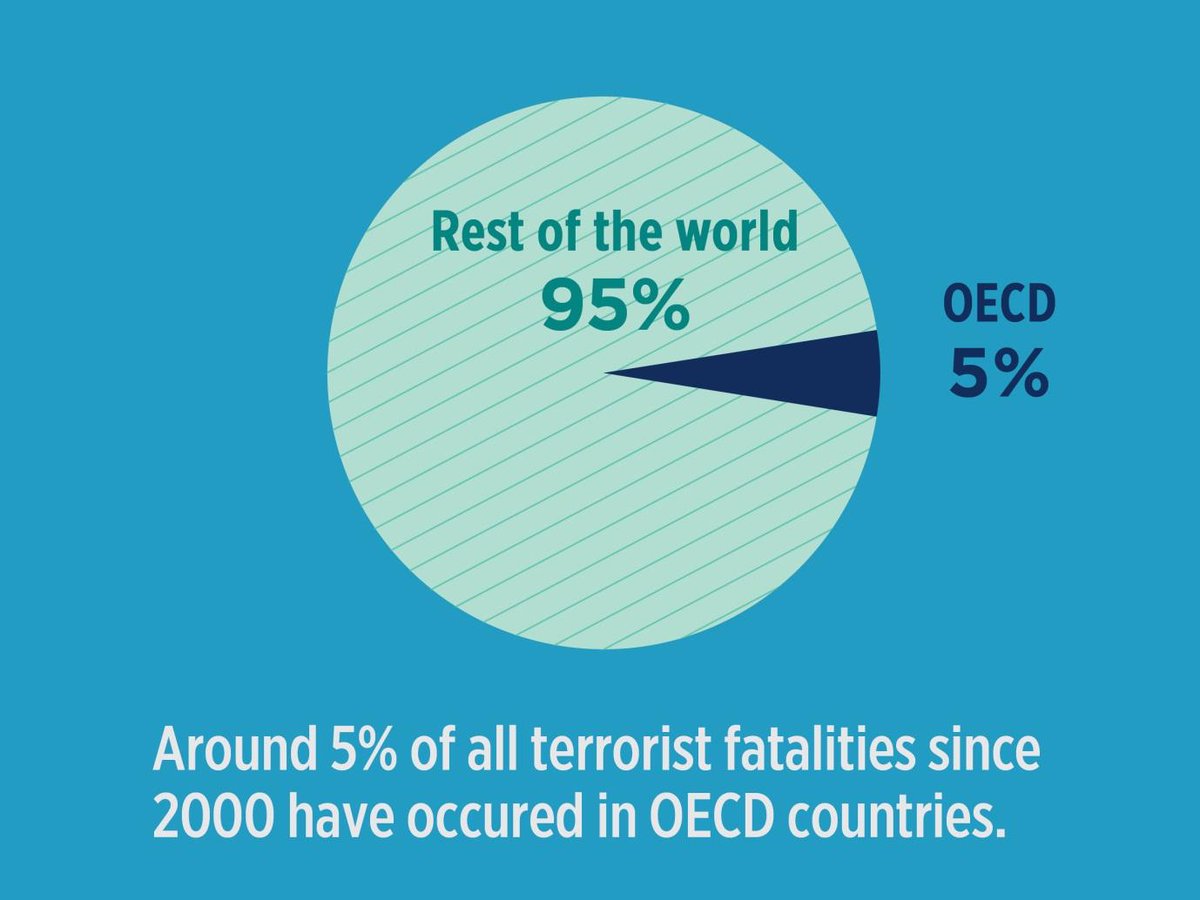
In total, 7 per cent of terrorist incidents and 5 per cent of all fatalities have occurred in OECD countries since 2000, resulting in 4,861 deaths from 3,151 attacks.
The report cautioned, however, that people were 40 times more likely to be a victim of homicide than be killed by terrorism.
