

EU imposes sanctions on 21 Russian and Ukrainian officials
People linked to unrest in Crimea face freeze on assets and travel ban after referendum vote in favour of union with Russia
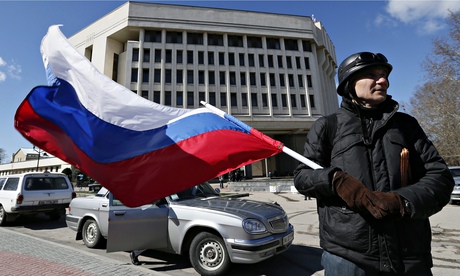
A man holds a Russian flag in front of Crimea's parliament in Simferopol, Ukraine. Photograph: Yuri Kochetkov/EPA

European foreign ministers have imposed EU-wide sanctions against 21 Russian and Ukrainian officials linked to unrest in Crimea.
Ministers and European Union officials said on Monday that the 21, mainly political figures involved in the breakaway of Crimea rather than business figures, would face a freeze on assets as well as a travel ban. That number could be expanded later in the week, they added.
The punitive measures announced on Monday came on the eve of an address to the Russian parliament by President Vladimir Putin on Crimea. He is expected to take steps to formalise the incorporation of Crimea into Russia but, if he felt the need to try to slow the imposition of sanctions, he could opt for a more measured response.
The sanctions follow the referendum in Crimea on Sunday, in which there was an overwhelming vote in favour of union with Russia. The EU condemned the referendum as illegal and said it would not recognise the outcome. The US was also planning to impose sanctions against Russia.
It is notoriously difficult to secure EU agreement on sanctions anywhere because they require unanimity from the 28 member states. The Associated Press reported that several countries – Spain, Portugal, Italy, Greece and Cyprus – had expressed reservations, mainly about moving too quickly.
The 21 named were on an original list that ran to about 120 people.
The Dutch foreign minister, Frans Timmermans, described sanctions as inevitable, saying: "I hope the Russians will realise that sanctions will hurt everyone, but no one more than the Russians themselves."
Expanding those on the sanctions list is almost certain to be discussed at the EU summit on Thursday and Friday. Some EU states are torn about taking punitive measures against Russia, undoing all the years of patiently trying to establish closer ties with Moscow as well as increase trade. The EU has already suspended talks with Russia on an economic pact and a visa agreement.
The aim of some members is to gradually increase sanctions, just as the EU did with Iran, to put pressure on Putin.
The German foreign minister, Frank-Walter Steinmeier, said any measure must leave "ways and possibilities open to prevent a further escalation that could lead to the division of Europe".
After the breakdown of 11th-hour talks in London on Friday with his Russian counterpart Sergei Lavrov, the US secretary of state, John Kerry, hinted that a new diplomatic window might open after the referendum. But there is no sign yet of any compromise by Russia.
