

Brief History Of Sri Lanka And Resolution Of Conflict Looks Nearer
Dr. G K Nathan
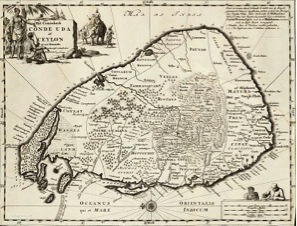 Legendry history of the Island, known as Lanka to Sinhalese and Eelam to Tamils, starts with epic of Ramayana based in two countries India and Lanka or Eelam. There are places in the Island linked to the epic and folklore tales are told
  by peoples about these places in the Island by both ethnic groups. The places linked to Ramayana are venerated and respected by all; even though there are perceived differences between the Sinhalese and Tamils, as they speak different languages and pursue Buddhism and Hinduism, respectively. Genetic studies show commonalty in the evolutions of peoples, taking all aspects of life of both Sinhala and Tamil peoples show that there are many common features between the two Nations. The strategic location of the Island in the East – West Sea route, in the Indian Ocean, attracted foreign visitors to the Island from the beginning of Common Era (CE). It is known to foreign visitors by different names as: Taprobane, Serendip, Zeylan, Ceylon and in 1972 the Island was renamed as Sri Lanka using the Sinhala name, but in Tamil the Island is referred to as “Illankai” a derivative from the word Eelam, Illam. Even in this modern era, Sri Lanka remains as a strategic location as seen from the stands taken by China, India, the USA and the UK on the conflict.
Peoples’ antiquity in Sri Lanka has been a point of contention, beside the numerical strength of Sinhala and Tamil peoples; the best way to pursue, the unresolved rights of a Nation, is to use the UN International covenant on civil and political rights (ICCPR). Nevertheless, political leaders of the majority Sinhala community have used the claim of antiquity and their numerical strength to decide the rights of other minorities, in particular that of the Tamil Nation. Examination of the antiquity of the Sinhala and the Tamil Nations in Sri Lanka will be guidance to others to enforce a justifiable solution to the long standing conflict in Sri Lanka. Relative geographic location of countries in the region is undoubtedly a good indicator of the probable migration patterns between neighbouring countries to determine the antiquity of claimants in Sri Lanka. Fact that the West coast of the Island is separated from the Tamil country in South India by Palk Straight, only about 20 km apart at the narrowest point is a good pointer as to who would have been the first visitors? The geographic location of the two countries points to Tamils as the first settlers in the Island. Tamil Brahmi scriptfound in Tissamaharama, Southern coast of the Island further proves the antiquity of Tamil settlement based on language dating back to 120 BCE. In comparison, Sinhala language only appears in inscription dated between 8th to 9th centuries CE, which shows Tamil, was in use, almost a millennium before Sinhala language came into use in Sri Lanka. Also there is evidence that people lived in the Island, as early as, 125,000 years ago and during this period the subcontinent and the Island were at times were bridged; making land communication a distinct possibility; further prove that migration of people between the Island and the southern subcontinent has occurred far back in history. Mahavamsa, the chronicle compiled in the 6thcentury CE by Buddhist monks, used Pali a North Indian language which came into use with introduction of Buddhism in the Island. Mahavamsa, the main source of Sinhala history failed to refer to practice of Buddhism among Tamils in the Island and as well as flourishing of Buddhism in South India, where many very rich Tamil Buddhist literature were created. Many scholars have rejected fanciful story of landing of Vijaya in Ceylon. According to H W Codrington the story given in the Mahavamsa about the advent of Vijaya has been copied from earlier legends found in Jataka stories. Considering the proximity of the Island to South India, this story has a very small element of truth and only some Aryans from the North of India did come and settle in Ceylon, and mingled freely with the Dravidians of Ceylon and South India. Codrington remarks that the resulting position was – though the Sinhalese language was of North Indian origin – the social system of the Sinhalese is that of the South. Perhaps use of Pali in Buddhist writings may have influenced development of Sinhala language to be identified as of North Indian origin, but the genetic study of Tamils and Sinhalese, referred to above confirms this interpretation. Unfortunately, the politicians of Sri Lanka, to gain popularity among Sinhala Buddhist perpetuated the myth; which has turned for the worst led by Sinhala Buddhist chauvinistsBodu Bala Sena (BBS) with the support from members of ruling hierarchy. While the moderate Sinhala elements’ voices are lost in the loud noise, the BBS declares “Sri Lanka is Sinhala Buddhist country” and attacks on Mosques, Hindus temples, Christian churches and religious symbolisms are on the rise, with no action taken against perpetrators. Britain’s action at the time of Independence in 1948, contrary to past history brought separate “countries” together in the hope that there will be amity between peoples. Looking back at that decision to unify the country rather than decentralization of power at the time of Independence has been proved wrong, needing urgent remedial action to restore peace in the Island. Read More
