

Threat To Religious Freedoms In Sri Lanka Highlighted At US Senate Committee
 September 13, 2013
The loss of religious freedom in Sri Lanka was drawn into sharp focus yesterday when US Senator Marco Rubio, a Republican representative from Florida said 30 churches had been attacked over the past four months in the island.
“30 churches have been attacked by Buddhist extremists – quite frankly I never knew such a thing existed, but apparently it does” the US Senator said, expressing concern about the increasing loss of religious liberties in countries of South Asia.

US Senator Marco Rubio
Speaking during the confirmation hearings of the Obama nominated Nisha Desai Biswal, who is set to replace Robert O. Blake as the next Assistant Secretary of State for South and Central Asia Rubio urged that US foreign policy should not just reflect the country’s interests, but also its values.
“In this part of the world, religious liberties are under incredible duress,” Rubio said highlighting cases of intolerance and anti-Christian violence in India, Pakistan, Uzbekistan and Sri Lanka.
Rubio called for the US Government to rethink its foreign aid support to Governments of countries in which religious freedom was under grave threat.
Arizona Senator John Mccain also brought up Sri Lanka in the Q&A session Biswal had to face before the Senate Foreign Relations Committee in order to have her appointment confirmed. Mccain said that human rights abuses taking place in Sri Lanka were rising to a level that was very disturbing. “Is the US active enough in condemning the ongoing human rights abuses,” Mccain asked the nominee.
Biswal responded that Senator Mccain’s assessment “comports” with her understanding of the situation in Sri Lanka. “The US has made clear that we believe that if Sri Lanka does not address through its own internal processes that there will be increasing calls for international processes to address these issues,” Biswal told the Committee.
UNHRC: Sri Lanka Says Approach Of Each State To Reconciliation Must Be Context-Specific
September 13, 2013
Sri Lanka has highlighted the highlight the need to adopt “a pragmatic, context specific approach in addressing issues of transitional justice” and noted that “the approach of each state to reconciliation must be context-specific, taking into account the particularities of each state and the aspirations of its people”.
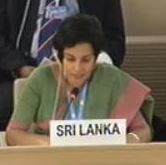
Manisha Gunasekera
Intervening during an Interactive Dialogue with the Special Rapporteur on ‘Truth, Justice, Reparation and Non-recurrence’ Pablo de Grieff, at the ongoing 24th Session of the Human Rights Council on Thursday (12 September 2013), Sri Lanka’s Deputy Permanent Representative to the UN in Geneva Manisha Gunasekera has observed, that “the Government of Sri Lanka has undertaken a harmonious and holistic approach to reconciliation, taking into consideration a range of cross-cutting issues including resettlement, housing, land, rehabilitation and reintegration of ex-combatants including former child soldiers, democratisation, accountability, demilitarisation, demining, infrastructure development, livelihood development, education, vocational training, trauma and psycho-social counselling, support for female-headed households and war widows, the trilingual policy, etc. These actions initiated shortly after the ending of the terrorist conflict in May 2009, are presently being continued in the context of the National Plan of Action for the implementation of the recommendations of the LLRC, in a time bound manner. 