

Full Text: TNA’s Northern Provincial Council Election Manifesto – 2013
The Mandate Given To The Tamil National Alliance -September 3, 2013 |

The Tamil People overwhelmingly gave the TNA a mandate at the General Election held in April 2010. The TNA has continued to act in accordance with that political mandate and is now facing the Northern Provincial Council Election as a necessary step in the fulfilment of that objective. It is pertinent to recall the salient features of that mandate:
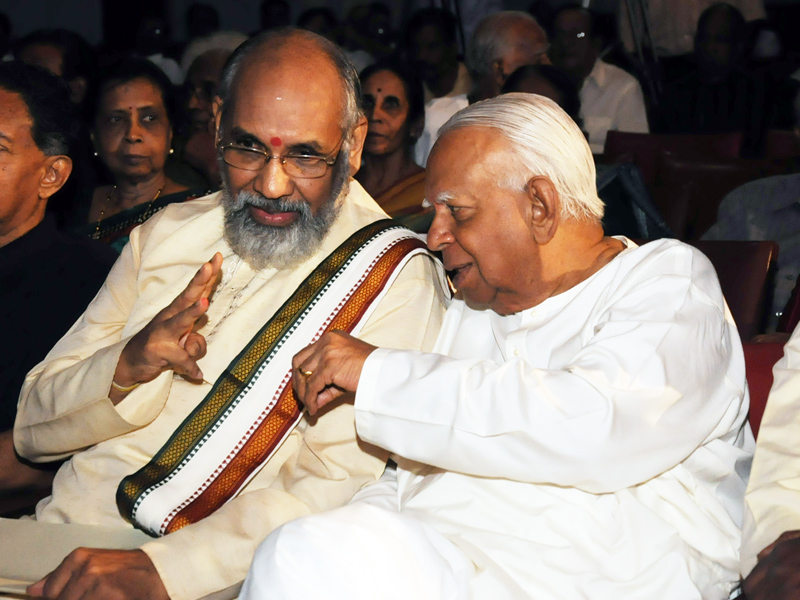
Wigneswaran-with-Sambanthan
At the time of independence from colonial rule in 1948, Ceylon was foisted with a unitary type constitution with simple majoritarian rule. In 1949 a sizeable number of Tamils of Recent Indian Origin were disenfranchised. State aided colonization of the preponderantly Tamil Speaking territory, particularly the Eastern Province, with the majority community intensified. The Ilankai Thamil Arasu Kadchi (ITAK) was formed as a consequence in December 1949. In this background in April 1951 the ITAK articulated its claim that the Tamil People in Ceylon were a Nation distinct from that of the Sinhalese by every test of nationhood and were therefore entitled to the right to self-determination. As a necessary corollary to the exercise of this right, we demanded a federal arrangement in the North and the East, where the Tamil Speaking Peoples are a predominant majority. In 1956 Sinhala was made the only official language of the country, again by the use of the parliamentary majority that was available to the majority community. Various peaceful agitations were organized between this time and the late 1970s to win back the right to self-determination that was lost first through foreign conquests and later due to a system of government not accepted by the Tamil People that reinforced majoritarian hegemony. Agreements were also entered into between two Prime Ministers, S W R D Bandaranaike and Dudley Senanayake, and S J V Chelvanayakam, the leader of the Tamil People in 1957 and 1965 respectively, relating primarily to the alienation of state land in the North-East. Both were unilaterally abrogated by the governments of the day.
In 1970 a Constituent Assembly was formed to enact an autochthonous constitution. ITAK also participated in this exercise and urged the inclusion of provisions to share powers of governance with the Tamil Speaking Peoples on the basis of shared sovereignty within a united country in keeping with their democratic verdicts. Those proposals were defeated by majority votes and the members of the ITAK left the Constituent Assembly. Similarly the Tamil People did not grant their consent to the enactment of the 1978 Constitution. Thus the first and second Republican constitutions entrenched a Unitary State, continued with Sinhala as the only official language, gave to Buddhism the foremost place and were enacted without the consent of the Tamil People.
Systematic State-sponsored colonization was carried out since independence in 1948 in order to change the demographic pattern of the North-East, which are the areas of historic habitation of the Tamil Speaking Peoples. This continues with full vigour in the North after the end of the war in 2009. The government retains an oppressive army presence in the Northern Province and is engaged in acquiring large tracts of land for ‘military purposes’.
In addition to the acts of discrimination, including standardization which affected the tertiary education of the Tamil youth and discrimination in employment in the state sector, organized violence was periodically unleashed against the Tamil People in the country in 1956, 1958, 1961, 1977, 1981 and 1983. No protection was provided by the State to the Tamil victims. On these occasions, affected Tamil People from other parts of the country were transported by the State to the North and East thereby recognizing these two provinces to be their homeland.
