

Mandela Day-July 18: In honour of the beacon of inspiration to the world
UKTamilNews.com
By Harrish Thirukumaran
-17 July 2013,
 Nelson Mandela International Day is globally realized through its registered approval by the United Nations. It is to be celebrated every year on July 18, which is Mandela’s birthday.
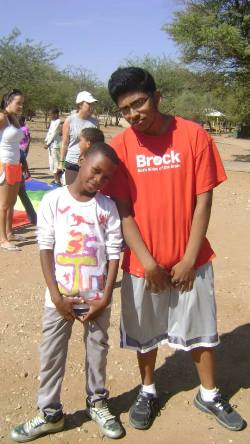
Junior and I (Harrish) in Namibia-(pic by Dan)
 The primary focus of the occasion is to commemorate Mandela’s commitment to the promotion of democracy, peace, and freedom. In addition, it calls for widespread volunteerism for the good of humanity in honour of his person.
Since the former president of South Africa has reached a critical stage in his lifetime it should be acknowledged why this day should be treated with strong international recognition.
Mandela is first seen as a human rights lawyer who legally fought extensively for social justices and equalities. His mission had been widely remembered through his struggle against the cruel Apartheid regime in his native South Africa. A system that literally meant ‘apartness’ had legalized racial segregation of black and white South Africans also simultaneously indicating social discrimination and racism. In addition, it had created an unequal colour barrier that had strongly favored white Afrikaners over various black ethnic groups. The system economically had indeed created large disparities between the groups through things like education and healthcare. The South African homeland was a place that promoted white supremacy.
Overall, the system had denied blacks basic legal, social, political and economical rights. This political classification had undermined the essential values of a democracy and equality. It had even gained considerable influence regionally, spreading its power northwest into neighboring Namibia. Due to this, Mandela condemned this system as an injustice and soon became a crucial figure advocating against the oppressive government because of its deprivation amongst differing racial groups.
Through his battles, Mandela had to endure grueling challenges and develop his political notions to reform a corrupt system. All efforts striven towards equalized rights throughout South Africa and its controlled constituents. His anti-apartheid beliefs and destabilization abilities had and should be progressively recognized as a global political force and moral achievement among many citizens worldwide.
His contributions into restoring democratic principles to an authoritarian nation have been praised onto an ideological level that eventually lead to installment of a free electoral system. He is also credited for introducing a multi-racial competitive structure that had guaranteed Nelson Mandela’s tenure as South Africa’s first black president. A truly historic moment that was much needed after living under a racial supremacist system.
Once granted office, Mandela would be able to express his own social and economical ideals on a larger international scale for those who suffer different inequalities. On a domestic front, his policies of democratic equality were able to bring the divided racial groups together economically. Internationally, his policy of diplomatic mediation has also been significant in resolving disputes.
His administration was pragmatically determined to eliminate poverty, mobilize healthcare, and disassociate discrimination.
Mandela’s presidency indeed influentially directed a stable South African political model for many sovereign nations to follow in the distant future.
Today, though Mandela has retired from politics, his iconic legacy lives on and prospers throughout many political affairs via the work of his NGOs and foundations. His actions and beliefs have been integral in a fundamental journey to successfully ensure a comprehensive society where all people benefit regardless of colour, gender or sexual orientation. He is inevitably an idealized beacon of equality, freedom, and inspiration that must be followed to resolve the world’s recurring social issues.
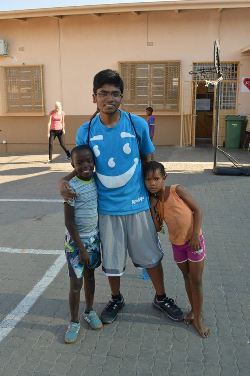
With Dino and Christy at the BNC-pic by Maegan
 The world should and can be responsible enough to critically understand the man’s qualities along with advancing his egalitarian doctrine.
Nelson Mandela International Day can influence all nationalities, as a stable society is determined through the level of opportunity for the average person.
Mandela today is fondly referred to as “Madiba”, the honuorific title granted by the humanitarian world, derived from his proud Xhosa heritage.
Lastly, Nelson Mandela’s charismatic leadership has been encouragement for myself to travel and experience Africa. Through one of the international programs at my University I traveled late this Spring to Namibia, a neighbouring country of South Africa.
Alongside several of my Brock mates I volunteered at a local school organization called the Bernard Nordkamp Centre, in Katutura, Windhoek the capital of Namibia. It is a true life-changing experience assisting the youth after school program there and I hope to write about it in the near future.
“Thank you Madiba”.
(Harrish Thirukumaran (Email ~ rish1610@gmail.com) is entering his second year at Brock University, Ontario
