

Fr. Thani Nayagam Birth Centenary: “All humanity is my fraternity”
 by K. Thirukumaran-11 July 2013,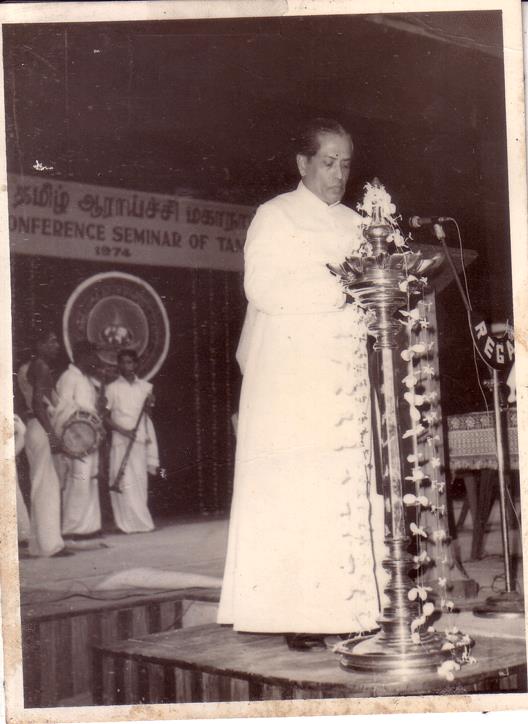
The Birth Centenary celebrations of Fr. Xavier Stanislaus Thani Nayagam have been held at the Federation of Tamil Sangams of North America convention (FeTNA) venue from July 5-6th at the Sony Centre in Toronto.
 An exhibition of publications, photographs and mementos of Rev. Thani Nayagam was held open both days and a panel discussion on various aspects of Rev. Thani Nayagam’s vocation, scholarship, and commitment to language rights were held on July 6th. A key note address was delivered at the convention on the life and work of Rev. Thani Nayagam along with a short documentary and a book, ‘Tamilaram’ was also released.
‘Tamilaram’ was first published in 1983, in Jaffna, Sri Lanka as a compilation of tributes written by friends and colleagues of Rev. Thani Nayagam following his death in 1980. The second edition was released by Canadian Tamil Congress at the FeTNA convention in Toronto to mark the centenary commemoration.
‘Tamilaram’, reading or browsing the pages of this ‘garland of tributes’ replenishes with what the presence of Father Thani Nayagam would have been; the elegance of humanism, service and humbleness are felt; and ecstatic it is – finding the first article in ‘Tamilaram’ is by Fr. C.A. Joachim Pillai OMI, professor emeriti at St. Augustine’s Seminary and Toronto Theological School of The University of Toronto.
Fr. C.A. Joachim Pillai’s tribute is titled, “The Grace of Experiencing Nature” – One way of looking at Fr. Thani Nayagam’s Life:
The following excerpted from Fr. C.A. Joachim Pillai’s tribute sums up Father Thani Nayagam for those who do not know about him:
“As an internationalist, Fr. Thani Nayagam remained open to all cultures not merely in theory, but in real practice. He knew English and Italian literature as much as his own Tamil literature, not to mention his competence not only in the classical languages of India, but also in Latin and Greek. He understood well that true unity can be built only on the uniqueness of diverse cultures. He wanted that Tamil culture – so ancient and so new – be allowed to grow and blossom and radiate in the world its own particular fragrance of communion with self, nature, neighbor and the Unsee
