

Rajapaksa takes major gamble on NPC issues
 Internal fissures have prompted the Cabinet of Ministers to discuss again on Thursday the exclusion of two key provisions in the 13th Amendment to the Constitution and related issues. At last Thursday’s meeting, Cabinet Secretary Sumith Abeysinghe circulated to ministers two sets of documents. Both were signed by External Affairs Minister, G.L. Peiris, who is also a professor of law. Both related to constitutional amendments that require a two-thirds majority in Parliament and relate to changes in the 13th Amendment to the Constitution.

By Our Political Editor-Sunday, June 09, 2013
- Cabinet to take vital decision this week on Constitutional amendments
- JHU, NFF insist on changes, SLMC, TNA and Left parties oppose moves to weaken PC system
- Ahead of Pillay visit, President submits memo to incorporate 53 more LLRC recommendations to National Action Plan

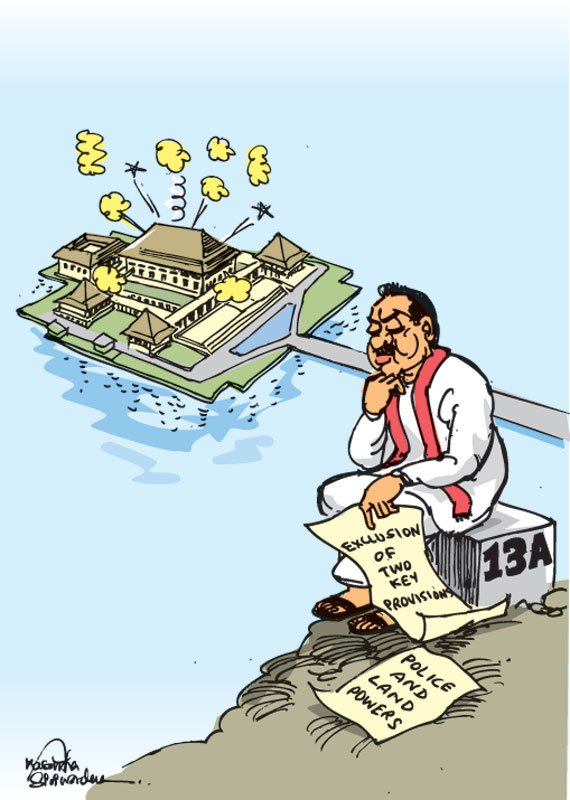 Internal fissures have prompted the Cabinet of Ministers to discuss again on Thursday the exclusion of two key provisions in the 13th Amendment to the Constitution and related issues. At last Thursday’s meeting, Cabinet Secretary Sumith Abeysinghe circulated to ministers two sets of documents. Both were signed by External Affairs Minister, G.L. Peiris, who is also a professor of law. Both related to constitutional amendments that require a two-thirds majority in Parliament and relate to changes in the 13th Amendment to the Constitution.
A two-page document is titled ‘LEGISLATIVE POWERS OF PARLIAMENT AND PROVINCIAL COUNCILS – DRAFT AMENDMENT TO ARTICLE 154G (3) OF THE CONSTITUTION’. Pointing out that it is “suggested for consideration by Cabinet of Ministers,” Peiris adds, “this relates to an aspect of the distribution of legislative powers between Parliament and Provincial Councils.” In the next page, he gives the draft of the new constitutional amendment. It reads:
“2. The Constitution of the Democratic Socialist Republic of Sri Lanka is hereby amended in Article 154G by the repeal of paragraph (3) thereof and the substitution therefor of the following paragraph.
“(3). No Bill in respect of any matter set out in the Provincial Council List shall become law unless such Bill has been referred by the President, after its publication in the Gazette and before it is placed on the Order Paper of Parliament, to every Provincial Council for the expression of its views thereon, within such period as may be specified in the reference and
National Freedom Front leader Minister Wimal Weerawansa signs his party's public petition to collect two million signatures urging the Government not to go ahead with the Northern Provincial Council elections.
(a) where the majority of such Councils agree to the passing of the Bill, such Bill is passed by a majority of the Members of Parliament present and voting; or
(b) Where the majority of the Councils do not agree to the passing of the Bill, such Bill is passed by the special majority required by Article 82.”
In terms of existing provisions of the 13th Amendment to the Constitution, statutes applicable to provinces (in respect of matters set out in a Ninth Schedule), no Bill for amendment or repeal is permissible without the express approval of all Provincial Councils. Existing provisions also allow adjoining provinces to form one administrative unit with an elected Provincial Council.
In terms of existing provisions of the 13th Amendment to the Constitution, statutes applicable to provinces (in respect of matters set out in a Ninth Schedule), no Bill for amendment or repeal is permissible without the express approval of all Provincial Councils. Existing provisions also allow adjoining provinces to form one administrative unit with an elected Provincial Council.
