

Petrie report: Diplomatic blunder projects Sri Lanka as a Rwanda


By Our Political Editor
= President must intervene to prevent irreparable damage to country's image because of failure by EAM and mission in UN
= UN issues statement against impeachment of CJ while composition of UNHRC changes
= UN issues statement against impeachment of CJ while composition of UNHRC changes
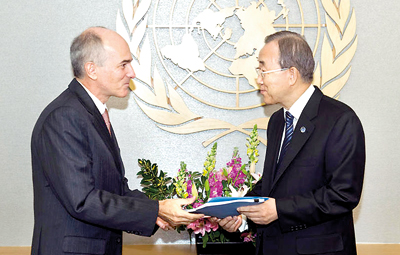
Secretary-General Ban Ki-moon receives the Independent Review Panel Report on Sri Lanka from ASG Charles Petrie. UN Photo/Eskinder Debebe
It was a week of more challenges for the UPFA Government both in Sri Lanka and abroad.�In Colombo, the official process to impeach Chief Justice Shirani Bandaranayake began on Wednesday. The eleven-member Parliamentary Select Committee chaired by Minister Anura Priyadarshana Yapa held its first meeting in Parliament. Standing Orders of Parliament prevent reportage of proceedings of the Committee.
It was a week of more challenges for the UPFA Government both in Sri Lanka and abroad.�In Colombo, the official process to impeach Chief Justice Shirani Bandaranayake began on Wednesday. The eleven-member Parliamentary Select Committee chaired by Minister Anura Priyadarshana Yapa held its first meeting in Parliament. Standing Orders of Parliament prevent reportage of proceedings of the Committee.
Speaker Chamal Rajapaksa warned all MPs not to discuss matters relating to the PSC outside the House. Warnings have also been issued to the media to heed Standing Orders when reporting. Within one month of last Wednesday’s meeting, the PSC report is required to be presented to the Speaker. However, the Committee is not precluded from seeking extensions.
The next day (Thursday) Chief Justice Bandaranayake received a letter from the PSC to respond to the 14 allegations against her within seven days. She has also been asked to appear before the Committee on November 23, one of her lawyers said yesterday. A team of leading lawyers led by Romesh de Silva will represent her. They were preparing her responses to the charges. These developments came as the impeachment resolution itself caught the attention of the office of the UN High Commissioner for Human Rights. From its headquarters in Geneva, Gabriela Knaul, the UN Special Rapporteur on the independence of judges and lawyers, issued a detailed statement.
Among other matters she noted, “Judges may be dismissed only on serious grounds of misconduct or incompetence, after a procedure that complies with due process and fair trial guarantees and that also provides for an independent review of the decision.” She noted that “the misuse of disciplinary proceedings as a reprisals mechanism against independent judges is unacceptable.” In her view, Knaul said, “the procedure for the removal of judges of the Supreme Court set out in article 107 of the Constitution of Sri Lanka allows the Parliament to exercise considerable control over the judiciary and is therefore incompatible with both the principle of separation of power and article 14 of the International Covenant on Civil and Political Rights.”
That the remarks were made when both Colombo and Geneva are yet to reach accord on a date for the visit to Sri Lanka by the UN Human Rights High Commissioner Navi Pillay adds significance. She has been tasked to report to the UN Human Rights Council on the progress Sri Lanka has made in the adoption of provisions of the US-backed resolution passed in March this year.
The situation has been made worse. In almost every crisis faced not only by the UPFA Government, but by Sri Lanka itself, the woeful inadequacy of the External Affairs Ministry (EAM) is highlighted with great clarity. Whatever the rights and wrongs of an impeachment move on the Chief Justice would be, the EAM has failed to set out the Government’s own position to the country’s diplomatic missions abroad. If indeed that has been done, not one country has defended Sri Lanka. The EAM has not been able so far to respond to what this UN Rapporteur; an official, whose pronouncements are taken cognisance of diplomatically by other countries, has commented upon. If that is just one lapse, there is much more. The EAM, as we reveal today, is out of focus. Whilst its officials are busy paying all attention to their Minister, G.L. Peiris’ pet project “Look towards Africa,” things are happening elsewhere.
Last Monday, the UN General Assembly in New York elected by secret ballot 18 member states to serve on the Human Rights Council in Geneva. Contrary to expectations, the United States received 131 votes, Germany 127 and Ireland 124. Others elected are Argentina, Brazil, Cote d’Ivoire, Estonia, Ethiopia, Gabon, Japan, Kazakhstan, Kenya, Montenegro, Pakistan, the Republic of Korea (south Korea), Sierra Leone, the United Arab Emirates and Venezuela. From the elected countries, Cote d’Ivoire, Estonia, Ethiopia, Ireland, Kazakhstan, Kenya, Montenegro, Sierra Leone, the United Arab Emirates and Venezuela are on the HRC for the first time. Whilst United States has been re-elected, Argentina, Brazil, Gabon, Germany, Japan, Pakistan and South Korea served non-consecutive terms.
