

MR's London fiasco: Diplomatic and intelligence failure
MR's London fiasco: Diplomatic and intelligence failure | ||
| ||
| By Our Political Editor President Mahinda Rajapaksa flanked by British parliamentariens at Sri Lanka’s High Commission in London | ||
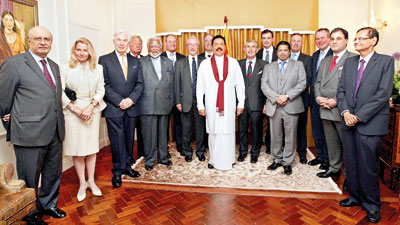  The SriLankan Airlines special flight to London with President Mahinda Rajapaksa and entourage on board last Sunday shifted departure schedules at least twice. The SriLankan Airlines special flight to London with President Mahinda Rajapaksa and entourage on board last Sunday shifted departure schedules at least twice.
This was after the Sri Lanka High Commission in Britain warned that Tamil diaspora groups were planning to stage protests at Heathrow Airport. He was to leave earlier that day and arrive in London in the night. Instead, he turned up at the Carlton Super Seven's series rugger match at the Police Grounds in Thimbirigasyaya.
There he saw British High Commissioner John Rankin and invited him to take a seat near him. "Forget about what the newspapers have been reporting," others around heard Rajapaksa telling Rankin. He was alluding to media criticism after the envoy's remarks in his High Commission's own website. The British envoy had wanted military camps in the north to be reduced to levels existing in the south. Such calls for demilitarisation have been made in official statements issued by other envoys and governments too.
However, a group within the UPFA government said the remarks were a counter to a public declaration made by Rajapaksa only a few days earlier. He told the Victory Day celebrations on May 19 that no military camps in the north would be shut down. He said they were necessary for reasons of "national security."
The same group was to suggest that Rankin be declared persona non grata or a person not welcome in Sri Lanka. The group was robust in its thinking that the President should not "tolerate unfriendly remarks" by those representing western nations but "take them on". Rajapaksa and even some of his senior advisors were not in favour of this stance. It was felt "unwise" at a time when he was to visit Britain and Sri Lanka was to host the Commonwealth Heads of Government Meeting (CHOGM) next year.
|

