

In conversation with Bishop Duleep de Chickera

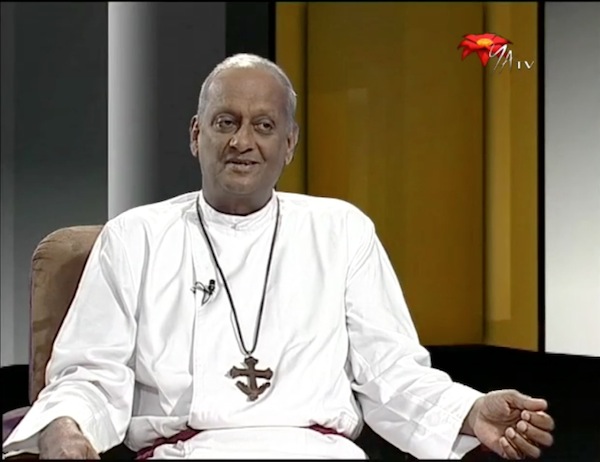 I clearly remember Bishop de Chickera at S. Thomas’ College, from around 25 years years ago. The fact that I hadn’t seen him in person for a quarter of a century hit me as I strode up to the foyer of Young Asia Television’s offices to meet him just before our interview, and for a moment, I was a student of 10 or 12 again. I remembered him walking around College, addressing us occasionally and writing behind his desk in his open office, visible to students who passed it on their way to assembly or class. Off camera, I once referred to him as ‘sabba‘ – our schoolboy term for Sub-Warden, which either he didn’t hear, or didn’t seem to mind. I was for that brief moment however frozen in terror, wondering whether he would pull me up not for a caning, but for that measured, calm questioning more fearful, and effective, than any fear of physical pain or punishment. Of course, our banter about the College of our memory moved on to his tenure, from May 2001 to December 2010, as the head of the Anglican Church in Sri Lanka. By his own admission, they were long years, spanning three key phases – the Ceasefire Agreement, the tsunami and the end of the war, including the nature of its denouement and the challenge of reconciliation and a political settlement after it.
We began our interview by talking about why he became a Priest, when much younger, he wanted to become a lawyer or join the Army. In an interview published in the Sunday Times a while ago, Bishop de Chickera said that before he joined the ministry, he was a ‘superficial Christian’. I ask him what this means, and how it is different to the Christian he is today. The Bishop’s answer ends by saying that the role of the clergy diminishes the more the laity is able to lead their lives guided by an authentic faith.
We go on to speak about the Bishop’s take on sexual identity and homosexuality in particular, that has rent asunder the Anglican Church. Anchored to his sermon at the Lambeth Conference in 2008 (which around 200 bishops boycotted), where he noted that,
and went on to speak of the need for an,
When asked to reflect upon his sermon, the Bishop underscored the need to keep an honest and open conversation about the matter, noting that gay and lesbian people must have the right to define their own sexuality. He said,
We then talk about his more activist voice, during the 10 years he led the Anglican Church, in going before the Lessons Learnt and Reconciliation Commission (LLRC), issuing statement over,inter alia, the incarceration of Sarath Fonseka, the singing of the National Anthem in Tamil, 18th Amendment and the arson attack on the Sunday Leader newspaper in 2007. The response the Bishop received to some of these statements ranged from the unfriendly to, particularly in online fora, the downright dismissive and disrespectful. I ask him why he said and wrote what he did, and how he coped with the flak he and the Church received.
Given his submission to the LLRC, we go on to talk about the Bishop’s take on reconciliation in Sri Lanka, after the release of the final report of the LLRC as far back as December 2011, albeit only in English. The Bishop notes that every Sri Lankan, as compulsory reading, should have a copy of the LLRC’s recommendations. Noting that the LLRC’s Commissioners did well and surprised their critics, he said,
After speaking in more detail about the Bishop’s take on reconciliation post-war, I ask him about the nature of a God, as referred to by him in a statement over the 18th Amendment to the Constitution, issued in September 2010 to prevent what was a heinous constitutional amendment from coming about. In this statement, after noting that it is “imperative that Parliament rejects this Bill, and that all who value democratic freedom in the country voice their objection to it”, the Bishop ends with a call to “the God of peace and justice” to “hear our cry and bless and nourish our beloved nation.”
Given the passage of the amendment, I noted that there was either a miscommunication with God, or that the cries weren’t loud enough and asked the Bishop why the God he appealed to didn’t intervene. The Bishop gave an interesting response, though noting that there were no easy answers on this score even amongst theologians.
Towards the end of our conversation, we talk about the Bishop’s submissions, in October 2010, to the out-going US Ambassador Patricia Butenis during a bi-lateral meeting they had held. Asreported via Wikileaks, the Bishop is purported to have urged the US Ambassador,
The Bishop expands this point, and goes on to end our conversation with some vital observations on the state of human rights activism in Sri Lanka, the often vituperative nature of the debate over the protection of rights and reconciliation, and finally, how anyone engaged in reconciliation needs to, ultimately, embrace the enemy.
The full interview can be viewed below, and will be broadcast on TV over the course of the following days in Sri Lanka. The schedule of broadcasts can be downloaded here.
