Peace for the World

Peace for the World
First democratic leader of Justice the Godfather of the Sri Lankan Tamil Struggle: Honourable Samuel James Veluppillai Chelvanayakam

Sunday, December 31, 2017

Use of plastic and polythene Kicking the habit Raising public awareness on non-degradable products


By Risidra Mendis-2017-12-31

For many years, the polythene menace has caused havoc in the environment and has resulted in deaths of both animals and humans. But, despite the serious damage caused to the environment by the irresponsible use and disposal of polythene, no measures were taken to minimize its usage until recently.

The ban on some products of non-degradable polythene that came into effect recently was accepted quite positively by the public and has, to a certain extent reduced the usage of non-degradable polythene products in the market.

The ban on lunch sheets, grocery bags, shopping bags and polystyrene or rigifoam lunch boxes came into effect on 1 September 2017 after the Central Environment Authority (CEA) Chairman Prof. Lal Dharmasiri informed President Maithripala Sirisena and Prime Minister Ranil Wickremesinghe of the serious problems caused to the environment by the use of polythene.

Polythene everywhere

"The President who is also the Minister for Environment and Prime Minister Wickremesinghe asked us to find a solution to control the polythene and plastic menace. The Universities of Sri Jayewardenepura and Kelaniya conducted a research on polythene usage in the country. The research revealed that 6.7 kilos of polythene is used by a single person every day. Polythene and plastic are spreading rapidly and polluting the environment. People were in the habit of just walking into a shop and buying something and taking it away in a bag made out of polythene because they had easy access to polythene shopping bags," Prof Dharmasiri explained.

He added that lunch sheets were also used by the public because they were readily available in the market and because they were cheap. "The use of polythene became a problem in the country because it was not disposed of properly. Polythene and plastic don't degrade and as a result, the environment started getting polluted.

Polythene was dumped by the side of the road and in drains. When people went on trips they ate their food and threw the lunch sheets into nearby forests. When polythene is disposed of in an irresponsible manner, it gets stuck in drains. I have seen pieces of polythene stuck on top of trees after been blown away by the wind. When polythene is thrown into the forests and into garbage dumps, wild animals feed on it. Many animals have died after eating polythene from garbage dumps near forests," Prof Dharmasiri said.

He went on to say that people are also affected by the irresponsible disposal of polythene and that when it gets thrown on roads and in garbage dumps, it can collect water.

"Stagnant water is a good breeding ground for the dengue mosquito and so many people have already died from dengue. A decision was then taken by CEA with the approval of the President to ban the use of lunch sheets, grocery bags, shopping bags and polystyrene or rigifoam lunch boxes from the market. Polythene manufactured under 20 microns is not degradable and causes serious damage to the environment. When polythene is produced with less than 20 microns calcium carbonate is added. The overuse and continued use of calcium carbonate in polythene is not good for our health and the environment. Vendors want to make maximum profits so they sell polythene that is non-degradable. Polythene used for decor and other functions such as weddings, political rallies and religious events are also banned.

The CEA will tell all politicians not to use polythene for decorations during political campaigns, because most often the polythene used for the decor is just left behind after the rallies and pollutes the environment. Some politicians are already adhering to the polythene ban and not using polythene for their political campaigns," Prof Dharmasiri explained.

Changing attitudes

He added that there is only one company in Sri Lanka that produces rigifoam lunch boxes and this company produces 75, 000 of them per day. "Even though this rigifoam box is banned from the local market, the company can produce this product and sell it overseas.

As an option for rigifoam lunch boxes, a cardboard box can be used instead. Cardboard boxes are very cheap and can be recycled easily. Some people are asking us why we are not banning the yoghurt cup. It is not practical to ban all types of polythene from the market at once. Burning polythene in public is also banned because the fumes that spread from the burning polythene can cause cancers and breathing problems for people. However, some people still continue to burn polythene in public. High Density Polythene (HDP) is banned in the country while Low Density Polythene (LDP) can be produced and used. HDP can be produced in a thin form which is why people prefer to buy that product over the LDP," Prof Dharmasiri said.

He explained that there is only a small difference between the prices of the degradable polythene and the bio-degradable polythene. "But some people are complaining about the price difference in the degradable and bio degradable polythene. When the Government increases the prices of cigarettes and liquor, people don't complain. After the polythene ban in September 2017 we didn't start raiding places to check if polythene manufacturers are still producing non-degradable polythene because we wanted to first create awareness among people of the harmful effects of using this type of polythene. CEA has informed the Police, Government institutions, religious places and universities about the ban and the importance of co-operating with the Government to stop using polythene that is harmful to the environment," he said.

Going green

Polythene and plastic can be recycled. However a proper plan has to be in place to collect polythene and plastic bottles that need to be disposed from houses and offices.

Polythene manufacturers who want to convert their polythene manufacturing machines from HDP to LDP will be given some concessions by the Government. The public has to co-operate and start using these environmentally-friendly products. They have to put in a small effort to use bio degradable polythene products. But, the co-operation of the public will have a big impact on the country. CEA is planning to introduce an Extended Producers Responsibility (EPR) where the producers of polythene have to take responsibility for the polythene that they produce and dispose of it in a responsible manner.

"We cannot say when we can completely stop the usage of banned polythene products. However, we are working on minimising the usage of polythene in the local market." Prof. Dharmasiri concluded.

Every Breath You Take …


article_image

By Dr. Ranil Senanayake-

Air pollution has become a very serious and very visible burden on humanity. The WHO estimated that it was responsible for 3 million premature deaths worldwide per year in 2012; much of this mortality is due to exposure to small particulate matter of 2.5-10 microns in diameter (PM10), which cause cardiovascular and respiratory disease, and cancers.

Even healthy people experience health impacts from polluted air, the effects include respiratory irritation or breathing difficulties during exercise or outdoor activities. The current health status and the pollutant type and concentration, or and the length of exposure to the polluted air, determines the rate of cardiovascular and respiratory disease, and cancers. High air pollution levels can cause immediate health problems.

The air in Colombo is already of poor quality. The PM10 has an annual average of 36 µg/m3 of these particles. That’s 3.6 times the safe level set by the WHO. While the well- being of the citizens of Colombo seem the least important to the planners of our future, we need to inform ourselves on the cost we have to pay, so that we could defend ourselves from the consequences of ill-informed decision making.

The current air pollution level in all of Sri Lanka has an annual average of 22 µg/m3 of PM2.5 particles, which is 2.2 times the WHO safe level. It has also been estimated that in 7,792 people died from air pollution-related disease and that the rate is increasing each year. The top illness caused by air pollution is Ischemic heart disease. Further, 33 children die of air pollution-related diseases every year. Currently, the main source of ambient air pollution in Sri Lanka is vehicular emissions, which in Colombo contributes to over 60% of total emissions. But, lurking in the activities of the proposed Port City, there is a huge hidden danger. The danger that uncontrolled construction debris will pose to air quality and to the health of the residents of Colombo city.

Construction activities that contribute massively to air pollution include: land filling, operation of diesel engines, demolition, burning, and working with toxic materials. All construction sites generate high levels of dust (typically from concrete, cement, wood, stone, silica) which can carry for large distances over a long period of time. Construction dust is classified as PM10 or particulate matter less than 10 microns in diameter, invisible to the naked eye.

Research has shown that PM10 penetrates deeply into the lungs and cause a wide range of health problems including respiratory illness, asthma, bronchitis and even cancer.

Another major source of PM10 on construction sites comes from the diesel engine exhausts of vehicles and heavy equipment. This is known as diesel particulate matter (DPM) and consists of soot, sulphates and silicates, all of which readily combine with other toxins in the atmosphere, increasing the health risks of particle inhalation.

We have witnessed a lame, shameful excuse for an EIA and SEIA on the Port City landfill that was accepted by the Environmental Ministry. The landfill was facilitated without responding to any of the public concerns. While the legality of these actions will be discussed into the future, current public interest should focus on the Phase 2 EIA: Construction of the buildings and infrastructure of the Port City. This EIA will be based on the concept master plan and infrastructure requirements submitted to the UDA (and described in Chapter 2 of the SEIA ). The construction of permanent structures/built environment on the landfill will take place only upon receiving necessary approvals for the Phase 2 EIA study.

As we have learnt to expect from past performance, there will be a secret Phase 2 EIA which will be approved out of the public eye and construction will be allowed to begin. Land will be sold and we will be told that they cannot control the development activity. Before this happens, we must demand a public hearing of the Phase 2 EIA of the Port City to be conducted before any approvals are given. But irrespective of that, there should be a maximal allowable limit on air pollution set at today’s level. Any activity that contributes to pollution exceeding these levels must be penalized by the Government.

The price of increasing the air pollution burden will be, accelerated aging of the lungs, Loss of lung capacity and decreased lung function, development of diseases such as asthma, bronchitis, emphysema, and possibly cancer, shortened life spans etc. Is this what we want for ourselves when we breathe?

Long-term exposure to polluted air will have permanent health effects, those most affected will be, Individuals with heart disease, coronary artery disease or congestive heart failure, Individuals with lung diseases such as asthma, emphysema or chronic obstructive pulmonary disease (COPD), pregnant women, outdoor workers, older adults and the elderly, children under age 14, athletes who exercise vigorously outdoors.

Can we expect the Municipality or Ministry of Health to follow the example in the United states, where eight northeastern states sued the U.S. Environmental Protection Agency to force it to impose more stringent controls on a group of mostly Midwestern states whose air pollution they claim is being blown in their direction and creating public health problems in their communities. The airborne pollution was being created by burning fossil fuels and through the use of cement and construction chemicals in the Midwestern states. They should place stringent controls on air quality now.

As the skyline to the sea around Colombo will be increasingly blocked bycurrent construction happening today, the through flow of air will be reduced. We can already see this happening. Allowing another barricade to airflow to be created in front of that, should be seen as an infringement of one’s basic right to a healthy breath. It seems tragic that no politician wants to act of the defense of public health, our only hope is that it is the president himself who is the Minister for the Environment, can direct his ministry to act in the defense ofthe quality of air. If not, we will begin to lose our health, with every breath we take.

Palestinians recall envoy to US for consultations after Jerusalem move


Palestinian local media reports indicate discussions will be about future steps PA will take in response to Trump’s move
President Mahmud Abbas refuses to meet US Vice President Mike Pence (AFP/file photo)


Sunday 31 December 2017
The Palestinians said on Sunday they were recalling their envoy to the United States for consultations in a move that follows US President Donald Trump's designation of Jerusalem as Israel's capital.
Palestinian Foreign Minister Riad al-Malki decided to recall PLO envoy to Washington Husam Zomlot, official Palestinian news agency WAFA said, without providing further details.
Palestinian local media reports indicated that discussions will be about the future steps the PA will take in response to Trump’s announcement, according to the JerusalemOnline website.
Trump's 6 December announcement regarding the disputed city deeply angered the Palestinians and led to weeks of unrest.
Palestinian officials had earlier said President Mahmud Abbas would refuse to meet US Vice President Mike Pence during a visit to the region that had been planned for December but which was later cancelled.
He has also said he would accept no further role for the United States in the Middle East peace process.
Violence since Trump's announcement has left 13 Palestinians dead, with most killed in clashes with Israeli forces.
On Sunday, while marking the 53rd anniversary of his Fatah movement, Abbas called Jerusalem "the eternal capital of the Palestinian people".
Jerusalem's status is perhaps the most sensitive issue in the Israeli-Palestinian conflict.
Israel sees the entire city as its capital, while the Palestinians want the eastern sector as the capital of their future state.
Israel occupied east Jerusalem and the West Bank in the 1967 Six-Day War. It later annexed east Jerusalem in a move never recognised by the international community.

Gaza girls score for freedom

Aseel Nawas, seen at right, and Ghadir Shalabi, center, are among the 20 players of the Khadamat al-Nuseirat junior women’s football team.
Mohamed Hajjar
Amjad Ayman Yaghi-28 December 2017

Aseel Nawas is passionate about football. After school and homework, the first thing this 15-year-old will do is catch up on the latest football news, especially about Real Madrid, her favorite team.

And she plays. Every Monday and Thursday, Aseel trains for the Khadamat al-Nuseirat junior women’s team in the Nuseirat refugee camp in the central Gaza Strip.

“I used to play football with my friends in the neighborhood,” Aseel told The Electronic Intifada in explaining a passion that started when she was 8. “Football is the best thing that has happened to me and I wish one day that I can go to Brazil where women can play freely.”

Aseel, whose family wound up refugees in Nuseirat after being expelled from the now demolished Huj – a village northeast of Gaza – by Zionist forces in 1948, is one of a burgeoning number of Palestinian girls and women in who are taking to sport with a view to making it a professional career. It’s not an easy choice, less so in the more conservative Gaza Strip.

Her junior girls’ team comprises some 20 players and was established in 2016 when the club announced an effort – in part spurred by the success of women’s sports in the occupied West Bank – to enroll girls.

The effort was coordinated with UNRWA, the UN agency for Palestine refugees, but the first obstacle was to convince families, according to Hussam Abu Dalal, the club’s public relations officer.
“At the beginning, it was difficult for us due to the social misconceptions that this game is just for men, and the refusal of families to let their daughters participate,” said Abu Dalal.

Club members then took the initiative to make home visits to families to gain their trust and motivate them to allow their daughters the opportunity to break these social stigmas. Eventually, a number of girls were signed up, said Abu Dalal, and now families regularly turn out to training sessions to encourage their daughters.

Turning a corner

Palestinian women’s football began in earnest in 2004, when the first national women’s football team was established. From 2005 to 2008, local teams began springing up in the West Bank,
including Sareyyet Ramallah, Baladna in Jericho, and al-Assema. In 2008, the first women’s football tournament was organized in the West Bank with the participation of six teams.

According to the Palestinian Football Association, there are 12 women’s football teams in the West Bank, but just six junior teams for players aged between 12 and 16 in Gaza.

Ghadir Shalabi, 16, plays midfield for Khadamat al-Nuseirat but had to battle her family long and hard to be able to do so.

“I had to to argue strongly, persist and promise that playing football would not affect my studies,” said Ghadir, whose family is originally from Isdud, northeast of Gaza.

Ghadir’s father Muhammad Shalabi, 42, said he had not been keen on the idea of a women’s football team, especially one that included his own daughter.

“Now, I can see the difference in her,” Muhammad told The Electronic Intifada. “She is so active, she has organized her time to make room for studying and for football. I am proud of her. I’d advise my friends and everyone else to let their sons and daughters practice the sport they love.”

Ghadir’s team includes twins Maysa and Jumana al-Tawil, 12, whose family originially is from al-Maghar, a village in historic Palestine destroyed by Zionist forces in 1948. Both are defenders and both want nothing more than to bring home an international cup.

“We wear the same strip,” said Maysa. “It carries our club name. And all we talk about is to win an international tournament and return back with the cup.”

Obstacles for all

But national, let alone international, competitions remain a distant dream. The ability to travel is one of the biggest obstacles to sport in the West Bank and Gaza: for both women and men. While funding, especially in the impoverished Gaza Strip, is a perennial problem, access to the outside world condemns Palestinian sportspeople to a life of isolation.

Israel regularly prohibits travel, whether abroad or between Gaza and the West Bank, and has arrested several athletes when they tried.

In February, Khadamat al-Nuseirat won a local tournament and attracted attention from West Bank clubs. The team remains confined to Gaza, however, since Israel has not granted permits for travel to the West Bank through the Erez checkpoint. No team from Gaza, therefore, contests the Palestinian national league.

And Israel is not the only obstacle. In September, Khadamat al-Nuseirat was invited to train and play in Egypt. But the Egyptian-controlled Rafah crossing on Gaza’s southern boundary remains largely closed and is difficult to cross even when open, and such participation also remains a pipe dream for the ambitious youngsters.

“We need to build the capacities of our sportswomen in the Gaza Strip,” said Ahmad Haroun, the sports supervisor with Khadamat al-Nuseirat. “The girls are very passionate about the game and after winning the tournament here, are very eager to participate in the West Bank league. But due to the siege imposed by the occupation, this is not possible.”

Haroun said Khadamat al-Nuseirat, in spite of the difficulties, is hoping to expand female sport with plans for tennis and volleyball teams. And Suha Abu Dalal, the coach of the girls’ team, said this was about more than just sport.

“The girls love football,” said Abu Dalal. “But their playing it, here in Nuseirat camp, with all the financial difficulties we face, is also a message to the rest of the camp of how spirit can prevail over circumstances.”

Amjad Ayman Yaghi is a journalist based in Gaza.

Devin Nunes, targeting Mueller and the FBI, alarms Democrats and some Republicans with his tactics

Rep. Devin Nunes (R-Calif.) arrives for a closed House Republican conference meeting on Capitol Hill on Dec. 19. (Aaron P. Bernstein/Reuters)

 
Devin Nunes, targeting Mueller and the FBI, alarms Democrats and some Republicans with his tactics

Rep. Devin Nunes, once sidelined by an ethics inquiry from leading the House Intelligence Committee’s Russia probe, is reasserting the full authority of his position as chairman just as the GOP appears poised to challenge special counsel Robert S. Mueller III’s investigation of possible coordination between the Trump campaign and Russian officials.

The California Republican was cleared in December of allegations he improperly disclosed classified information while accusing the Obama administration of exposing the identities of Trump affiliates on surveillance reports. Since clearing his name, Nunes has stepped up his attacks on Mueller’s team and the law enforcement agencies around it, including convening a group of Intelligence Committee Republicans to draft a likely report on “corruption” among the investigators working for the special counsel.

Republican lawmakers and Fox News question the integrity of the FBI, as special counsel Robert Mueller's Russia probe intensifies. 
Though Nunes has not officially wrested his panel’s Russia probe back from the Republicans he deputized to run it, the chairman’s reemergence as a combative Trump loyalist has raised alarm among Democrats that the future of the investigation may be clipped short or otherwise undermined. Even some of Nunes’s GOP allies have expressed concern about his tactics, prompting rare public warnings that he should temper his attacks on federal law enforcement.

Nunes, who is chairman of the House Intelligence Committee, speaks on Capitol Hill in October. Surrounding him are Rep. Peter King, (R-N.Y.), left, and Rep. Ron DeSantis (R-Fla.). (Susan Walsh/AP)

“I’m interested in getting access to the information and not the drama,” Rep. Trey Gowdy (R-S.C.) said earlier this month, when Nunes began threatening contempt citations for FBI Director Christopher A. Wray and Deputy Attorney General Rod J. Rosenstein in the wake of revelations former Mueller team members had exchanged anti-Trump texts.

More recently, Gowdy said that his “heart would be broken” if Nunes follows through on reported plans to issue a corruption exposé about the FBI, citing concerns that issuing such a report outside the context of a comprehensive investigation of the Justice Department could prove damaging to law enforcement.

Gowdy, a member of the Intelligence panel who also chairs the House Committee on Oversight and Government Reform, suggested that Nunes has taken some of these steps without the express blessing of House Speaker Paul D. Ryan (R-Wis.),who has been involved in crafting the GOP’s multipronged approach to examining a string of allegations from Russian election interference to alleged mismanagement at the nation’s top law enforcement agencies.

A spokesman for Nunes declined to comment.

But Nunes’s moves coincide with what Democrats say is a coordinated GOP effort to shutter the House Intelligence Committee’s Russia probe, publicly absolve President Trump of the most serious allegations against him, and refocus the House’s resources against the law enforcement officials, such as Mueller, who continue to investigate Trump.

For months, Democrats have kept an unofficial count of the ways they say Nunes worked behind the scenes during the time he was under ethics investigation to slow or stymie the House Intelligence Committee’s Russia probe. Nunes never relinquished his sole, unchecked authority to sign off on subpoenas even as he handed the day-to-day operations to Reps. K. Michael Conaway (R-Texas), Gowdy and Thomas J. Rooney (R-Fla.). People familiar with the Intelligence committee’s work estimated Nunes’s effective veto cost Democrats dozens of requests for interviews and documents that were never sent out, despite repeated entreaties from the minority side.

This includes requests for subpoenas to obtain additional testimony from key figures in the probe who Democrats say were not forthcoming enough in interviews — among them Attorney General Jeff Sessions and Trump’s son Donald Trump Jr. Democrats surmise they might have compelled them to return if not for Nunes’s resistance.

Republicans have dismissed such complaints as political posturing. Conaway said that he has received every subpoena approval he has requested from Nunes, while others pointed to the steady stream of witnesses who sat for interviews with the House Intelligence Committee — and challenged Democrats to name who they say is missing.

“Adam’s list is pretty much every character in any Dostoyevsky or Tolstoy novel,” Gowdy said, referring to the Intelligence panel’s top Democrat, Rep. Adam B. Schiff of California. “I get the intrigue and the mystery of these unusual-sounding names, but at some point you have to tie it back to what we’re looking at.”

“You can interview anybody that’s ever met a Russian in the government and it’s not going to get you any closer,” said Rooney. “Ten months, how many witnesses? I want to know, ask them how much longer they want to go. How many more witnesses do they need to hear, and specifically which witnesses, and why?”

But to Democrats, the march of witnesses in and out of the committee’s secure interview facility in the Capitol building basement has provided little assurance the probe is being run properly.

The packed schedule, sometimes featuring two or three overlapping interviews per day, has sparked complaints from Democrats that it is impossible to fully prepare for or monitor the investigation’s progress. Even when members are able to focus on one witness at a time, people familiar with the probe said, relevant requested documents often fail to materialize until after the interview has concluded — and the interviewees are hardly ever invited back.

The order of interviews has also been a point of ongoing dispute. While Senate Intelligence Committee leaders boast of a methodical process that starts with peripheral players and builds to key witnesses, the House Intelligence Committee’s order is comparatively haphazard and unstructured — almost designed, critics say, to give the probe a “veneer of respectability” while effectively giving investigators whiplash.

Nunes’s hand in such decisions was never direct, people familiar with the probe said. During the period he was under an Ethics Committee investigation, he never once attended a closed-door meeting at which the Russia probe was discussed — something both his allies and critics attest to. But at least one of his senior committee staffers was always present at such sessions to help update members, question witnesses and otherwise run the probe, multiple people said. Even Republicans acknowledge it was difficult to distinguish between staffers’ allegiance to the committee and their loyalties to Nunes.

“I don’t know where his staff ends and HPSCI” begins, Gowdy said, referring to the House Intelligence committee by its official acronym. “Some of them are apolitical nonpartisan members of his staff, and I’m not smart enough to know who’s what.”

Once the House Intelligence Committee concludes its investigation, it is unclear what precise role remains for Nunes in the House GOP’s continued push to investigate allegations of bias and other misconduct in law enforcement. The House Committee on Oversight and the Judiciary Committee have already launched an inquiry into the FBI’s handling of the Hillary Clinton email probe. And a joint investigation by Nunes and Gowdy into the Justice Department and FBI’s review of circumstances surrounding an Obama-era deal giving Russia a stake in the American uranium market seems to have lost its initial momentum.

If there is one aspect of the Russia probe that seems destined to outlast the House Intelligence Committee’s preferred timeline, it is Nunes’s investigation of Fusion GPS, the firm behind a dossier detailing Trump’s alleged connections to Russian officials, financiers and exploits in Moscow. Nunes’s subpoena of the firm’s bank records is caught up in a court battle, and the chairman’s staff is in touch with the office of Sen. Charles E. Grassley (R-Iowa), according to the senator, who is also looking into reports that the Clinton campaign and the Democratic Party paid for research that ended up in the dossier’s pages.

The dossier continues to be a focus of the president’s in tweet storms seeking to discredit Mueller’s probe. Most recently, he blasted the FBI for focusing on the “Crooked Hillary pile of garbage” dossier “as the basis for going after the Trump Campaign.” In recent weeks, he has also tweeted encouragement of Nunes’s efforts to unearth information about the dossier from the “deep state.”
Nunes, meanwhile, appears to have made up his mind about the House Intelligence Committee probe into the allegations surrounding Trump and Russia, expressing his convictions in an interview with Fox News.

“We have no evidence of Russia collusion between the Trump campaign” and Russia, Nunes said.

America’s Military Doesn’t Have Enough Money to Do Its Job

No automatic alt text available.
BY -
NOVEMBER 22, 2017, 9:00 AM
Sherlock Holmes once solved the mystery of a disappearing racehorse by noting “the curious incident of the dog in the night-time.” But, a Scotland Yard detective objected, “The dog did nothing in the night-time.” Holmes’s laconic reply: “That was the curious incident.”

Today, in Washington, the dog that isn’t barking is the defense budget. It is the biggest issue that no one — at least no one outside the defense policy community‚ is talking about.

There are plenty of warning signs that the defense budget is too small to meet the United States’ global commitments, and that military readiness is suffering with dangerous consequences. Back in June, Defense Secretary Jim Mattis told the House Armed Services Committee that having returned to the military after four years of retirement, he was“shocked by what I’ve seen with our readiness to fight.”

What shocks a hardened warrior like Mattis? Defense analyst Dan Goure notes: “the Army has only three brigade combat teams out of more than 50 fully manned, equipped and trained for major conflict…. Due to a lack of spare parts and insufficient maintenance dollars, only about half of Navy and Marine Corps front line fighters are currently available for combat. In addition, the Air Force is short some 1,000 pilots even though its size has shrunk significantly over the past decade.”

Yet despite these shortcomings, the “operations tempo” for the military, especially the Navy, Air Force, and Special Operations Forces, remains as high as ever. The Navy has seen its fleet reduced from 594 ships in 1987 to just 278 ships today, yet it still keeps roughly the same number of ships deployed outside of home waters. That means crews have to work at a frenetic pace; naval expert Seth Cropsey of the Hudson Institute says it’s common for sailors to work 100-hour weeks.

This punishing ops tempo is believed to have contributed to two terrible accidents suffered by destroyers this summer — both the USS John S. McCain and USS Fitzgerald collided with merchant ships, killing a total of 17 sailors. The ship shortfall will only be exacerbated by those collisions, with the Fitzgerald likely to be out of service for more than a year. Navy Secretary Richard Spencer says,

“We have been punching way above our weight and possibly robbing Peter to pay Paul to get our missions done, and now the bills are coming home.”
ABOUT THE AUTHOR

Max Boot is the Jeane J. Kirkpatrick senior fellow for national security studies at the Council on Foreign Relations. His forthcoming book is “The Road Not Taken: Edward Lansdale and the American Tragedy in Vietnam.”

The Marine Corps is also paying a terrible price for the shortfall of defense dollars. According to dataobtained by Breaking Defense, “aircraft accidents have killed 62 Marines in the last six years, compared to just 10 personnel from the much larger Navy.” The deadly accidents include the crash of a MV-22 Osprey tilt-rotor aircraft in August, killing three, and of a KC-130T transport aircraft in July, killing 16. The problem is that the Marine Corps is flying aging aircraft such as AV-8 Harrier jump jets (which entered service in 1985), early models of the F/A-18 Hornet (1984), and the CH-53E Super Stallion helicopter (1981). The money simply isn’t there to rapidly phase out these aging aircraft with newer models such as the F-35.

Overall, the Heritage Foundation finds in its 2018 Index of U.S. Military Strength that “the United States’ military posture is rated ‘marginal’ and is trending toward ‘weak.’” Heritage analysts rate the Army and Marine Corps as “weak” and the Navy and Air Force as “marginal.” The military has had to abandon its historic, post-1945 commitment to fight two major wars at once — that is simply beyond its current capabilities.

Those trends are all the more alarming when we see America’s rivals — including Russia, China, Iran, and North Korea — rapidly building up their arsenals. Russia has rebounded from the nadir of the 1990s to field increasingly professional military forces equipped with high-tech weapons that allow Vladimir Putin to project power as far away as Syria. China, meanwhile, is building aircraft, missiles, submarines, and even aircraft carriers to tilt the balance of power in the Western Pacific in its favor. Both Russia and China now field ultra-quiet diesel submarines that are hard for the U.S. Navy to detect.

These are dangerous developments that threaten to unravel the post-1945 Pax Americana and leave the United States and its allies vulnerable to aggression.
 The problem is widely recognized in both Congress and the Trump administration, and yet it is unlikely that anything will be done about it.

During last year’s campaign, Donald Trump promisedmore defense spending to increase the army from a planned active-duty end strength of 450,000 personnel to 540,000; the Marine Corps from 24 infantry battalions to 36; the Navy from 278 combat ships to 350; and the Air Force from 915 combat-ready fighter aircraft to 1,200. Those are good goals. But the defense budget that the Trump administration released in March doesn’t come close to funding those commitments.

Trump proposes adding $54 billion, or 10 percent, to the core defense budget (excluding wartime costs). Although the president boasts that this is “one of the largest increases in national defense spending in American history,” it is, in reality, only the 16th-largest increase since 1977. And it is wholly inadequate to the size of the challenge. Given the limited capacity of U.S. shipyards, it would take 18 years to create a 350-ship navy at a rate of four new ships a year. The Trump defense budget funds just one, or possibly two, new ships for 2017-2018.

Recognizing the shortfall, the Senate and House of Representatives just approved a $700 billion defense budget — a significant increase from Trump’s $603 billion request. So, problem solved, right? Wrong. This is only an “authorization” bill, and its passage is largely symbolic. The actual money for the Pentagon has to come from appropriations bills, and the appropriators are unlikely to be so generous, because they have competing priorities. Republicans want tax cuts; the tax bill passed by the House last week would add $1.7 trillionto the already large federal budget deficits, crowding out defense spending. Democrats don’t like the tax cuts, but most of them want more domestic, not defense, spending. Although there are defense hawks on both sides of the aisle, neither caucus, at the end of the day, prioritizes defense spending over other ideological commitments.

And neither, for that matter, does the Trump administration. Note that the president — who has plenty of time to opine on the NFL, the “fake media,” Jimmy Kimmel, the mayor of San Juan, Hillary Clinton, Gold Star families, “Little Rocket Man,” “Al Frankenstein,” and other favorite targets — has absolutely nothing to say about defense spending. It simply isn’t a priority for him, or for his aides. Even Defense Secretary Mattis, who favors more defense spending, has not made it a single-minded priority in the way that Caspar Weinberger did in the 1980s.

Back in the Reagan administration, the president settled the debate between Weinberger and budget director David Stockman firmly in favor of the Pentagon. Today the widespread sense is that budget director Mick Mulvaney calls the shots more than Mattis does. Mattis is a probably distracted simply preventing Trump from launching World War III, with little energy left over for budget fights.
Mattis is a probably distracted simply preventing Trump from launching World War III, with little energy left over for budget fights.
 In any case he is by nature and experience a warrior, not an accountant.

The result of the bipartisan, bicameral lack of urgency is that the Pentagon is being funded with a three-month “continuing resolution” that was passed in early September and expires in early December. There is a real risk, in fact, that congressional leaders will fail to agree to a budget by then and will simply pass another continuing resolution, even though the military complains that this make it impossible to do long-term planning or budgeting. Rep. Adam Smith (D-Wash.), the ranking member of the House Armed Services Committee, rightly called this “fricking stupid” and describes it as “borderline legislative malpractice.”

Yet, with presidential leadership on this issue (or any other) effectively AWOL, there is scant chance of fixing what ails defense.  Sen. John McCain (R-Ariz.), chairman of the Senate Armed Services Committee, said, “We are gambling with the lives of the best among us and we’re now seeing the cost  —  the tragic but foreseeable costs of an overworked, strained force with aging equipment and not enough of it.” The gamble is going to continue, with the losers being the men and women in uniform sworn to protect the United States.

Trump The Eradicator


Trumpism is a natural reaction to the self-destruction of America’s industrial base. But the president’s mania to wreck international trade agreements and impose tariff barriers will result in diminishing America’s economic and political influence around the globe.

by Eric S. Margolis- 
( December 31, 2017​, Toronto, Sri Lanka Guardian) There is much President Trump does not understand about the outside world. High up on the list is the crucial importance of US trade policy in creating and sustaining the American Empire.
The key to the post-World War II US imperium was granting other nations commercial access to the huge, vibrant American domestic market. This, as much as the highly successful Marshall Plan in Europe, was responsible for stabilizing the world economy and extending US geopolitical power across much of the globe.
I vividly recall when war-ravaged Japan produced only junk and cheap toys. A small town in Japan called ‘Usa’ produced fake Zippo cigarette lighters stamped ‘made in USA.’ Five years later, I was amazed to discover the quality and capability of new transistor radios from an electric company later known as ‘Toshiba.’
Japan’s hard work and determination played a key role in rebuilding that war-ravaged nation, half of whose cities and industries had been fire-bombed into ruins.
But industrial Japan would not have risen from the ashes without access to the American market which consumed an ever-larger share of Japan’s high quality exports.
South Korea and then China followed the same growth curve, responding to America’s insatiable demand for lower cost products. In both cases, the boom in exports sparked rising economic activity in domestic industries and commerce.
Today, large parts of the world economy depend on access to the US market, its primary engine of growth. Canada and Mexico are prime examples. Almost 80% of Canada’s exports go to the US. As a result, Washington treats Canada like a dependency, though most Canadians don’t seem to care.
A major trade war between the US and Canada looms, centered on efforts by Washington to break into Canada’s heavily protected dairy, poultry and swine markets. Amid all the heated exchanges between Ottawa and Washington, there is hardly any mention of improving the cruel treatment and lessening the terrible suffering of farm animals.
What President Trump and his advisors don’t seem to get is that China’s access to Wal-Mart shelves deeply affects its behavior. Profits from China’s exports have been plowed into $1.2 trillion of US treasury instruments, making the Communist People’s Republic America’s leading creditor.
It’s an old canard that nations that trade don’t go to war. Untrue. Just look at Britain and Germany in 1914 or Germany and the Soviet Union in 1941. War, as the bellicose Trump threatens, is quite possible even between major trading partners like the US and China.
Risks of a Sino-US military confrontation over the disputed South China Sea or North Korea remain dangerously elevated. The dangers of war to major industrial powers Japan and China also remain elevated, posing another systemic risk to the world economy.
Trump’s campaign to return manufacturing to America and repatriate profits held overseas makes good business sense. The ravaging of America’s once mighty industrial base to boost corporate profits was a crime against the nation by unscrupulous Wall Street bankers and short-sighted, greedy CEO’s.
The basis of industrial power is the ability to make products people use. Shockingly, US manufacturing has shrunk to only 14% of GDP. Today, America’s primary business has become finance, the largely non-productive act of paper-passing that only benefits a tiny big city parasitic elite.
Trumpism is a natural reaction to the self-destruction of America’s industrial base. But the president’s mania to wreck international trade agreements and impose tariff barriers will result in diminishing America’s economic and political influence around the globe.
Access to America’s markets is in certain ways a more powerful political tool than deployment of US forces around the globe. Lessening access to the US markets will inevitably have negative repercussions on US exports.
Trump has been on a rampage to undo almost every positive initiative undertaken by the Obama administration, even though many earned the US applause and respect around the civilized world. The president has made trade agreements a prime target. He has targeted trade pacts involving Mexico, Canada, the EU, Japan, China and a host of other nations by claiming they are unfair to American workers. However, a degree of wage unfairness is the price Washington must pay for bringing lower-cost nations into America’s economic orbit.
This month, the Trump administration threatened new restrictions against 120 US trade partners who may now face much higher tariffs on their exports to the US.
Trump is in a hurry because he fears he may not be re-elected. He is trying to eradicate all vestiges of the Obama presidency with the ruthlessness and ferocity of Stalinist officials eradicating every trace of liquidated commissars, even from official photos. America now faces its own era of purges as an uneasy world watches.
Copyright Eric S. Margolis 2017

Three things that will shape the economy in 2018

-December 28, 2017

Professor of Innovation & Knowledge Exchange, University of Oxford


Whether you follow opinion polls, experts, the media, or soothsayers, a few common themes have emerged regarding the economy in 2018 and beyond.

The ConversationThese are Brexit, the rise of the robots and a continued obsession with bitcoin and cryptocurrencies. Here’s a primer on how to better understand these three stories that will dominate the news.

1. Brexit

Someone claimed to have asked their iPhone: “Siri, what’s a good metaphor for Brexit?” Siri replied with the news story of someone trying to kill a spider with a blowtorch, and burning his house down. It nicely captures Britain’s approach to the EU.

Few would deny there are problems with the EU; some of which may be as annoying as having an unwanted spider in one’s house. But there are different ways of approaching these issues, some of which may prove more drastic and costly than others. While moving the European Parliament between Brussels and Strasbourg may be a costly waste of resources, and the euro project never made economic sense, it is quite another thing for a country to voluntarily give up access to its key export markets – as was recently made clear by the founder of Cobra beer, Lord Bilimoria.

Even if the UK negotiates a favourable trade deal in 2018, what the impact will be on UK industry is unknown and unknowable. Hence the importance of developing an effective industrial strategy, to maximise the chance of UK industry being able to continue to sell to Europe, even if faced with tariff and other restrictions. It’s important for industries to compete on the basis of high quality and innovation. Such industrial success will also be key for finding new markets, which may prove vital if European ones are blocked.


Brexit trade negotiations will start in 2018. shutterstock.com
The industrial strategy looks good as far as it goes, in identifying potential growth areas, and setting out the sort of investments which will be required to stay at the forefront of new product and process developments. But it’s hard to get too excited when a number of its predecessors sunk without trace.
A big reason is that for over a century British industry has been locked in a trap of “short-termism”, with managers focusing on the next quarter’s share price and dividend payout, for fear that if these dip their company may be prey to takeover. And behind this industrial weakness lies the dominance of finance and the City of London, which has always been more interested in global deal-making than domestic investment.

The unveiling of the latest industrial strategy left many asking who is responsible for monitoring its performance and ensuring its success? It is unlikely to succeed unless such a commitment is made – along with delivering long-term industrial investment; greater corporate diversity; a revolution in Britain’s education, training, and skills base; the creation and implementation of regional policy; tackling inequality of income, wealth, and opportunity; boosting Research and Development and innovation; and ensuring environmental sustainability.

2. Robots and jobs

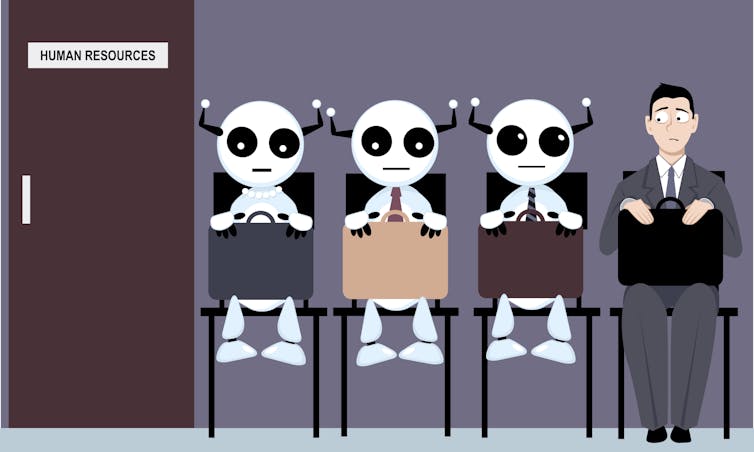
While the industrial strategy has focused on new technology sectors such as robotics, these have also been depicted as threatening to wipe out swathes of jobs over the next ten years. That may be, but we need to recall that the same was said by the Luddites 200 years ago – and many times since.
There are two crucial aspects to why technology will not render us all jobless. First, although new technology replaces some jobs, it creates others. And given that technological innovation usually helps promote economic growth, the outcome has generally been more jobs rather than fewer.

No need to look so worried. shutterstock.com

Second, if the number of jobs – or rather, the total amount of employment – were to decline, this should be a good thing, as the work could be shared out. This would give more time for leisure, with less intensive, stressful work. That has long been the promise, though rarely the reality.

To reduce employment (either the number of jobs, or the amount each of us had to do, if a reduced amount of employment enabled greater leisure time for all) means increasing the amount produced per person (or per person hour). In other words, higher productivity. This is not occurring in Britain. Indeed, over the past ten years the UK has witnessed the exact opposite, with the rate of productivity growth declining rather than increasing. So, don’t plan for your three-day week just yet.

Bitcoin, blockchain and bubbles

Much of the above – stagnant productivity growth, the need for an industrial strategy, even the vote for Brexit – might be laid at the door of the 2007-08 global financial crisis and the subsequent global recession in 2009 – the first time the world’s output and income had fallen since the 1930s.

Another thing to be wary of into 2018 is the fact that the danger of a repeat performance of this crash remains. International governments prevented the global recession slipping into a 1930s-style global depression by boosting government spending. But as soon as the immediate danger had passed the UK government – and several others – reverted to type, imposing austerity policies that held back the already fragile recovery.

So, another shock to the global system could create a further financial crisis and recession. Last time the trigger was home-loan defaults; what might trigger the next one? Defaults on the growing car-loan debts? International conflict and even war? Or perhaps the bursting of the bitcoin bubble?
Blockchain technology will be used increasingly for a range of activities – from the accreditation of global online learning to the creation of cryptocurrencies such as bitcoin, which are basically IOUs in digital form.

So the answer to the question whether the bitcoin bubble will burst, or whether bitcoin becomes mainstream, is “both”. Cryptocurrencies will replace some of what current banking and monetary systems do. But the extent may be limited by concerns over their use for illegal activities, their heavy resource use in an era when we need to be making less use of energy, and their susceptibility to speculative bubbles and crashes, which always carries the threat of more general crises and recessions.

Happy 2018!
Rise of the strongman: Asia’s top 10 newsmakers in 2017


The first year of the Trump presidency couldn’t have gone better for authoritarians across the Asia Pacific. China’s influence in the region and indeed across the world, meanwhile, continued to grow.


An alleged genocide took place against the Rohingya Muslims of Rakhine State, Burma, as more than 650,000 fled into Bangladesh in a few short months. As it lost ground in Syria and Iraq, Islamic State came to the region through an assault on Marawi City in the Philippines.

With democracy on the decline across Asia, individual political personalities more important than ever. Here are those who shaped the news this year.

Image-1
Xi Jinping, President of China

In 2017, Xi Jinping became the most powerful Chinese leader since Mao Zedong though insertion of his own political thought into the Communist Party’s constitution. The Economist has now called Xi the world’s most powerful man. At the helm of the planet’s most populous nation and second largest economy, the president made strides towards his stated aim of restoring China’s historical glory this year. Highlights were aggressive investment across Asia through the Belt and Road initiative, staying in the Paris Agreement on climate change while Trump’s America pulled out, and refusing to back down on territorial claims in the South China Sea. Under Xi’s command, Beijing is tightening its grip over Hong Kong. In charge of “socialism with Chinese characteristics”, the world seems to be Xi’s oyster.

Kim Jong Un, Supreme Leader of North Korea

At least by his standards, 2017 was a successful one for North Korea’s eccentric dictator Kim Jong Un. While his leadership failed to prevent a raft of new sanctions against Pyongyang, Kim was successful in provoking the leader of the free world into an ongoing exchange of personal insults and by November had declared North Korea’s nuclear statehood. As we opined in September, Kim has repeatedly given the metaphorical middle finger to Western diplomacy. For his efforts, Kim was even named TIME magazine’s runner-up Person of the Year.

Donald Trump, President of the United States

Widely considered to have changed the presidency forever, Donald Trump dismantled decades of US diplomacy in Asia during 2017. Retreating from the Obama administration’s “pivot to Asia”, Trump shied away from being too enthusiastic in the promotion of human rights and democracy. Instead, he welcomed a number of Southeast Asian autocrats like Duterte and Prayut to the White House. His support for the Philippines’ drug war has damaged the United States’ image in Asia while relentless Twitter shade directed at Kim Jong Un was ridiculed the world over. Most recently, protests broke out in Muslim nations like Indonesia and Malaysia over his intended decision to declare Jerusalem the capital of Israel. If America’s time in the sun wasn’t already over, Trump has made sure of it.
Shinzo Abe, Prime Minister of Japan

On track to become Japan’s longest serving premier, Abe and his Liberal Democratic Party won a shock election by a landslide after calling it in October. The Prime Minister has sought to overall Japan’s post-war pacifist constitution so as to allow the country to develop a strong military of its own, which he had initially promised would take place in 2020. While that unpopular move has been shelved for now, Abe has nevetheless declared he will “firmly deal” with North Korea, an aim towards which he has buddied up with Trump.

Narendra Modi, Prime Minister of India

A staunch Hindu nationalist of the Bharatiya Janata Party (BJP), the leader of the world’s second largest country by population remains wildly popular. A Pew poll released in November showed that nine in ten Indians hold a “favourable view” of Modi. They are happy with his economic management, but his Hindu nationalist platform has emboldened communal violence aimed primarily at Muslims. More and more Muslim Indians in 2017 fell victim to vigilante mobs for killing cows. In March, Modi selected a radical Hindu accused of inciting violence against Indian Muslims to lead the country’s largest state Uttar Pradesh. This furthered long-held fears that India will ditch its secularism and become a “Hindu Pakistan” – in other words an intolerant, religious state which offers little protection for its diverse minorities. Given Modi has promised to create a “New India” by 2022, the march of hardline Hindu nationalism looks to continue throughout 2018.

Image-2
Aung San Suu Kyi, State Counsellor of Burma (Myanmar)

The de facto leader of Burma emerged as the surprise villain of 2017. “I’m no Mother Teresa” she pronounced in April. Long a hero of democracy and human rights under the country’s brutal military dictatorship, Aung San Suu Kyi disappointed many around the world in 2017 for her failure to speak out on behalf of persecuted Rohingya Muslims and prevent them from falling prey to what some have called ethnic cleansing and even genocide. While Western criticism of Burma has been relentless, Suu Kyi has a friend in the Chinese Communist Party. Arrests of foreign and local journalists with the tacit support of the State Counsellor’s National League for Democracy do not bode well either for Burma’s difficult democratic transition. Suu Kyi may have been stripped of international accolades like the Freedom of Oxford during 2017, but she remains a popular figure amongst a huge portion of Burmese.

Hun Sen, Prime Minister of Cambodia

Almost single-handedly responsible for dismantling Cambodian democracy in 2017, Prime Minister Hun Sen had a ripper year. The Kingdom’s leader for 30 years, Hun Sen attempted to cement another 10 years in power by dissolving the opposition Cambodian National Rescue Party, media outlets including the Cambodia Daily newspaper, and clamping down on NGOs like the US-funded National Democratic Institute ahead of 2018’s election. This crackdown has earnt condemnation from governments and human rights groups from around the world, but Hun Sen isn’t done yet – his government is pondering the introduction of ‘Thai style’ lese majeste laws before next year’s poll.

Rodrigo Duterte, President of the Philippines

Once dubbed the Filipino Trump, Duterte outdid even the American president when it came to ruthless top-down policymaking and outrageous language during 2017. Along with his US counterpart this year he mocked journalists as ‘spies’, bragged he had murdered somebody as a teenager and said cops should kill his own son should he be found to be involved with illegal drugs. During 2017, Duterte dismantled the peace process with communist insurgents by reclassifying them as a terrorist group and introduced martial law in the southern Mindanao, a tactic reminiscent of the country’s former dictator Marcos. While his government stands accused of gross rights violations including the extrajudicial killings of more than 10,000 people amid the drug war since June 2016, he turned heads in November when he offered to host a ‘world summit’ on human rights. As with Suu Kyi though, Duterte has a friend in China who is unperturbed by widespread human rights abuses. In fact along with Hun Sen, the president was in late 2017 even nominated for China’s Confucius Peace Prize.
Prayut Chan-o-cha, Prime Minister of Thailand

Thailand’s military seized power in 2014 for the 12th time since Thailand became a constitutional monarchy in 1932. At the head of its junta is Prayut Chan-o-cha, who insisted this year that he can “do whatever” without being held accountable. The country’s formerly vibrant civil society and political parties have come under the chill of military dictatorship, with rising prosecution of dissenters under draconian cybercrime and lese majeste laws. Having repeatedly promised a return to democracy via a popular vote, it has now been delayed to November 2018. Nevertheless, along with a number of Southeast Asian autocrats, Prayut was in 2017 invited to Trump’s White House. With the government pursuing former popularly-elected PMs Yingluck Shinawatra and her brother Thaksin, Thailand’s democratic future remains uncertain.

Basuki “Ahok” Tjahaja Purnama, former Governor of Jakarta

Jailed in May under Indonesia’s strict blasphemy laws for allegedly insulting Islam, Ahok may not be a strongman but rather represents a victim of the ugly identity politics which affected many societies around the world in 2017. After replacing now-president Joko Widodo as governor in 2014, Christian, ethnically Chinese Ahok enjoyed strong support but drew the ire of Islamic fundamentalists. Perhaps more importantly – he made enemies with his no-nonsense style of leadership and anti-corruption drive. Fears have grown for Indonesia’s historical religious tolerance amid rising fundamentalism – of which Ahok is seen to be the most high-profile victim to date. As the world’s third largest democracy, his case is emblematic of the perilous nature of democratic values and human rights as we move into 2018.