Peace for the World

Peace for the World
First democratic leader of Justice the Godfather of the Sri Lankan Tamil Struggle: Honourable Samuel James Veluppillai Chelvanayakam

Thursday, June 28, 2012


 I killed Chandi Malli at MaRa’s behest – Amare disgorges confidential information

(Lanka-e-News-27.June.2012, 11.55 PM) Geegana Gamage Amarasena alias Julampitiya Amare the deadliest of criminals and hired assassin of the Rajapakse regime who is now in remand prison is disgorging confidential information from time to time , according to reports reaching Lanka e news .

The most important of these is his murdering of one individual, Chandi Malli. Amare who is in a most disillusioned depressed state had while speaking about his exploits revealed the murders he had committed. When referring to the murder of chandi malli , a one time IRC , Amare has told with pride that he was responsible for that murder. Chandi Malli was a murderer who enjoyed MaRa ‘s patronage. He was a PC member and a bosom pal of MaRa.

When Chandi Malli was returning after signing at the CID based on a court order , he was shot and killed by an unidentified assassin in the vicinity of the CID. That was an era when the LTTE was most powerful , and this killing was blamed on the LTTE. MaRa visited the scene of murder of Chandi Malli apparently grief stricken. Yet , it is reported that he felt relieved because a witness who can go against him has been liquidated .( It is a common practice of his to kill all those who had been very close to him who know of his secrets) 

Among the disclosures of Amare is : Chandi Malli was killed by him and his supporters, and for this orders, facilities and security were given by Regime chief. Immediately after the murder he had gone straight to a house of MaRa at that time near the SLBC, Amare had stated .

What is surprising and intriguing is , the son of Chandi Malli who was killed through Amare is at the moment with the Rajapakse regime. He had now been made the Chairman of a local body . He is also now one of the murderers for MaRa’s son NaRa and is performing his murder duties towards the Medamulana Walauwa.
He is an indispensable notorious pal of NaRa. Hence it is an irony that Amare who murdered the father Chandi Malli is a closest pal of the latter’s son. Certainly therefore, the mental conditions of NaRa, Chandi Malli’s son and Amare merit psychiatric examinations.

Lanka e news is in possession of more information disgorged by Amare . Even what are being told by those who say ‘Amare in jail’ and therefore can speak , are with us . Lanka e news will soon reveal all these details to our valuable viewers of the site.
DIG Sumith Edirisinghe forgets his past
Thursday, 28 June 2012

DIG Sumith Edirisnghe in-charge of the Nugegoda Division had arbitrarily entered into a land belonging to former parliamentarian Nimal R. Peiris on Hokandara Road, Thalawatugoda and broken down the buildings on the land, Lanka News Web learns. Peirs’ land extends up to one ace and 29 perches.
DIG Sumith Edirisinghe has acted in this arbitrary manner on a directive issued by Defence Secretary Gotabhaya Rajapaksa who is in-charge of the Urban Development Authority (UDA).
Officials from the UDA together with police and army personnel have entered former Colombo District parliamentarian Nimal R. Peiris’ land and demolished the buildings on the land claiming they were unauthorized structures since the land was located on an illegally filled stretch of land.
It is DIG Sumith Edirisinnghe who had ordered the police and army personnel who had arrived at the land to break down the buildings on the land. Peiris had been angered by the actions and had argued with the DIG.
The DIG had shouted at the police personnel saying, “Catch this fellow by his legs and put him in the jeep.”
“Ok, try and do that you ungrateful scoundrel,” Peiris had shouted back and the DIG had slowly moved away.
Former parliamentarian Peiris, relating the story over the telephone to Lanka News Web said that the land had been in his family for the past 75 years and that it was gifted to him by his father. He added that the funeral pyre of his father who passed away about 20 years ago was also made in the respective land.
Peiris further told Lanka News Web that DIG Sumith Edirisinghe had got caught in a land mine explosion on Aturugiriya Road, Hokandara during the JVP terror period in 1988-89and that he had a narrow escape. Afterwards, he had killed 37 young men and women in the Malabe, Aturugiriya and Thalawatugoda areas and buried them in the crate created by the landmine explosion.
When Chandrika Banadaranaike Kumaratunge assumed office in 1994, this mass grave had been dug in 1995 and Edirisinghe at the time had been serving as an ASP. Magistrate Champa Buddhipala serving as the magistrate of Court No. 4 in Colombo had issued open warrants on Edirisinghe and then OIC of the Aturugiriya Police, Anton Siri Kumara.
The former MP said that Edirisinghe had then met him and begged to save him. Edirisinghe had then been provided refuge at Peiris’ residence for a few days.
Edirisinghe had later surrendered to court and had got himself released on bail.
Peiris observed that Edirisinghe had then been found a job as a service station assistant at a station owned by one Anuradha in a state in the US. He had later managed to regain his job at the police through then head of Kumaratunge’s security division, DIG Nihal Karunaratne.
Peiris finally said that DIG Edirisnghe has today forgotten the past.


Two Dimensions Of The National Question
June 28, 2012 
Dr. Laksiri Fernando
Colombo TelegraphThere have been two clearly discernible dimensions to the ‘national question’ in Sri Lanka in modern times. By modern times, I mean the period beginning with colonialism particularly under the British (1815) and the awakening of various ethnic communities into national consciousness under capitalism or print capitalism.
The first dimension of the national question signified or still signifies the independence from colonialism and after independence (1948), the freedom from post-colonialism or what is perceived as imperialism or outside interference, primarily from the Western hemisphere. This can be termed as the external dimension of the national question. The ‘independence,’ ‘sovereignty’ and ‘territorial integrity’ have been the main demands or slogans of this dimension of the national question while it also could invoke the ‘overall right of self-determination’ of the country. At times, India has also come into this equation as a challenge or a threatening power.
The second dimension of the national question has been the much vexed problem in the country for the last three decades or even before and the failure to resolve this problem peacefully has been the reason for the war, death and destruction. The second dimension of the national question means the ‘Tamil national question’ or the national question of the minorities particularly of the Tamils and the Muslims. This is the internal dimension of the national question. As ethnic nations or national groups in society, they rightfully aspire for national equality in many spheres and denial of them has led, on the part of the Tamils, to demand ‘autonomy,’ ‘federalism’ (internal self-determination) and ‘separation’ (external self-determination). The ‘self-determination’ has been their main slogan or demand in various forms.
In contrast to the peaceful resolution of the first or the external dimension of the national question or independence, the abysmal failure on the part of the political leaders to resolve the internal dimension or the second dimension of the national question is very much conspicuous. This article attempts to highlight the inverse relationship between these two dimensions of the national question with a brief outline of their origins and argues that a creative or a rational balance between the two might be the solution for the country’s present deadlock on reconciliation and other issues.
Realty and Exaggeration      Read More
Web censorship reaches new level: Five Tamil language web sites blocked
June 28th, 2012

NfR Sri Lanka, a network of Sri Lankan journalists and human rights defenders condemns the blocking of five tamil language news websites which report on Sri Lanka . In a situation where print and electronic media is under severe self censorship, internet based media plays a critical role in providing information on Sri Lanka .
 NfR sources in Sri Lanka have confirmed that five websites, namely
http://www.tamilwin.comhttp://www.athirvu.com,http://www.saritham.com
http://www.ponguthamil.comhttp://www.pathivu.com are not accessible through any of the Sri Lankan internet service providers. People in Sri Lanka can now visit those sites only trough proxy servers.
 NfR believes that open discussion and freedom of information on issues that affect citizens is pivotal in the democratisation of post war Sri Lanka . NfR views this unhealthy development as a continuation of media censorship imposed by the Government of Sri Lanka (GoSL). Although the GoSL has been accusing internet based media for unethical reporting the very same GoSL controlled media is well known for publishing politically motivated cooked up stories and many media monitoring reports has shown that state controlled media is the heavily biased in covering politically important issues.
 In that context NfR views this ban as yet another politically motivated anti-democratic step towards creating a mind controlled society in Sri Lanka .
 TamilNet, a popular news and opinion site on Tamil issues was the first site blocked by the GoSL. On June 19, 2007, on the orders of the GoSL allInternet Service Providers in Sri Lanka blocked the access to the TamilNet website. Since then GoSL has blocked dozens of news and opinion web sites reporting on Sri Lanka . Today major Sinhala language news and opinion websites operating from outside Sri Lanka , such ashttp://lankaenews.comhttp://www.lankanewsweb.comhttp://www.srilankaguardian.org/ remain blocked.
  In November 2011 the GoSL proclaimed that any website dealing with Sri Lankan affairs must register with the government or face legal action. At the same time number of websites was blocked by the GoSL. In May 2012 Supreme Court rejected the fundamental rights case filed against blocking of websites by press freedom watch dog, the Free Media Movement of Sri Lanka saying that there no basis to grant leave to proceed.
 NfR calls on all media and democratic organizations to take note of this continuing media censorship in Sri Lanka and support and strengthen alternative Sri Lankan media, in defense of basic democratic rights of all people in Sri Lanka . At the same time NfR calls on internet based media in Sri Lanka to be ethical, balanced and fair in their reporting.

Written by 

Basil gets contract to convert Rupavahini systems to digital
Thursday, 28 June 2012

Arrangements have now been made to convert all broadcasting of Sri Lanka Rupavahini Corporation (SLRC) into digital technology and Economic Development Minister Basil Rajapaksa is making an effort to secure this millions worth project.
The intellectual committee appointed to study the project and make proposals has said that BVBT 2 technology has to be used for this purpose. The committee has made the proposal saying it would practical since it is a technology used in other Asian countries and even in European countries. The relevant Cabinet memorandum had received the approval from the Cabinet of Ministers. Project proposals have now been called to select a company to carry out the project.
However, a special Japanese representative who has visited Sri Lanka on an invitation by Minister Basil Rajapaksa has asked that the project be handed over to his country. He has explained that it would only be fair to give the project to convert the SLRC system into digital to his country since it was Japan that initially built the Rupavahini.
A senior official from the SLRC said that the technology used in Japan is used only in Japan and North America and that many countries have discarded the technology claiming it is outdated. All countries have taken into the new BVBT 2 technology.
He added that if the Japanese technology is introduced to SLRC due to foreign pressure, the company would eventually have to face massive technical and financial issues in future.
However, the SLRC management and the Media Minister are now in a difficult spot since Minister Basil Rajapaksa is continuously insisting that the project to make the SLRC digital be handed over to the Japanese.
The local agent for the Japanese official, who was invited to the country by Basil, is well known businessman Sumal Perera’s Access Company. The millions of rupees given to Access through various projects by Basil have been invested in several projects carried out by Access.
It was Basil Rajapaksa who got China Harbor that constructed the Hambantota Port to Sri Lanka. Access was also the local agent for China Harbor.
China Harbor has been given many large scale development projects under Minister Basil Rajapaksa.

Three Years After Civil War Tamils In Sri Lanka Remain Isolated And Stigmatized


International Business Times
By PALASH R. GHOSH:    June 28, 2012 
Two boys walk past local government election campaign posters in Jaffna(Photo: Reuters)


Three years after a civil war between the Sri Lankan government and Tamil separatists, tens of thousands of Tamils in the country lack national identity cards (NIC), making it difficult for them to access public services and subjects them to police and army harassment.

In Sri Lanka, all citizens aged 16 or above are required to carry an NIC -- however, in 2009 during the final days of the deadly conflict between the Sri Lankan armed forces and the rebel Liberation Tigers of Tamil Eelam (LTTE), many Tamils were displaced from their homes by the fighting and lost everything, including their identity papers.
BBC reported that more than 100,000 Tamils, who tend to concentrate in the northern region of the island nation, have either lost or damaged their identity cards. Moreover, in areas that were controlled by the LTTE during the civil war, such identity cards became meaningless as the Tamil rebels were seeking to form an independent nation anyway.


BBCSri Lanka's Tamils face identity crisis

The National Identity Card was introduced in Sri Lanka in 1972

Sri Lankan National Identity Card

27 June 2012
Without a national identity card, many Tamils in Sri Lanka cannot avail of basic services and it makes them suspect in the eyes of the police, writes Ponniah Manikavasagam of the BBC's Tamil service.
In a remote and dusty part of Kilinochchi district in the Tamil-dominated northern Sri Lanka, people gather around a group of officials working with an election monitoring service called the People's Action for Free and Fair Elections (Paffrel).
Sitting in the shade, out of the fierce mid-day heat, officials from Paffrel, along with various government and non-governmental organisations, discuss with local people the status of their National Identity Cards (NIC), a document which is a legal requirement for all citizens of 16 years or over.
Sri Lankan Tamils meet officials for their identity cardsTens of thousands of people were displaced in 2009 in the final chapter of the long conflict between the rebel Liberation Tigers of Tamil Eelam (LTTE) and the Sri Lankan military.
Tens of thousands of Tamils do not have an identity card      Full Story>>>
Hudson in hospital after Eliyantha White’s treatment
Thursday, 28 June 2012

Chairman of Sri Lanka Broadcasting Corporation (SLBC), Hudson Samarasinghe has been hospitalized recently after being treated by Presidential physician, Eliyantha White. After receiving White’s treatment, Samarasinghe has suffered from internal bleeding and the President had directed that he be immediately admitted to the Apollo Hospital.
Samarasinghe had recovered after being treated a few days in the ICU, but he reportedly suffers from a poor memory. He has told people who had visited him in hospital never to receive any treatment from White and that he provided some intoxicating powder drug as treatment. Samarasinghe has added that he had a narrow shave with death.
Although Chief Government Whip Minister Dinesh Gunawardena said in parliament a few months back that Eliyantha White was not the President’s personal physician, has been assigned security personnel from the Ministerial Security Division (MSD).
The Silumina newspaper has recently reported that Eliyantha White is a medical advisor to the President. When a minister had questioned the editor of the newspaper about White being the President’s physician, the editor had responded saying the report that was published was sent by the President’s photographer, Sudath Silva.
'We even need permission to bury our dead': Sri Lanka's war legacy lingers
      guardian.co.uk
The GuardianPost-civil war Sri Lanka may be on an upward economic curve but, for Tamils in the north, military control remains a way of life
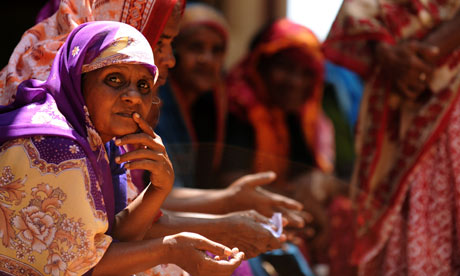
Tamil women in Mullaitivu, north-east Sri Lanka. Locals say the wait for justice and reconciliation continues. Photograph: Ishara S Kodikara/AFP/Getty Images
MDG : Sri Lanka Tamil women look on in the northeastern town of Mullaittivu
Three years after its civil war, Sri Lanka has emerged as a middle-income country on course to meet most of the millennium development goals. GDP rose by around 8% during 2011 and tourism is set to bring in more than $1bn this year. Yet this national success story obscures the tale of an unsettled north that remains under military control.
The northern Tamil districts of Jaffna, Kilinochchi, Mullaitivu, Mannar and Vavuniya lost three decades to conflict, which ended in the defeat of the Liberation Tigers of Tamil Eelam (LTTE) by government forces in May 2009. Although open warfare has ceased, and despite major government investment in the reconstruction of the region, Tamils say they are still waiting for justice and reconciliation.
Jutting out at the island's most northern tip, the Jaffna peninsula was largely cut off from the rest of Sri Lanka until 2009. Today, Jaffna still seems in a daze. Plants grow up through bullet holes and weeds have crept into gutted homes without roofs or residents.
With one soldier for every 10 civilians, life on the peninsula does not yet bear the hallmarks of peace. Tensions run high as the Sri Lankan army maintains tight control over the region through checkpoints and military bases. Following a meeting with Hillary Clinton in Washington, the external affairs ministry secretary Karunatilaka Amunugama, criticised international pressure to reduce the military presence. "Sri Lanka does not go to other countries and call on those countries to remove their troops from one place to another," he said. "It is simply not done because it is an internal matter."
Speaking on the third anniversary of the end of the civil war, President Mahinda Rajapaksa used his annual victory speech to defend the proliferation of military camps in the north and east against what he characterised as a backdrop of strong pro-LTTE activity in the diaspora.
In Jaffna, the animosity is palpable. "The military [are] supposed to have no administrative duties here," said Anpu, 22, a student who did not give his surname. "But they interfere every day; we even need their permission to bury our dead." Accusations of political abductions and the harassment of civilians continue. The destruction of symbolic Tamil sites – including a Jaffna graveyard containing the bodies of 2,000 LTTE fighters, which was bulldozed to make way for an army base in 2010 – has further strained the social fabric.
But despite the friction, the north is slowly reopening for business. The potholed road from the south, which was badly damaged during the war and closed to public vehicles until 2009, is undergoing improvements. It is still controlled by a gauntlet of military outposts and flanked by de-mining teams, but trade has started to benefit from a relaxation of permit restrictions.
According to the government, 98% of those displaced during the war have been resettled in "an environment of confidence and satisfaction". Although this statement overlooks issues with land rights and lagging mine clearance, it is clear that effort has been put into ensuring a support system for returnees.
Government funding has kickstarted much-needed modernisation of damaged and dilapidated water and sanitation systems in the north. In 2010, a report by the Asian Development Bank (ADB) said less than 0.5% of residents in the Jaffna peninsula had access to piped water, compared with a country average of more than 32%. With a $164m cash injection from the ADB, L'Agence Française de Développement and the Sri Lankan government, that is set to change.
But a recent report by the Centre for Policy Alternatives said: "While the government has repeatedly expressed interest in developing a framework for reconciliation, there are also concerns that the government is opting for a postwar model of economic development to consolidate peace rather than substantively address issues of democracy, a political solution, human rights and accountability."
"A lot of people feel that if you address the economic issues the rest will fall into place," says Priyanthi Fernando, executive director of the Colombo-based Centre for Poverty Analysis. "But it needs to be a mix of practical solutions to immediate problems and being able to go behind those practicalities to understand the root of the conflict."
Export-oriented, the next chapter in Sri Lanka's economy will rely heavily on foreign support. The UN Human Rights Council resolution adopted in March has stepped up pressure on the Sri Lankan government to investigate allegations of war crimes by troops in the final months of the war and act on the conclusions of the commission of inquiry on lessons learnt and reconcillation. Among those recommendations is the suggestion: "The military presence must progressively recede to the background to enable the people to return to normal civilian life and enjoy the benefits of peace."
"This infrastructure will not be accepted as a trade-off for our rights," says Anpu. "And it will not overwrite the need for the justice for our dead."

‘Sri Lankan Navy should stop harassing fishermen’

Return to frontpageCHENNAI, June 28, 2012 

Tamil Nadu Chief Minister Jayalalithaa writes to Prime Minister Manmohan Singh on the plight of Indian fishermen "traditionally fishing" in contentious Katchatheevu.
Observing that Indian fishermen hailing from Tamil Nadu have been “traditionally fishing” in contentious Katchatheevu, Chief Minister Jayalalithaa on Thursday urged Prime Minister Manmohan Singh to ask Colombo to stop its navy from harassing them.
Referring to the latest incident, she said fishermen in 45 boats fishing near Katchatheevu on June 26 were harassed by Sri Lankan Navy personnel.
They reportedly chased the fishermen away after cutting the ropes and damaging nets of 10 boats, resulting in a huge loss to the fishermen, she said in a letter to Dr. Singh.
“You are aware that I have brought to your kind attention the various incidents of attack on Indian fishermen from Tamil Nadu by the Sri Lankan Navy/miscreants within the past 12 months and sought your intervention,” she said.
This latest incident of harassment has shocked the state of Tamil Nadu and created a “psychological fear” in the minds of the fishermen, she said.
“I wish to reiterate that from time immemorial fishermen of Tamil Nadu have been traditionally fishing in the waters near Katchatheevu, notwithstanding any geographical or political boundaries,” she said.
The Chief Minister requested Singh to take up the issue with Sri Lanka and impress upon them the need to instruct their Navy to exercise restraint and refrain from harassing “innocent” Indian fishermen pursuing their livelihood in their traditional waters, she said.
Katchatheevu, an islet on the Palk Straits, was ceded to Sri Lanka by India in 1974.
Sri Lanka has been objecting to Tamil Nadu fishermen fishing in that area.


Population plunge in Sri Lanka’s Tamil base


2012-06-27
COLOMBO - Sri Lanka's first national census in 30 years has shown a dramatic 20 percent drop in the population of the Jaffna peninsula, the long-time base of Tamil rebels during the island's ethnic conflict.
According to a preliminary census report released Wednesday, the population in Jaffna, which the rebels once ran as a de facto separate state in the northeast, had fallen from 734,000 in 1981 to 583,000.
Work on the census began last year.
The report offered no analysis, but a Tamil legislator in the national parliament said it reflected an exodus during the fighting between Tamil rebels and government forces from 1972 to 2011 that claimed an estimated 100,000 lives.
"Our estimate is that out of the one million Tamils who fled the fighting and are living abroad, at least 80 percent were from Jaffna," said Suresh Premachandran.
"If not for the war, the population in Jaffna would have been over 1.4 million," he added.
One likely consequence of the new census figures will be a reduction in ethnic Tamil minority representation in the national parliament, which is dominated by members of the Sinhalese majority.
Seats in the 225-member parliament are allocated on the basis of a region's population. Nine seats are currently allocated for Jaffna, but Premachandran said that would now drop to six.
The census put the national population at 20.27 million, about 600,000 down on estimates based on a sample survey carried out in 2001.
Sri Lanka's ethnic conflict ended in May 2009, with the final defeat of the Liberation Tigers of Tamil Eelam (LTTE) by government forces.
NOWWOW, the new kid on the block
Logo
New Opportunities for Wounded, Widowed and Orphans of War – that’s the groundbreaking new charity out there!
Anyone who had been glancing through the many pages of web-based news media for the latest developments on the home front couldn’t have missed out on the poignant story presented in reporting and pictures of a group of poor kids of Kilinochchi proudly posing with their new bikes presented to them by the Member of Parliament Mr. Sivagnanam Shritharan, thanks to the initiative of a North American Charity called New Opportunities for Wounded, Widowed and Orphans of War (NOWWOW). The students who live far away from their schools will now have an impetus not to miss out on the classes. NOWWOW feels that it has made use of an excellent opportunity to ensure that the hopes and dreams for the future of Vanni don’t falter due to negligence. NOWWOW is the new kid on the block, but it is determined to cater to the livelihood of one widow at a time, the future prospects of one student at a time, the care and parenting support for one orphan at a time and medical help for one disabled at a time.    full story |

SOS of Eezham Tamils seeks global Tamils, world humanity to respond

TamilNet[TamilNet, Wednesday, 27 June 2012, 19:20 GMT]
Mu’l’livaaykkaal was only a beginning for the Sinhala State and its international abetters to perpetuate genocide of Eezham Tamils to suit overlapping agendas. After three years of Colombo’s accelerated structural genocide facilitated by the international community of establishments, the Tamil leaders in the island have once again voiced an SOS in unison on Tuesday, appealing to global Tamils and global community of humanity, to intervene and save their nation from militarised annihilation. Gagged, but experiencing the realities of the hoodwink of ‘post-war reconciliation,’ the voices coming from the island show better clarity and bearing, compared to the hijacked diaspora confused over where to address the issue and a Tamil Nadu leadership silent after a resolution that doesn’t address fundamental solutions, political observers in the island said. 

Thirumu'rika'ndi

Leaders and representatives of different political parties, TNA, TNPF, TULF, DPF and Sinhala representatives of USP and NSSP along with affected Tamil civilians staged a demonstration at Thirumu'rika'ndi in Vanni on Tuesday against land grab and militarised annihilation of the nation of Eezham Tamils. 

While on one hand the agent State in Colombo is engaged in genocidal land grab, its international abettors on the other, aim for large scale land grab in the island. In the process, they facilitate each other. 

What is now voiced in the island is in sharp contrast to what the parliamentarians of New Delhi, section of Chennai based media, former peace facilitators and international crisis managers at the behest of the US Establishment try to hoodwink the world public opinion and try to blunt the struggling spirit of the diaspora, the political observers in the island said. 

Extracts of the speeches made by the leaders of the demonstration along with their voice recordings, are given here for the diaspora, Tamils in Tamil Nadu and the global community of humanity to grasp what is happening in the island and to plan out an appropriate global strategy to meet the situation:
Selvarajah Kajendren (TNPF):
Selvarajah Kajendren at Thirumu'rika'ndi on 26 June 2012 by TamilNet

Protest at Thirumu'rika'ndi
Mano Ganesan (DPF):
ano Ganesan at Thirumu'rika'ndi on 26 June 2012 by TamilNet

S. Sritharan (ITAK, TNA):


Mavai Senathiraja (ITAK, TNA):
ritharan and Mavai Senathirajah at Thirumu'rika'ndi by TamilNet

Suresh Premachandran (EPRLF, TNA): 
Suresh Premachandran at Thirumu'rika'ndi on 26 June 2012 by TamilNet


Protest at Thirumu'rika'ndi
M.K. Sivajilingam (TELO, TNA):


MK Sivajilingam at Thirumu'rika'ndi 26 June 2012 by TamilNet

 Full story >>

Wednesday, June 27, 2012


BBCQueen and Martin McGuinness shake hands

27 June 2012
The Queen shook hands with former IRA commander Martin McGuinness.

Video


The final day of the Queen's two-day visit to Northern Ireland was marked by an historic handshake and a huge party.
The Queen and Duke of Edinburgh were driven through the grounds of StormontHer Majesty and former IRA commander Martin McGuinness shook hands for the first time.
The meeting between the monarch and Northern Ireland's deputy first minister took place at a charity event in Belfast on Wednesday morning.
In the afternoon she attended a Diamond Jubilee party attended by 20,000 in Stormont.
The Queen and Mr McGuinness shook hands at a private meeting and later shook hands in public.

Refugees for 20 Years, Tamil Catholic Families Forced to Live in the Jungle

http://www.salem-news.com/graphics/snheader.jpg


Refugees in Sri Lanka
Refugees in Sri Lanka, courtesy: asianews.it