Peace for the World

Peace for the World
First democratic leader of Justice the Godfather of the Sri Lankan Tamil Struggle: Honourable Samuel James Veluppillai Chelvanayakam

Monday, January 30, 2012

The Nightmare in the Congo-It is an understatement to say that everyone wants a piece of this place.

http://www.salem-news.com/graphics/snheader.jpgJan-24-2012

Congolese
Congolese face a bitter life of disparity.

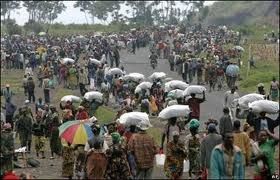
(WASHINGTON D.C.) - Imagine the entire state population of Arizona murdered in an 11-year period by neighboring rebel groups, all six million people. The women of Phoenix, Flagstaff, Camp Verde and other cities brutally raped while their children and husbands are forced to watch.
After this horrific act of war, the husbands are shot, dismembered and the women left bleeding and ruined in their communities. For the men who do survive, they are unable to look at their wives for the shame they suffered by not being able to protect them from the atrocities that occurred.
Imagine the children who were forced to watch their mothers being violently raped and their fathers murdered only to meet the same fate at their tender ages. For those children who were not killed knew they would be taken as child soldiers and “bush wives” to the rebels.

Read Full Article

-------------------------------------------------------------------

Sri Lanka's Killing Fields - Channel 4 UK Documentory


Jon Snow presents a forensic investigation into the final weeks of the quarter-century-long civil war between the government of Sri Lanka and the secessionist rebels, the Tamil Tigers. With disturbing and distressing descriptions and film of executions, atrocities and the shelling of civilians the programme features devastating new video evidence of war crimes - some of the most horrific footage Channel 4 has ever broadcast.


read more...

GR rejects testimony attributed to unnamed Gen. Reveals US attempt to bribe serving officer

January 30, 2012,
article_image
by Shamindra Ferdinando
Defence Secretary Gotabhaya Rajapaksa yesterday said that none of the Majors General directly involved in eelam war IV had made a testimony to any US lawyer, in New York in 2010, alleging extrajudicial killings of civilians, surrendering LTTE cadres and dissident journalists during eelam war IV.
“Those directly involved in the campaign are still in service. They’ll never betray the country for personal benefit,”
Defence Secretary Rajapaksa told The Island.
He was responding to a report by Emmanuel Stoakes posted on www.truth-out.org on Sunday (Jan.29).
The Defence Secretary said that the government expected more anti-Sri Lanka propaganda in the run-up to UN Human Rights Council sessions in Geneva late Feb-March 2012.
Citing testimony of a former General, recorded in an affidavit, the report captioned ‘Sri Lankan General admits war crimes; US may hold crucial supporting evidence’, claimed that the military officer had backed war crimes allegations made by human rights watchdogs. Claiming that the officer had been extremely well-placed to comment on military activity during the war as he held high-level security clearance and access to the flow of orders during the final days of the conflict, the website declined to name the officer for reasons of safety.
Asked whether any senior officers had been punished since the conclusion of the conflict, Rajapaksa said that several had been removed on disciplinary grounds, though none of them were directly involved in the campaign.
Anyone claiming to have access to secret directives, which led to alleged extrajudicial killings, may have operated outside normal chain of command, thereby being responsible for their actions, the official said.
The Defence Secretary likened the decision to conceal the identity of the person who had made the testimony to a US lawyer to that of the UNSG Ban Ki-moon’s Panel of Experts (PoE) recommendation to an unprecedented 20-year embargo on both written and oral material in its hands pertaining to alleged war crimes committed by GoSL troops.
The Defence Secretary said the bottom line was that a section of the international community was making an attempt to build a case against Sri Lanka on the basis of unsubstantiated allegations made by anonymous men. He stressed that no country could be penalised on the basis of accusations made by faceless men.
The Defence Secretary recalled how the US Embassy in Colombo had made an abortive bid to bribe one-time media spokesman Maj. Gen. Prasad Samarasinghe to make allegations against Sri Lanka. The diplomat, who had made the move after the conclusion of the conflict in May 2009 offered to accommodate Maj. Gen. Samarasinghe and his family in the US. Had they possessed indisputable evidence against Sri Lanka, the US Embassy here wouldn’t have tried to use a serving officer to support their sordid operation, the Defence Secretary asserted.
The Defence Secretary said that the ongoing efforts to bring to the fore a so-called affidavit should be examined in the context of an attempt to employ a serving officer against Sri Lanka.
Rajapaksa said that those accusing the Sri Lankan military of executing LTTE cadres during the final phase of the conflict had conveniently forgotten that of nearly 12,000 personnel in custody over 11,000 had been reunited with their families following rehabilitation. As the International Organisation for Migration (IOM) had access to detainees, had there been executions, it would have come out, he said, adding that the ICRC, too, was allowed to evict those wounded on the Vanni east front.
The Defence Secretary said that unlike allegations made against Sri Lanka by anonymous persons, www.truth-out.org posted an article captioned ‘Afghan judges accuse US of war crimes’ as an article related to the piece on Sri Lanka.
The writer, David Swanson, quoted a judge visiting the US to learn legal and political system as having said, “The United States tells other countries how to be democratic and operate within a rule of law, but the United States as role model breaks every one of those things.”
A second judge was quoted as having said, “US Constitution speaks of freedom and a people’s government but the United States is running secret prisons, torturing, disappearing people, and locking people up for years with no due process.” The behaviour of the United States, she said, violates everything that she and her colleagues were being taught that the United States stands for. “It may seem trivial,” she continued, “but it affects our daily lives.” If a member of the international occupying forces gets into a hit and run with their car, and you go to the base to complain, you are threatened. They have total immunity from any rule of law, she explained.


An action plan for Sri Lanka

Return to frontpage

A. P. J. ABDUL KALAM        January 31, 2012
The outline of a sustainable development system to empower villagers.
The process of evolution of human beings has been greatly accelerated by the application of science and technology in several fields. With the expansion of ideas, the geopolitical situation changed and many new independent nations were born in the era of the Second World War. Most of the nations had a great civilisational heritage, but suffered under colonial rule for centuries. After the end of colonial rule, independent nations formed governments of their own, often propelled by democratic aspirations. The process continues, and the 21st century is going to see an evolved world. We are all destined to realise happiness, dignity of life, freedom and creativity — but only if nations become noble.
How do we define a nation's nobility? It is not merely in terms of economic indicators, human development indicators, or any other form of numerical indicators. It is more of a qualitative than a quantitative measure. Naturally, a noble nation has to be populated by people who are noble — not just at the individual level but in a collective sense as well. And nobility has to begin from the top, from the leader, and percolate to various levels of society, down to the artisans and peasants.
Do we have a good example? Is there an ideal description of such nobility?

Tamils await their peace dividend

The Globe and Mail                                        Published 

For Tamils, the end of Sri Lanka’s civil war has brought no peace dividend; for Tamil women, peace has brought with it a continuation – and in some cases an intensification – of violence and insecurity. In the country’s predominantly Tamil-speaking north and east – a region half the size of Nova Scotia – tens of thousands of “war widows” have been living under the control of the central government and Sinhalese security forces since 2009 and the end of the civil war, whose last few months saw as many as 40,000 civilians killed.

MORE RELATED TO THIS STORY

To date, the government’s response has been to deny the existence of threats to women’s security – past or present. Sri Lanka’s ambassador to the U.S. recently claimed that there is “no discrimination for women in Sri Lanka” and reduced the existence of rapes to a “couple of cases,” while a military spokesman said there was no “insecurity issue” for women in the north and east. This would come as a surprise not only to the women and girls from that region who have been victimized over the last three years, but also to women across Sri Lanka who have seen increasing gender disparities in income and higher education, as well as many recent cases of murder, rape and sexual harassment in the south by current and former security force members.There has been an alarming increase in gender-based violence, including domestic violence, within the Tamil community, as well as forced prostitution and trafficking. All of this is against a backdrop of credible evidence of wartime sexual violence by government forces, including video footage showing soldiers making sexual comments while handling dead, naked bodies of female suspected Tamil Tiger fighters, some with their hands bound. At the UN Human Rights Council session opening late next month, there is a chance to finally ensure accountability and to address the current state of insecurity; Sri Lanka and the international community, including Canada, should take it.
These government denials should also be a red flag to anyone wanting to believe that Sri Lanka’s Lessons Learnt and Reconciliation Commission – whose long-awaited report to President Percy Mahendra Rajapaksa was made public in December – represents a change in the regime’s approach to accountability and reconciliation. The government has already shown no compunction in ignoring the LLRC’s finding that women in the north and east “feel unsafe in the presence of the armed forces,” and, given past performance, there is every likelihood it will disregard the LLRC’s sensible recommendations on governance, land issues and a political solution.
Indeed, any positive outcomes that could flow from the LLRC report will likely remain theoretical, given that the report failed to provide a thorough and independent investigation of alleged violations of international humanitarian and human rights law in the final stages of the war, as demanded by the UN and others, including Canada. From the beginning, the government hamstrung the LLRC by giving it a feeble mandate, choosing pro-government commissioners with clear conflicts of interest, and failing to provide any witness protection.
The LLRC’s report accepts at face value the largely unexamined claims of senior government and military officials who planned and executed the war, fails to adequately address the many credible allegations detailed in last April’s report of the UN Secretary-General’s panel of experts on accountability in Sri Lanka, and rolls back well-established principles of international law. In the end, the LLRC works to exonerate the government and, in so doing, undermines its own limited calls for further inquiry, including a call for yet another government investigation of the above-mentioned video footage, which officials repeatedly have described as “faked.”
There is, however, an opportunity to address Sri Lanka’s entrenched culture of denial and impunity – including for crimes against women – at the upcoming session at the UN Human Rights Council. Canada has already played an important role in recent months by reminding the world about the need for accountability and justice in Sri Lanka. Now is the time to put their principles into action in Geneva. Canada should take a firm stand at the HRC and work closely with the United States, Britain, other members of the European Union and, critically, African and Asian states – especially India – to make sure this marks the beginning and not the end of a real accountability process.
At a minimum, there should be a formal dialogue at the council to discuss both the LLRC and UN reports, to ensure that the full range of credible allegations of war crimes, and the deficiencies in domestic accountability processes, are addressed openly and in detail. It is essential that the council remain seized of this matter and mandate a high office – such as the UN High Commissioner for Human Rights – to monitor and assess the Sri Lankan government’s implementation of the LLRC’s recommendations and any further accountability efforts. Finally, Canada and other HRC members should be prepared at this June’s session to endorse an international inquiry, absent a truly credible domestic accountability process – an all but inevitable result.
As the international community seeks, laudably, to recommit itself to the protection of civilians in armed conflict, it needs to reflect seriously on what happened in Sri Lanka: arguably one of its greatest single failures to provide even a modicum of safety to hundreds of thousands innocent victims of war. If the opportunity is again missed to provide some form of accounting, the sustainable peace that all Sri Lankans deserve after so many decades of civil war and political violence will be only further out of reach.


Bashing Sri Lanka’s Peace

- Pro LTTE Diaspora do not give up using foreign media to bash Sri Lanka.

Response to an article appearing in the Washington Post of January 12, 2012 in the Style Section pages C1 and C4 titled “Unpeaceful Coexistence”with a reference to Sri Lanka among other countries. The link to the original article appears below.

by A Sri Lankan American in the Washington

File Photo
( January 30, Washington DC, Sri Lanka Guardian) This response is being submitted to the Washington Post one of the largest newspapers in the nation’s capital. However, Washington Post and particularly the journalist Emily Wax has a history of relying only on one side with flawed information about Sri Lanka as narrated by the supporters of the Liberation Tigers of Tamil Elam (LTTE) a proscribed organization in the USA and 32 countries throughout the world. The word of a group on the side of terrorism is hardly credible considering the struggle in many countries of the world including the USA to whose doorstep it has found its way. The tone of this article encourages a reversal of the hard fought peace from terrorism that Sri Lanka is trying to enjoy. We continue to have trouble setting the record straight. Submitting this article to the Washington Post may also suffer the same fate.
Those who express views as stated in this article are contributors to the separatist war in Sri Lanka that has caused suffering to the powerless Tamil people living in Sri Lanka. They were used as bait for a cause not for their benefit but for political brutal power over the innocent, helpless and low caste ordinary peace loving citizens of the north of Sri Lanka. Some members of the diaspora financed the supply of lethal weapons to the LTTE for the destruction of their own people. Today, two years after the end of the war, reconciliation and reconstruction both in the physical development of the devastated areas and relationships between people have progressed in a positive direction to a visible level of harmony among the Sinhalese and Tamils who have put peace before separation for their future lives in Sri Lanka. The views of those on Sri Lankan soil should be the focus in determining the aspirations of all communities in Sri Lanka and not that of a group of supporters bent on separating a peaceful country with guaranteed border disputes and unsolved issues for chaos in the longer term.

Transnational Government of Tamil Eelam (TGTE) dislodges Sri Lankan High Commissioner and his team's plans


Sunday, 29 January 2012
Cabinet Minister of Transnational Government, Mrs Balambihai Murugadas Minister for Women, Children and Elderly Affairs of the Transnational Government of Tamil Eelam, lodged the maiden question to the visiting Foreign Minister of Canada Hon John Baird at the Royal Commonwealth Society lecture on 23 Jan 2012 which took the Government contingent by surprise.

Last ditch shuttle diplomacy is a little too late

by Pearl Thevanayagam

(January 30, London, Sri Lanka Guardian) The government is despatching emissaries to the four corners of the world in its last ditch efforts to ward off war crimes. External Affairs Minister, Prof. G.L. Peiris, is earning frequent-flyer miles what with shuttling across the continents trying to undo the horribly expensive advertising firm, Bell Pottinger's, abysmal campaigning for the government in thwarting war crimes allegations.

How does one compare the LLRC report to the Darusman report?
Now the government is trying its level best to accuse INGOs (international non-governmental organisations ), exiled journalists and Tamils abroad of conspiring to overthrow the regime which stands accused of gross human rights violations and crimes against humanity which escalated in the final stages of the war in early 2009. The lame-duck of a commission set up in the aftermath of leaked media reports that it ruthlessly killed thousands of civilians in the name of wiping out LTTE terrorism remains just that. A lame-duck.
Read More »

Western fantasy holidays mask Sri Lankan reality

The Drum Opinion
Civilians arrive at the village of Putumatalan in Puthukkudiyirippu, northern Sri Lanka.(file photo: Reuters)
Keshia Jacotine
Sri Lanka now finds itself between two empires; Britain and China.
For nearly 150 years, Sri Lanka (then known as "Ceylon") was part of the British Empire. Before that, both Dutch and Portuguese settlers exerted control over parts of the country for years.
Sri Lanka is now considered to be one of China's "String of Pearls"; each pearl refers to a point of strategic interest for China along its sea-lanes from the Middle East to the South China Sea.More