Peace for the World

Peace for the World
First democratic leader of Justice the Godfather of the Sri Lankan Tamil Struggle: Honourable Samuel James Veluppillai Chelvanayakam

Monday, July 1, 2019

Former CJ helps Gota’s legal team with Lasantha murder lawsuit

Former Chief Justice Asoka De Silva (L) Gotabaya Rapaksa (centre) John C. Ulin, a partner at the law firm Arnold and Porter is Gotabaya Rajapaksa’s lawyer in the US. (R)
Home30 June, 2019

Former Chief Justice Asoka De Silva (L) Gotabaya Rapaksa (centre) John C. Ulin, a partner at the law firm Arnold and Porter is Gotabaya Rajapaksa’s lawyer in the US. (R)
Former Defence Secretary Gotabaya Rajapaksa last Thursday (27) filed a motion in the California Central District Court seeking to dismiss the case filed against him by Ahimsa Wickrematunge over the alleged extra-judicial killing of Lasantha Wickrematunge, the founding Editor of The Sunday Leader.

In an unprecedented move, former Chief Justice Asoka De Silva was appointed Advisor to the President by Mahinda Rajapaksa in 2011 after retiring as the head of the judiciary.


Rajapaksa’s motion to dismiss the case was accompanied by a lengthy declaration filed in court on his behalf by former Chief Justice Asoka De Silva. “I submit this declaration at the request of Counsel for Defendant Nandasena Gotabaya Rapaksa in support of his motion to dismiss this action,” the declaration filed by the former CJ stated.

A curriculum vitae attached to the declaration states that De Silva was appointed as Sri Lanka’s 42nd Chief Justice in 2009. “On my retirement His Excellency the President of the Republic of Sri Lanka sought my services as Presidential Advisor,” the CV recalls.

It is extremely irregular for retired judges to accept government appointments after they retire from the Supreme Court, in order to preserve the appearance of the independence of the judiciary. Article 110 (3) of the Constitution explicitly forbids any person “who has held office as a permanent Judge of the Supreme Court or of the Court of Appeal” from pleading, acting, or practicing in any court, tribunal or institution as an Attorney-at-law at any time without the written consent of the President.
Ironically, the former Chief Justice cited this provision in his declaration on behalf of Rajapaksa.

“Article 110 prohibits any Superior Court Judge from holding any other paid office or employment except with the written approval of the President. The same Article provides that no judge of the Supreme Court or Court of Appeal, after ceasing his office as a judge, may practice as a lawyer in any Court or tribunal without the written approval of the President.”

It is unclear whether the efforts of former Chief Justice De Silva in support of Gotabaya Rajapaksa would fall under the scope of this constitutional provision because the filing took place in a court of law outside of Sri Lanka’s jurisdiction.

While De Silva held office as Chief Justice, his son-in-law Isuru Balapatabendi was given a diplomatic posting to The Netherlands by the Rajapaksa Government. At the time, De Silva’s daughter was reportedly studying at the Leiden University in The Hague. Balapatabendi held office as a politically appointed diplomat from 2008-2010. De Silva retired as Chief Justice in May 2011.
De Silva’s declaration intended to demonstrate that Rajapaksa could be held accountable by courts in Sri Lanka. In support of this claim, he annexed a copy of an indictment filed by the Attorney-General against Rajapaksa in August 2018 over the misuse of Rs. 33.9 million in public funds to construct a mausoleum for his parents.


Despite being filed almost 11 months ago in the Permanent Trial-at-Bar, which is supposed to conclude cases expeditiously with day-to-day hearings, Rajapaksa’s trial has never begun. The case was thrown into uncertainty last Wednesday when the Attorney General’s Department, in response to a challenge filed before the Supreme Court, accepted flaws in the indictment and undertook to amend it, which may necessitate a refiling of the case and a reset in proceedings.

Earlier this month, Rajapaksa, who has taken up temporary residence in Singapore, failed to return to Sri Lanka or the court within the time stipulated for him to travel to Singapore. Citing medical grounds, Rajapaksa was granted an additional six-week delay in the start of the trial.

In 2017, he successfully petitioned the Court of Appeal in an ex-parte hearing and secured an order preventing his arrest in the investigation associated with this case.

The former defence secretary has secured similar orders from both the Supreme Court and Court of Appeal preventing his arrest in a slew of investigations ranging from the ‘MiG Deal’, Lanka Hospitals share price manipulation, Mihin Lanka aircraft leasing and the Avant Garde scandal. One order last year halted a trial from proceeding on a Rs 11.4 billion corruption charge.

Four judges from the country’s apex courts have recused themselves from hearing cases involving Rajapaksa over the past four years, in some instances only after having granted orders in his favour.

Nevertheless, at the core of the former Chief Justice’s argument in defence of Rajapaksa filed in the California court was that he could be held accountable by Sri Lanka’s independent judiciary if indeed the allegations were true.

Rajapaksa’s motion did not examine the merits of the case and the specific allegations filed by Ahimsa Wickrematunge. In fact, the motion filing was made with consciousness of the impact of the filing on the domestic constituency back in Sri Lanka, as is evidenced by a footnote to the motion.

“For the purposes of this motion only, Mr. Rajapaksa addresses the legal inadequacy of the Complaint even assuming that the well-pleaded allegations of the Complaint are true. While this temporary suspension of disbelief is an accepted feature of U.S. legal procedures, it is alien to Sri Lankan law. As many Sri Lankan citizens are following this case, Mr. Rajapaksa wishes to make absolutely clear that assuming the truth of the allegations for purposes of this motion in no way concedes their truth. To the contrary, Mr. Rajapaksa vigorously disputes the allegations.”

The motion also states explicitly that Gotabaya Rajapaksa “resides in Sri Lanka and is currently running for president there.” He states that the papers for relinquishing his US citizenship were only handed over to the US Embassy in Colombo on April 17, 2019, 10 days after he was served with summons for the Wickrematunge murder case at a Trader Joe’s carpark in Los Angeles, California.
Claiming that he is no longer a US citizen because he has now filed his papers, Rajapaksa argues that “nothing whatsoever ties this litigation to the United States.”

“Both Ahimsa Wickrematunge and Gotabaya Rajapaksa are domiciled in foreign jurisdictions, the alleged conduct occurred in a foreign jurisdiction, and all relevant evidence is located in a foreign jurisdiction. The only reason Plaintiff was able to sue in this District is that she managed to obtain ‘gotcha’ jurisdiction by serving Mr. Rajapaksa while he was visiting California.”

Rajapaksa also claims diplomatic immunity for his alleged actions, on the basis that the alleged conduct was undertaken in his capacity as Defence Secretary. “Rajapaksa therefore is immune from suit under common-law foreign-official immunity,” his lawyers pleaded.

“He committed the alleged wrongdoing while acting within the structure of the Sri Lankan government, drawing on his official power as Defence Secretary,” the motion posits. “The allegation that Rajapaksa acted in derogation of a norm against extrajudicial killing does not change this analysis.”

However, foreign ministry officials state that at no time did Rajapaksa, a US-Sri Lankan dual citizen, enjoy diplomatic immunity from Sri Lanka, and his US citizenship complicates efforts to claim immunity in that jurisdiction.

Sri Lanka’s sovereignty and national security also make an appearance. “Because this case involves questions relating to politics and security that go to the heart of Sri Lanka’s national sovereignty—and because it involves no questions that directly relate to California—Sri Lanka, not the Central District of California, is the appropriate forum.”

Rajapaksa’s attorneys praise Sri Lanka’s “well-established legal system steeped in the English common law and Roman Dutch law, among other traditions, as well as a constitutional structure of government and an independent judiciary.”

In a bizarre twist, Rajapaksa draws attention to reports praising the judicial reforms introduced by the 19th Amendment to the Constitution. “Recent developments bolster the idea that the Sri Lankan judiciary is capable” of providing redress to Ahimsa Wickrematunge, the motion claims. He cites reports that praise the Sri Lankan judiciary for “demonstrating their independence” during last year’s constitutional crisis when his brother tried to illegally seize the office of Prime Minister and was shot down by the Court of Appeal and the Supreme Court.

In this same vein, Rajapaksa alleges that adjudicating the Wickrematunge case in California would deprive Sri Lanka’s judiciary of the opportunity to “stand tall” and “pass judgment on behalf of its own people.”

Rajapaksa also pleaded that “caseloads in the Central District of California are high, and there is no reason to further burden this court with a case that has no connection to this district or the United States more broadly,” and that the cost of hearing the case in California “will significantly outstrip any local interest it may hold.”

“The facts alleged in the Complaint suggest that all relevant evidence is located abroad, and some appears to be in the possession of a foreign government. The United States will need to expend substantial resources to request the evidence, and, if it does receive it—which is far from certain, given the national security implications raised by this litigation—there may be additional translation costs.”

Rajapaksa also expresses concern that witnesses listed by Ahimsa Wickrematunge, “who allegedly conspired with Rajapaksa and executed his orders,” may be unwilling to testify because doing so could expose them to liability. Indeed, the fate of such witnesses domiciled in Sri Lanka would be unclear if Gotabaya Rajapaksa were to be elected the next President of Sri Lanka.

Rajapaksa also implies that even if the California Court ruled against him in the case “it would be difficult to enforce the judgment.” Again, the motion highlights that “Rajapaksa resides in Sri Lanka, where he is running for president.”

The emphasis by Rajapaksa that he is running for president comes even though no election has yet been called, and no party has formally endorsed his candidacy. However, were he to be elected president, no legal remedy would be available against him in Sri Lanka. Article 35 of the Constitution states that “While any person holds office as President of the Republic of Sri Lanka, no civil or criminal proceedings shall be instituted or continued against the President in respect of anything done or omitted to be done by the President, either in his official or private capacity.”

In effect, if Rajapaksa were to become President, Sri Lankan courts would become off-limits to Ahimsa Wickrematunge or anyone else seeking to hold him to account in any civil or criminal proceedings.

Rajapaksa’s motion concludes as follows. “This case—brought against a former Sri Lankan Defense Secretary and current presidential candidate just before elections there—has no place in a U.S. court. Everything about this case is centered in Sri Lanka; nothing connects it to this District. The Defendant is immune from suit for his official conduct. And the Complaint is barred because it is untimely, because all the alleged conduct occurred abroad, and because Plaintiff failed to exhaust Sri Lankan remedies. The Court should dismiss the Complaint in its entirety and with prejudice.”

According to US law, Ahimsa Wickrematunge and the Centre for Justice and Accountability (CJA) who filed the lawsuit on her behalf, have 30 days to respond Rajapaksa’s motion to dismiss the case, with counterarguments and experts of their own.

Many legal analysts in Sri Lanka were stunned that in the midst of an effort to demonstrate that he was at the mercy of the Sri Lankan judiciary, Rajapaksa flagrantly demonstrated that he has a former Chief Justice of the Supreme Court on his payroll in violation of judicial traditions and constitutional norms.

As startling was his assertion of the mausoleum case as an example of the judiciary in Sri Lanka holding him to account, just days after his lawyers secured yet another delay in the case, nearly a year after it was initially filed before the Permanent Trial-at-Bar, and almost two years after the Court of Appeal blocked his arrest in that case.

The reality of Gotabaya Rajapaksa’s vulnerability to the Sri Lankan justice system since he relinquished office in January 2015 is that he has obtained orders preventing his arrest or trial on more cases than the number in which police have even recorded his statement.

In a brief interview, Ahimsa Wickrematunge told the Sunday Observer that she and her attorneys were aware of the motion filed by Rajapaksa seeking the dismissal of the suit, and that their response to his claims will be filed with the District Court in California.

Pressed on her reaction to Rajapaksa’s motion being supported by the former Chief Justice who presided over the judiciary during crucial initial stages of the investigation into her father’s murder, the slain journalist’s daughter was somber and poignant. “There is no reason to be surprised. This is Gotabaya Rajapaksa.”

JUDICIARY UPHOLDS PEOPLE’S SOVEREIGNTY


Fr. Augustine Fernando (Diocese of Badulla)-Monday, July 1, 2019-Monday, July 1, 2019 

The notion of democracy arose initially among the Greeks. This notion got incorporated also to the Senate and the Roman People (Senatus Populus Que Romanus). SPQR is still symbolically extant even today in Rome. Jus gentium, law of the people, came to be applicable to the Roman citizens and foreigners in Rome. Marcus Tullius Cicero (106-43 BC), lawyer and statesman has said, ‘In a republic this rule ought to be observed: that the majority should not have the predominant power’; ‘More laws, less justice’, ‘Let your desires be ruled by reason’. Consequent to this spirit the notion of justice developed around the Mediterranean with also the intervention of St. Augustine of Hippo (354-430 AD) who questioned “What is a state without justice but a robber-band?” (City of God, Book IV Ch 4). Thus over the centuries began a development towards a people’s involvement in government which came to a climax with the Magna Carta.

There was a time when a despot or a king was a sovereign ruler and judge at the same time. The king took executive and arbitrary decisions on the basis that the king was divinely appointed and therefore above the law. But when the king as executor became unjust the powers immediately close to him rebelled over the curtailment of their liberty to rule over others. It is in such a background that the Magna Carta Libertatum, the Great Charter of Liberties came to be formulated in 1215. This proceeded to gradually develop the foundation of liberty of individuals against the arbitrary authority of autocrats.

Consent of the people came to be a requisite to determine whether kings or consults or magistrates were to be in authority over the people. It was up to the people to establish a kingdom, an aristocracy or a democracy as was done in Rome.

Early in the 17th century, the Jesuit Cardinal Robert Bellarmine (1542-1621) wrote that kings do not rule by divine right but by the consent of the governed as political authority is in the people. This was a radical new idea in the early 17th century though it is a common view today. The thought of Robert Bellarmine caught the attention of Thomas Jefferson who in 1787 incorporated these ideas in the American Constitution of Independence which is the first Constitution to recognize the sovereignty of the people. Constitutions of many countries including Sri Lanka have been influenced by the American Constitution.

THE LEGISLATURE AND THE EXECUTIVE

Today the sovereign powers of the people have come to be vested according to Constitutional provisions in the three branches of the State: the Legislature, the Executive and the Judiciary and they are to serve the sovereign people. Though the very idea of democracy gives the State a firm foundation, without the citizens’ vigilance the modality of the State could suffer deterioration. The tendency for the Legislature and the Executive to arrogate excessive powers remains high as they neglect accountability, the common good and the security of the people. It is also possible for state persons and power to go mad, as instances in Sri Lanka have shown.

The Legislature enacts laws in keeping with the Constitution. The laws are valid for the whole of Sri Lanka and all citizens and others who happen to temporarily reside in Sri Lanka are subjected to those laws. In Sri Lanka too, laws get multiplied, but order and discipline tend to get totally neglected and injustice continues to prevail.

The Legislature could amend the Constitution itself if two thirds of the members vote for it and such amendment is approved by the people. Governments have overlooked this requirement and sometimes undemocratically ignored the people's verdict. Politicians in power often presume that populist support sanctions anything they decide to do. And they descend to the depths of extreme corruption. About a century ago G. K. Chesterton said that “Strength is the great weakness of politicians.”

The Executive presently are the President, Prime Minister and Ministers who are members of the Cabinet. They exercise authority. They are persons of governance individually and collectively responsible. To avoid embarrassment and taking decisions they often pass the buck. They are also often culpably ignorant, that is, they do not know what they should know! Those elected to the Legislature are members of the Legislature and are called Members of Parliament, MPs. They frame the laws and the Executive and state agencies enforce them. But there are instances where they break the laws they enact. Except seven members of the Legislature, none of the elected have declared their assets and liabilities as required by law. That is because they have many things to hide. Those who do not make the required declarations should be debarred from being candidates at any election.

The Legislature and the Executive should not set themselves up as superior to the Judiciary that upholds people’s sovereignty through the supremacy of the Law. The New Constitution should wipe away the ambiguities and contradictions that remain in the current constitution.

THE JUDICIARY

The Judiciary is an indispensable branch of the State upholding the sovereignty of the people through the supreme authority of the Law. The Judiciary is independent of the Legislature and the Executive.

The Judiciary can also judge between the persons and agencies of the State and any individual, group or community. Judging consists in watching over the socio-economic, politico-cultural relationships and equity among the people, individually, intra-community and inter-community relations as well as relations of people with the State and those representing the State. Through the courts of law spread throughout the island, the Judiciary interprets and applies the law to every case that comes before a Court and the Judge pronounces a judgement that all must adhere to. The judge has to rigorously reflect whether a motivation, word or action has been right or wrong. The judiciary must not also let slip from its hand the interpretation of the law and the cause of justice. Judges should not be carried away by sectarian attitudes or populist sentiments like politicians. The Judiciary must bring to the phenomenon of national, inter-community and society’s life order, sobriety, sanity and common sense. Judging is a function of governance and implicates justice and righteousness which is exercised by the Judiciary as the bulwark of democratic rectitude.

The people of our democratic society expect the judges to be learned in the Law and impartial and to pass judgements without fear or favour irrespective of the high authority of political institutions or even of the State, influential, powerful and rich who appear before them. In spite of the accused or the accusing persons having lots of money to spend on leading luminaries of law who could demolish the arguments of the opponent’s lawyer retained at a modest fee, a sagacious and wise judge could still pronounce a just, fair and well-reasoned judgement that cannot be opposed or challenged.

Those who do not agree with a judgement could appeal to a higher judicial authority. Judges too, even while acting without any malice, could make mistakes. The remedy is to appeal, in an orderly and civilized manner, without casting aspersions on anyone. However annoyed one may be with the verdicts given in courts of law, no one can barge into a court, create a disturbance and insult the judges. At the same time, no judge, however highly placed could treat anyone appearing before him in a roughshod and an unbecoming manner. Contemptuous behaviour is not permitted to anyone appearing before the honourable Judges. And judges too are respectful of the human dignity of those who appear before them. Judges should have acquired a judicial temperament. Courtesy, patience, understanding, compassion, courage and humility adorn good judges.

Sadly nonetheless instances of Contempt of Court have occurred in Sri Lanka. Though rare, instances of judges acting arbitrarily have cast a shadow on the impeccably good mirror image the people have of the judges in all parts of the country who are highly respected.

LAWYERS

Lawyers should in all circumstances assist the Judges in administering the law and upholding justice. It is not the lawyer’s function to justify the position of his client whatever the wrong he may have done. Lawyers cannot promote the impression that whatever the wrong or crime committed the ingenious and shrewd lawyer is able to save the wrong-doer or the criminal whatever his felony. Lawyers sometimes strain a gnat and swallow a camel.

A poor thief gets punished, a big thief with the help of a lawyer goes scot-free. Upholding justice is more than defending one’s client or supporting one’s partisan point of view. The social fabric should not be torn apart by the shrewdness of lawyers; intelligent lawyers should act democratically and help build the nation by upholding the principles of social justice. When one's client is obviously guilty, in some cases a way of just reconciliation or a plea for leniency and mercy preceded by a suitable warning may be more in order. 

Leadership crisis in Sri Lanka

"One of the problems of leadership is the ability to recognize a problem before it becomes an emergency." – A. Glasgow 


article_image
by Gnana Moonesinghe-June 29, 2019, 8:41 pm

These days the general comments one hears around in Colombo are that the Easter Sunday killings and destruction have impacted badly on the quality of our leadership, on our intelligence services even as much as it did on the ISIS bombers. Whether it could have been avoided or not is the question that calls for a response. From whom? Who is accountable to whom? The leaders are strutting around as if they were a law unto themselves unaccountable to none, unaware of SHAME.

The Easter Sunday is however not the only occasion on which our leaders have sent this nation reeling for want of appropriate policy decisions; shakeups of this tenor had happened before and we, the people, have to pull out of this Easter Sunday mayhem even as we pulled through on many of the earlier instances. Yes, this time, too, we have to move on, not without some serious damage to the dubious quality of the present leadership, to the economy, to the concept of pluralism as well as to the rule of law.

There are no visible signs of seeking alternative strategies to contain the damage caused to the nation and economy. A vicious, well planned campaign, not by any means a veiled one, to destroy the business of the Muslims is afoot. Muslim companies and their products are listed openly on the social media calling for the boycott of their products. There has not been even a whimper from our leaders condemning this move or on the need to seek strategies to contain this alarming trend from the racist counter endangering the unity within the nation. The boycott will negatively affect the already limping economy and the investment climate both from local and foreign sources. Are these causing anxiety to our leaders? If not, are they complacent, hoping that their silence will indicate empathy towards the call by extremists to boycott those enterprises owned by Muslims. Negativity from politicians? Is garnering votes and more votes their only concern?

Disenfranchisement of

the plantation workers

As early as 1948 the controversy concerning disenfranchisement resulting in statelessness of some among the Indian plantation workers led to political upset internally eventually spreading to India as well. A serious conflict situation was averted through mature leadership by the then political leaders. They chose negotiation as a tool to resolve the problem in hand rather than blow it out of proportion to become confrontational. It took over a decade to find a solution acceptable to all through skillful management by competent leaders like Prime Ministers Lal Bahadur Shastri in India and Sirimavo Bandaranaike in Sri Lanka. This is an illustration of what can be achieved by mature leadership supported by experienced and well equipped bureaucracy. In the matter referred to above, the leaders and officials from the two countries must share the credit for dousing what could have flared into a battle cry affecting the nerve center of Sri Lankan economy, the plantations, while rupturing Sri Lanka’s relations with India. Mature leadership is not the chosen guideline of policy making in the subsequent years.

1956

1956 and after are the benchmark years when the country had its share of problems to deal with consequent to populist policy making by subsequent governments. The absence of leadership qualities and grounded vision for the nation were the main reasons for this. Sri Lankan history is replete with instances of social upheaval due to the shortsightedness of their leaders. The ‘Glasgow quote’ amply exemplifies why countries face the kind of situations as we did over the years. Sri Lankan leadership allowed simple problems to snowball into major issues which then assume emergency proportions that require a complex purview. These are the years when the game plan changed from people centric politics to political gain for a win-win position for the politician. Leaders looked at political manoeuvrability as a tactic for personal advantage regardless of its impact on the welfare of the people; increasing the vote base gathering for electoral success took precedence over communal harmony unity or national development.

The moment that the Sinhala Only legislation was passed two reactions followed; one, the Sinhalese felt they had become more relevant in an assertive way while two, the rest of the ethnic communities felt marginalised. That it is necessary to recognise one’s mother tongue cannot be questioned; but this truism assumed a discriminatory complexion with the strong presence of a multi ethnic population in the country. This remained so despite English being proclaimed the link language later on to knit together this multi ethnic population.

Appeasement and trust building were two very urgent qualities vital at this juncture but the leaders both from the government and the minorities, had closed the channels for both. Consequently, poor management of the issues in hand produced the conflict situation. What followed is history. This could have been avoided if mature leadership had tried to contain the yawning gulf among the communities.

During the following years problems linked to the 1956 language legislation followed and became increasingly complex with the chauvinists entering the fray to resolve matters. The result was the 1958 Tamil Sinhala riots that killed and maimed people and destroyed homes; much of it could have been avoided by a more circumspect leadership, who could have avoided viewing all matters ethnic through the prism of immediate advantage to themselves. Consequent to these events, large sections of the Burgher community conversant in English, but lacking competence in working in the vernacular migrated to other countries. They feared they would become second class citizens in the land of their birth. Their migration was a great loss to the country, again a leadership failure of colossal proportion.

English- link language

Facilities available to gain proficiency in the English language did not keep pace with intent. English was declared the link language, a palliative given to make peace among the angry communal groups. The use of English was much as in the years prior to the introduction of Sinhala Only legislation. Rural youth were frustrated since their training in Sinhala only excluded them from the high profile opportunities available to those competent in English. The youth revolt in 1971 referred to English as the kaduwa that spliced society into two, the English speaking and the non- English speaking ones. The youth took to arms to correct this and to improve their economic conditions. The movement came to be notorious for its brutality. They killed and were killed in turn.

A receptive leadership engaged with the people in the post-election years could have perceived policy from a multiple group interest that would have helped to gauge the impact of the language policy on the multi- ethnic society. Although the Sinhala only policy resonated with sections of the majority community, it created suspicion and mistrust between the members of the plural society.

In summation, the 1956 legislation created the environment for alienation of the minorities, the creation of a majority minority division, justified the use of violence to secure a cause, and in turn made use of State violence acceptable as a tool to control violence in society. Race and religion became important features in political dialogue. Leadership over time permitted Buddhist clergy to influence policy although we are not a theocratic state. This created tension among the non -Buddhists.

Brief reference is made to the policy decisions taken by the leaders in the late 60s and early 70s, many of which were reverted subsequently for poor policy judgement. The nationalisation of plantations, economic interests and Christian schools together contributed to destabilising the existing system. A rethink of these changes compelled them to revise their policy. The plantations were returned for private management, Christian denominational schools were independently managed. Much later private schools were established to satisfy the felt need of the student population in the country.

Executive Presidency

The UNP government that came in 1977 introduced the Executive Presidency, a drastic structural change that further complicated Sri Lankan governance procedures. Every President who was elected promised the removal of the executive president. But the lure of power made all to renege and the system continues. The immediate past President retained it and passed the 18th Amendment permitting the incumbent a third term. The powers of the president were extensive which provoked the initiator to comment flippantly that under constitution he could do anything except to change a man into a woman or vice versa.

The impunity from justice during his tenure in office encourages dictatorial tendencies, a lack of accountability, corruption, lawlessness and personal insecurity.

A fundamental transformation in approach and management of the system is required. Change through elections is not the answer. It can very well mean that yet another lot will come in with the same or similar outlook and people’s circumstances will remain the same, similar to the election of the unity government in 2015.

Concentration on the sustainability of leaders makes concern for the people they have been elected to serve recede in importance; then the administration loses direction and no policy of importance is initiated or implemented.

The first President J. R. Jayewardene’s obsessiveness with stay in power made him contravene the democratic principles on many occasions. Elected Prime Minister, he became President. Later to make the MPs of his party stay in course he collected their unsigned letters of resignation to be used if necessary. An absolutely impermissible action in a democracy.

During the outbreak of communal violence the President as the head of state did not take timely action. He stated publicly that he was giving the army leave of action which meant that there was no law and order in the country, and the Tamils was left without protection while the hoodlums torched and attack them. Estrangement of the two communities was complete and the 30-year-war that followed impoverished the Tamil community and led to large scale migration to other countries. This is the origin of the diaspora, a group said to influence international opinion to highlight policy contrary to Tamil interest.

The end of the war saw international outcry about war crimes that were committed during the course of the war particularly towards the concluding stages. Assurances for a fast track inquiry to put this matter to rest has not yet seen anything conclusive. The government’s need to take a public stand on reconciliation strategies for a policy stand is not visible. Several ad hoc approaches are in progress but there is no way of gauging the scale of their success. An Office of missing persons has been set up but mothers and relatives are still walking around looking for their near and dear ones. Its role seems a protracted one in the play of the leaders.

The Unity Government

to rescue democracy?

The present government was set up to control the abuses under the previous government. Undemocratic practices were the way of life. Strong tendency towards dictatorial system, corruption of an unprecedented level, abuse of the rule of law and divisive communal politics were rampant. Sections of the SLFP and the UNP formed the unity government to do away with the abusive practices and to bring the offending leaders of the previous government to book through judicial scrutiny.

What a disappointment! One of the first acts of the President was to nominate defeated candidates from the SLFP to the national list contravening the basis laid out to nominate persons to the national list. Following on this questionable path the UNP became entangled in the Central Bank Bon Scam, which to date had not been investigated to the satisfaction of the public. After a time the President who came to investigate the corruption charges of the previous government violated the constitution by removing the Prime Minister and appointing the former President as the Prime Minister who in turn nominated a cabinet in place.

Sri Lanka had the unique citing of having two PMs and two Cabinets sitting concurrently. It was a question of enough is enough. When the President called for dissolution of Parliament then the judiciary intervened to declare it unconstitutional leaving the Prime Minister and the Cabinet of the unity government in place. The President’s action was a gross denial of the constitution and conduct unacceptable in a President who came on the agenda to right the wrongs of the previous government. Accountability to public opinion is totally missing and politician behave as if there are no constitutional precedents to follow. The poor showing of the leadership needs condemnation.

Easter Sunday tragedy

The national tragedy keeps growing. The Easter Sunday attacks appear to be the result of gross neglect both of leadership and the failure of the intelligence services to act on information received which could have averted the disaster. Lives were lost, people have suffered immense physical suffering as well as destruction of property. The economy is in dire straits and a bad jolt given to the tourist industry which was gaining buoyancy only to have international travel advisories posted against visiting Sri Lanka.

How could political leaders have permitted the setting up of a "Sharia University" except that many of the leaders became vulnerable to the temptation of easy money that came their way? Corruption has not been arrested by this government nor the rule of law established. The easy way to survive the tide appears to ride the ethnic hate which has brought together the traditional leaders and the Buddhist clergy spouting hate contrary to the lofty teaching of the Buddha.

Mechanism of bargaining used to summon Cabinet meetings

The latest peccadillo of the present government was the President’s refusal to chair the Cabinet meetings if the Parliamentary Select Committee set up to investigate the Easter Sunday Bomb attacks was not withdrawn. Although Cabinet meetings were not held for two weeks it was summoned on Tuesday last and the constitutional crisis was stalled. That it should be possible for the Head of State to bargain thus is a grave leadership shortcoming; a total lack of integrity so vital in governance.

This combination of opportunistic political leaders and sections of the Buddhist clergy are mindlessly wrecking the peace, security and development of the country. Civil society has to wake up and agitate for their rights. The coming election is a good opportunity for the people to make a wise choice. If their choice continues to be wanting, we as a nation will be doomed to darkness without salvation. Leadership crisis in the country will be complete.

A recall of past indiscretions in policy decisions are made here to emphasize the need for well thought of policies and strategies mindful of their consequences. Communication skills to engage with the citizenry must prevail if appropriate choices are to be made for the benefit and the development of the nation state.

Autocratic Leadership - Deceptions And Convenient Lies

A historical reminiscence of the glorious past of our country


by Zulkifli Nazim-29/06/2019

"Believe nothing, no matter where you read it, or who said it, unless your own reason and your own common sense agree." Gautama Buddha
(The quotation is a paraphrase of the original)
 
Independence is important for a country because it's the very reason of the country's existence. This independence gives a nation the right to decide its own fate and for this reason The RT Hon. D.S. Senanayake founded the United National Party on September 6, 1946, with the consensus of all communities Sinhala, Tamil and Muslim.


He was fondly called the “Father of the Nation” and in his inauguration speech, he said:
 
“We should understand that we are a Sri Lankan nation. Communal and Religious differences are completely ruled out. Irrespective of our being Sinhala, Tamil, Muslim, Malay or Burgher or even Eurasian, we ought to think this is our motherland. Buddhists, Hindus, Muslims and Christians need to bless this island of their birth”.
 
It is also worthy of note that Tamils and Muslims, Burghers and Malays fought along with Sinhala leaders and others to convince the British that our island can be governed as one entity.
 
Our lovely country is made up of diverse demographics, with people of varying intelligence and points of view, folks of negotiable political affections as well as brave citizens who live by admirable principles. For centuries our multi-ethnic society have been living together, sharing, caring, and contributing toward the development and welfare of our island.
 
A historical reminiscence of the glorious past of our country.
 
It is the duty of all right-thinking citizens of Sri Lanka to get together and team up to vastly improve our country and truly make it to get back its distinction and honour again. Not just resting on the accolades and laurels of our ancestors.
 
In order to achieve this, we have to start by choosing a sincere, honest and virtuous leader.
 
It is no secret that the corporate media in Sri Lanka are manufacturing views that reflects and serves the agenda of an oligarchy, offering an endless stream of propaganda, disinformation and lies, misinforming people and preventing them from understanding how the political machinery of the country really works.
 
The raging extremists and nationalists running amok throughout the vast wasteland of social media, should not be the ones who guide in determining our future and who our future leaders should be.
 
Yet we are the people voting. We are the ones our democracy burdens with the important, life-changing work of selecting who will lead us; and we the people collectively and repeatedly vote for the same crop of dishonest, corrupt politicians every election cycle.
 
If the understanding of basic issues by the people is so limited and our facility for interrogating facts so clearly bankrupt, how can we, the people be trusted to elect the right people?


Say, we have picked a leader from among the people who is heart-driven – someone who prioritizes raising the collective consciousness and struggling for the highest good of this country - Someone who identifies with the common man on the street and understands what the country needs on every level - what will we do, after the individual comes to power and he changes his moral stances?
 
Political leaders who change their moral stance are perceived not as brave, but hypocritical and ineffective.
 
We have seen and experienced umpteen number of times how even the smallest dose of power can change a person - “When Power Goes To Your Head, It May Shut Out Your Heart.”


Too often leaders forget their beginnings. They spend too much time trying to grab glory and riches for themselves without thinking about others. In a time of crisis they behave even worse, fighting to preserve their positions at all costs. That is exactly the opposite of what they should do, for themselves, their party and for the country.
 
What we have seen in our country is not only covetousness, reprehensible acquisitiveness and insatiable desire for power and wealth, but an individual, who is none other than our incumbent president had and has even conveniently forgotten the oaths he took on the holy remains of a great and honourable, illustrious and Most Venerable Maduluwawe Sobitha Thero.
 
The Most Venerable Sobitha Thero - A brilliant man of distinctive characteristics and attributes - The trail blazer whose struggle to bring about a change from a corrupt rule to good governance is impossible to forget. But the man who was given prominence by this great personality completely forgot about him; abjured, disawoved and rejects every honourable deed and has embarked on the road to insult and abuse a great honourable priest.
 
Neither the most venerable priest nor the people and the parties that supported him, to bring him to power did not, even in their wildest dreams, expected this worthless character would vent his hypocrisy and unleash a tirade of deception and spew vitriolic and hateful rhetoric against all those who supported him and protected him against his own enemies.
 
At the time of the passing of the 19th amendment, reducing the powers of the president, Maithripala Sirisena made an unforgettable and valuable utterance, in the presence of this great venerable priest and in the presence of a large audience –
 
We have created a “Sujatha Daruwek” (සුජාත දරුවෙක්) – Legitimate Child.
 
And today, it is quite the contrary - our president, utters a sweeping insult to this great man and all those who stood behind him, saying that the 19th amendment is a curse - A conspiracy by the prime minister in collusion with the NGOs. – The Sujatha Daruwa has become a Conspiracy and a curse. What sort of shameless person has he become?
 
It is indeed unfortunate to see that he, the president, is now an exasperatingly aggravating, extremely annoying and infuriarating beyond anyone’s comprehension. He has turned into a demagogue and a rabble-rouser.
 
We seek a free country: a country in which all individuals are sovereign over their own lives and are not forced to sacrifice their values for the benefit of others.
 
We seek the respect for individual rights is the essential precondition for a free and prosperous country. The country we seek to build is one where individuals will be free to follow their own dreams in their own ways, without interference from, extremists, nationalists, government or any authoritarian power.
 
We seek to banish and expel by decree, force and fraud as well as mayhem and needless violent disturbance and disorder in the country.
 
We seek the presence of a ruler who does no not inculcate fear and terror;
 
We seek a leader who does not infuse chaos, hate, discrimination and segregation; We seek a head of state, with virtue; one who will encourage and promote Love, Tolerance, Convergence of Character and Peace.
 
Concluding with a quote on “Virtue” by the Chinese Philosopher Confucius – 2500 Years ago:
 
"Virtue is more to man than either water or fire. I have seen men die from treading on water and fire, but I have never seen a man die from treading the course of virtue."

Professor’s Lament: Sarath Wijesuriya Talks In An Academic Prism 

Shyamon Jayasinghe
logo“What I see now is the clash of two worlds:the world of politics and the world of academia. Academics who indulge in politics must realise that the world of politics is full of imperfections weighed by the need to compromise on ideals, to pander to  popular sentiments and to invoke public appeal.”
Praise and Pity
Professor Sarath Wijesuriya is a personage much to be admired although his recent outburst against the Yahapalanaya (YP) government and its Prime Minister is clearly out of focus. 
I was in Sri Lanka during the 2015 landmark elections and I keenly watched the media and even observed at public meetings. Professor Sarath Wijesuriya (SW) deeply impressed me with his lucidity of mind and the utter clarity of his rhetoric and Sinhala expression. The bulk of academics in Sri Lanka have been acting as bystanders while a nationally vital political discourse has been going on. Yet, academics like Gamini Viyangoda and Professor SW took the lead in a widely desired civilian participation. The centre of the civil yahapalanaya movement had been Revd Maduluwawe Sobithato whom the country is indebted. These two academics assisted the monk. Praise be to Professor Sarath! It is a pity, therefore, that Prof SW has had to publicise sweeping and simplistic negative assessments of what the YP government has achieved so far.
Targeting President
Over a number of occasions recently Prof SW has scathingly attacked the President and the Prime Minister for having ‘totally betrayed the promised revolution.’ One can understand his picking on the President since the latter has turned his back on the goal of yahapalanaya and has been, not once, twice but numerous times, acting to sabotage the government he helped to create in 2015. If we are to mention one major factor that unexpectedly hampered the progress of the YP program it is, surely, the President’s treacherous political U-turn.
On the other hand, even the President cannot be wholly condemned since for the first four years he did  cooperate with the UNF government headed by Ranil Wickremesinghe. The major task of the abolition of the Executive Presidency could not be done due to the lack of parliamentary numbers. However, the 19th Amendment to the constitution was effected as a practical compromise with President Sirisena’s active involvement in getting the numbers to vote for it. President Sirisena now regrets he did that but his reasons are generated by a selfish desire to continue to be a powerful President.
Sirisena now states the 19th Amendment “is a curse.” It certainly was a curse when he pushed at loggerheads against the essential idea of parliamentary supremacy that underlies that amendment. Parliament’s newly-won  power frustrated Sirisena’s futile and crazy attempt to dismiss the Prime Minister and dissolve parliament. Along with his illegally installed Prime Minister, Opposition Leader Mahinda Rajapaksa, the President ran a fake government to the consternation of the serious ones and to the hearty laughs by those who had a sense of humour.
Constitutional Council, Independent Commissions and the Judiciary
The setting up of the Constitutional Council to make appointments to heads of key institutions that relate to law and order was a major YP achievement that our Professor ignores. The pathway is now clear for an impartial judiciary, an interference-free Police Force and Elections office. Composed of eminent independent citizens in addition to the bilateral political elements (the Prime Minister and Leader of the Opposition) this council plays a decisive role in the appointments concerned. Under the previous regimes this had not been so.The judiciary was, in reality, subservient to the President. This change had been a huge shift in the rules of the game that turned our administration irrevocably toward the yahapalanaya goal. The country saw what happened under former CJ Mohan Pieris and what happened to former Chief Justice Shirani Bandaranayake. Such things can no longer be happen. When the courts are free, the ordinary individual is free. There are a number of imperfections in the police force but here, too, One can observe that cops are acting with distinctly less fear of political reprisal.
Freedom of Information Act
The Right of Information Act has been passed thus giving any individual citizen the legal right to demand information from government officials with regard to matters that affect their rights. This accords with the public need for transparency.It will take time for most persons to utilise this, but that is coming. There are other bits of legislation that can be mentioned but we can leave them aside for now. Not the least that can be mentioned are legislative reforms that guarantee the freedom of business enterprise to operate without the fear of arbitrary state-take over.
Freedom of Protest
People walk a lot these days with freedom of fear of a hit squad coming in the dead of night. So many murders and disappearances of dissenters were reported under the previous regime. That isn’t happening now. People are not shot at while in protest (Rathupaswela). Not a single case of state terror has been reported during the yearof this government
The major Shift toward Yahapalanaya needs the New Constitution
Professor SW’s desire for the completion of the YP revolution essentially needs the installation of a new constitution. This is something he must understand. The draft is more or less ready but it has been frozen due to opposition from the legislators of the other side. This is another instance where deficiency in  parliamentary numbers have thwarted yahapalanaya. The draft does away completely with the institution of the Executive Presidency and the full restoration of parliamentary supremacy, which is the central goal of yahapalanaya. The draft also brings in changes to the way MPs are elected in order to ensure better quality legislators. There are other salutary changes mooted. But we have an Opposition that doesn’t know the need for bilateral action in the wake of common national needs.

Read More

Salience of ‘Strategy Safari’: Lessons for Lankans


 Monday, 1 July 2019
logo
‘Strategy Safari’ by Henri Mintzberg and others is a book that I keenly read a couple of times. Every time I read it, new insights with fresh perspectives were quite common. As a book, it’s a bit old but still gold. I referred to it recently to seek clarity with regard to the way forward of Sri Lanka in the wake of the Easter Sunday tragedy. Today’s column is a reflection on the salience of ‘Strategy Safari’ with its associated lessons for Lankans.

Overview

Strategy is an often confusingly-used term that may mean different things to different people. I have seen this happening in Sri Lanka, where crafting and executing strategy is cluttered by myriad jargons. We need clarity and commitment towards formulating and implementing strategy at corporate level as well as country level. It is people who design and deliver in driving results. To recover the economic growth through a multi-sectoral approach with professionalism in action is a timely need for Sri Lanka.

Enter the ‘Strategy Beast’

“It seems that we are over-led and under-managed”, says Mintzberg. Many may disagree. Yet, you cannot undermine this candid Canadian veteran. Having contributed to management in proposing 10 key managerial roles way back in 1971, he is sharp and sensible in his criticism.

Mintzberg cites a poem written by John Godfrey Saxe (1816-1887) highlighting the possible confusions towards strategy.

 It was six men of Indostan

To learning much inclined,

Who went to see the Elephant

(Though all of them were blind)

That each by observation Might satisfy his mind.

In essence, each of the blind men interpreted the elephant based on the part each one touched. The one who touch the tail thought that the ‘elephant is like a rope’.

And so these men of Indostan

Disputed loud and long,

Each of his own opinion

Exceeding stiff and strong,

Though each was partly in the right,

And all were in the wrong!

“We are the blind people and strategy formation is our elephant”, says Mintzberg. “One has grabbed hold of some part or other and “railed on in utter ignorance” about the rest. We certainly do not get an elephant by adding up its parts. An elephant is more than that. Yet to comprehend the whole we also need to understand the parts.”

It is obvious that being strategic is of utmost importance in the business context. It essentially shows how ‘smart’ you are in ‘playing the game’. The roots are from the Greek word ‘strategios’, which means the art of the General. Obviously, it has a military connotation. How a general orders the troops to attack, or to withdraw or to surround the enemy, with the aim of winning the war in mind. A battle front and a business front have a lot in common, particularly with the sky-rocketing competition, globally as well as locally.

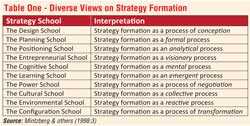
Interestingly, Mintzberg and his co-authors have attempted to draw a parallel to six blind men to 10 different approaches to strategy. According to them, none of them is absolutely right or wrong, but each lacks the holistic perspective. Table one captures the essence of such 10 schools of thought.

The table one amply shows the diversity in the approaches with inevitable strengths and shortcomings. They all speak of strategy either as a ‘plan’, ‘pattern’, ‘position’, ‘perspective’ or a ‘ploy’. Interestingly, though not popular, Five Ps of strategy can be identified in this sense.

Do we see the presence of the above approaches in Sri Lanka? In both private and public sectors alike, a strategic plan or a corporate plan (both are interchangeably used to mean the same thing) is considered essential. A multi-coloured spiral-bound thick report is prepared and presented and perhaps that is the end of the story. Whether there is a serious emphasis on achieving the formulated plan is questionable. This is more prevalent in the public sector where the annual audits would check the availability of a strategic plan as a checklist item and the implications beyond them is hardly investigated.
Broad consensus on strategy

While there is great diversity in discovering the ‘strategy beast’, there is some consensus as well. Mintzberg presents them as areas of agreement.

1. Strategy concerns both organisation and environment. “A basic premise of thinking about strategy concerns the inseparability of organisation and environment. … The organisation uses strategy to deal with changing environments.”

Easter Sunday attack as an environmental factor for tourism in Sri Lanka is a bitter and fitting example for the above. The prompt response as an industry in the aftermath of such a disaster is indeed encouraging, yet a slow recovery is the painful reality.

2. The substance of strategy is complex. “Because change brings novel combinations of circumstances to the organisation, the substance of strategy remains unstructured, unprogrammed, nonroutine, and nonrepetitive….”

In the VUCA (Volatile, Uncertain, Complex and Ambiguous) world that has come to our doorstep, the complexity of strategy is evident. The struggling Sri Lankan economy with global complications such as escalation of trade disputes, an abrupt tightening of global financial conditions, and intensifying climate risks could further find difficult to reach expected growth targets. 

3. Strategy affects overall welfare of the organization. “… Strategic decisions … are considered important enough to affect the overall welfare of the organization….”

This highlights the need for the involvement of all stakeholders including employees. “The only route to improved performance is by placing human resource at the centre of your strategic decision-making”, argues Linda Gratton, in her much-acclaimed book, ‘Living Strategy’. Needless to say, that the strategies at national level should be formulated in line with a broad, inclusive and comprehensive manner.

4. Strategy involves issues of both content and process. “… The study of strategy includes both the actions taken, or the content of strategy, and the processes by which actions are decided and implemented.”

This is another aspect where we pay over-emphasis on content and less on process. Occurrence of grand events to launch programs at an enormous cost and the process of executing is grossly neglected is a regular feature in Sri Lanka. We see more inauguration ceremonies then opening events showcasing the pomp and pageantry.

5. Strategies are not purely deliberate. “Theorists … agree that intended, emergent, and realized strategies may differ from one another.”

This is very relevant to Sri Lanka where the strategies deliberated prior to the Easter Sunday tragedy have to be revisited. The dismal first quarter performance experienced by many private sector organisations have learnt it in a bitter way. Promoting local tourism with more attractive corporate packages can be one such emergent strategy until the foreign tourism arrivals improve to a satisfactory manner.

6. Strategies exist on different levels. “… Firms have … corporate strategy (What businesses shall we be in?) and business strategy (How shall we compete in each business?)”

This is to be clearly understood by people at different levels of an organisation in cascading down the overall objectives. Whilst, satisfactory awareness and application is visible in the private sector, the presence of the cascading down effect from the national level to the provincial level and then to the divisional secretarial level is questionable.
Strategy at the helm 

I recall the statement made by the Malaysian High Commissioner in Sri Lanka at the Fireside Chat with leading foreign envoys held in Colombo recently. He referred to the consistent tourism strategy adapted by Malaysia with one solid slogan for the past 25 years, ‘Malaysia Truly Asia’. We, in contrast, have changed our slogan almost every year based on the likes and dislikes of those who are at the helm. A lot of food for thought with regards to consistency and continuity.

Sri Lanka as a nation is supposed to be moving ahead with a ‘Vision 2025’ of being a ‘country enriched’.  As the relevant government document states, “We will do so by transforming Sri Lanka into the hub of the Indian Ocean, with a knowledge-based, highly competitive, social-market economy. We will create an environment where all citizens have the opportunity to achieve higher incomes and better standards of living. To achieve this, we must create the conditions which will generate economic growth with equity. The structural transformation necessary to achieve this vision is currently underway.” As the said document further states, “We recognise the fundamental reality that Sri Lanka has a domestic market of only 20 million consumers with a modest per capita income, and must rely on external demand for sustained, high, and long-term growth. We will strategically position Sri Lanka as the hub of the Indian Ocean, securing opportunities for local businesses in global production networks (GPNs). This outward-looking approach will increase the efficiency of the domestic economy, contributing to a better life for all Sri Lankans.”
Way forward 

How far have we marched ahead in line with that impressive yet illusive path? Have we consciously executed the much-awaited yet delayed ‘so-called crafted strategy’? Have we seen the leading from the front with one voice and less noise in taking the country forward? A load of food for thought in order to move beyond a jungle of confusion through a ‘strategy safari’.

(The writer can be reached through director@pim.sjp.ac.lk, ajantha@ou.edu or www.ajanthadharmasiri.info.)

On Resuming the Death Penalty


LEN logoDr. Jayampathy Wickramaratne PC MP


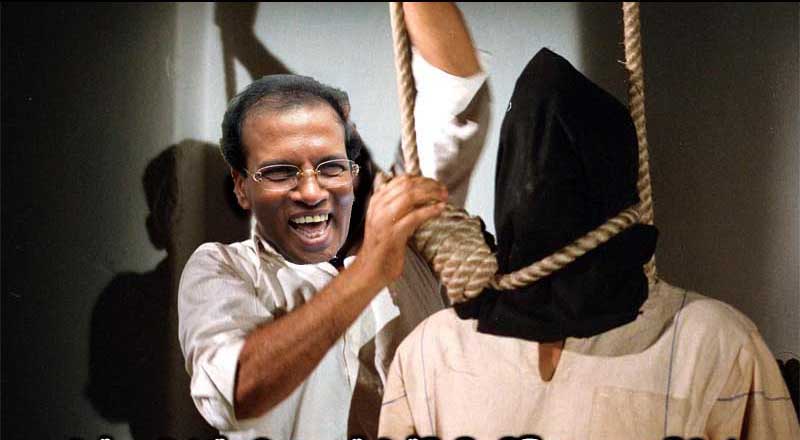
(Lanka e News -01.July.2019. 7.00AM)  President Sirisena’s decision to resume the death penalty has met with wide disapproval. The main parties in the Government and the Opposition - United National Front, Sri Lanka Podujana Peramuna, Tamil Nationalist Alliance and Janatha Vimukthi Peramuna are all opposed to it. Citizens’ organizations have condemned it. The United Nations, the European Union, the United Nations Office of Drugs and Crime (UNODC) as well as many countries have called for a reversal of the President’s decision. It has been pointed out that the application of the death penalty may also impede international cooperation to fight drug trafficking and terrorism. Many countries have laws that do not allow the exchange of information and extradition with countries which may impose capital punishment. The latest to join the chorus of opposition is the Sri Lanka Medical Association which has brought to the notice of all medical personnel that any involvement in the implementation of the death penalty would be against medical ethics.

Against Government policy, arbitrary and unconstitutional..

Since 2007, Sri Lanka has repeatedly voted at the United Nations in favour of resolutions calling for a moratorium on executions as a step towards the ultimate abolition of the death penalty. The 2007 resolution, which has been affirmed many times since then, declared that “the use of the death penalty undermines human dignity, and convinced that a moratorium on the use of the death penalty contributes to the enhancement and progressive development of human rights, that there is no conclusive evidence of the deterrent value of the death penalty and that any miscarriage or failure of justice in the implementation of the death penalty is irreversible and irreparable.” As recently as in December 2018, Sri Lanka again voted in favour of the moratorium.

As a matter of law, I argue that in view of the clear policy of the Government as evident from its continued commitment at the United Nations and the non-implementation of the death penalty from 1976 onwards, the President’s act of implementing the death penalty violates Government policy Also, under Article 42 (1) of the Constitution, it is the Cabinet of Ministers that is charged with the direction and control of the Government of the Republic. I therefore argue that the President cannot go against a Government policy. Further, major parties in Parliament are opposed to the resumption of the death penalty. The President is duty-bound to seek the views of Parliament. In the circumstances, the President’s decision to resume the death penalty is irrational, unreasonable, arbitrary and violative of Article 12 (1) of the Constitution.

Irreversible, miscarriage of justice possible..

Dr. Colvin R. De Silva stated in Parliament in 1956: “Of all things that the State may take away from man there is one thing which if you take away you cannot only not return, but you can never compensate him for, that is his life.”

History is replete with examples of grave miscarriages of justice resulting from the death penalty. To give just two examples, Timothy Evans was executed on 5 March 1950 in England for murdering a woman. Three years later, another man, John Christie, admitted responsibility for killing six women, including the woman that Evans purportedly killed! In February 1994, authorities in Russia executed serial killer Andrei Chikatilo for the highly publicised murders of 52 people. The authorities acknowledged that they had previously executed the "wrong man," Alexander Kravchenko, for one of the murders in their desire 'to stop the killings quickly.'

Not a deterrent..

Results of a 2008 poll of 500 police chiefs in the United States, conducted by R.T. Strategies of Washington, D.C. showed that Police chiefs ranked the death penalty last when asked to name one area as "most important for reducing violent crime." Their higher priorities included increasing the number of police officers, reducing drug abuse, and creating a better economy.

As is well-known, the capital crime rate in States in USA that have the death penalty is not less than in those States which have done away with the death penalty.

Michael L. Radelet, Professor of Sociology at the University of Colorado-Boulder, in his 2009 article "Do Executions Lower Homicide Rates?: The Views of Leading Criminologists” published in 2009 in the Journal of Criminal Law and Criminology wrote:

"Our survey indicates that the vast majority of the world’s top criminologists believe that the empirical research has revealed the deterrence hypothesis for a myth... 88.2% of polled criminologists do not believe that the death penalty is a deterrent... 9.2% answered that the statement '[t]he death penalty significantly reduces the number of homicides' was accurate... Overall, it is clear that however measured, fewer than 10% of the polled experts believe the deterrence effect of the death penalty is stronger than that of long-term imprisonment... Recent econometric studies, which posit that the death penalty has a marginal deterrent effect beyond that of long-term imprisonment, are so limited or flawed that they have failed to undermine consensus.

In short, the consensus among criminologists is that the death penalty does not add any significant deterrent effect above that of long-term imprisonment." (Emphasis added).

No previous President has sanctioned death penalty..

Although the death penalty is in the law books, it has remained only on paper and no President under the present Constitution has implemented it.

In 2005, when the accused in High Court Judge Sarath Ambepitiya murder case were convicted, there were fervent calls for the resumption of the death penalty. Fearing that President Chandrika Kumaratunga would relent, several persons requested me to discuss the matter with her. Despite the fact that Ambepitiya was my batch mate at Law College, I met President Kumaratunga, armed with facts and figures from across the world. Before I could finish my first sentence, she cut me short and said: “Whatever people may say, it is I who have to sign a death warrant. I will never sign”. That was the shortest conversation I have had with her.  I was very impressed because this came from a person whose father and husband had both been assassinated and who herself had miraculously escaped an assassination attempt, losing an eye. 

When the appeals of the accused in the Ambepitiya murder case were dismissed in 2006, again there were calls for executing at least the main accused. However, President Mahinda Rajapakse, also a batch mate of Sarath Ambepitiya, declined. I was happy to see him reiterate his opposition to the death penalty last week.

If President Sirisena does go ahead with the executions, he, as a Buddhist, will never be able to sleep peacefully; the ghosts of the four convicts will haunt him forever. President Sirisena has on more than one occasion gone back on promises and commitments, the latest being his outburst against the Nineteenth Amendment which he himself spearheaded, now calling it a curse. I will not be surprised if he goes ahead with the executions and claim a few years later that he had made a mistake.

It is apt to end this piece with a quotation from the leading judgment of the South African Constitutional Court in the landmark case of Makwanyane where the Court unanimously held that the death penalty violated the right to life: “The greatest deterrent to crime is the likelihood that offenders will be apprehended, convicted and punished. It is that which is presently lacking in our criminal justice system....”  [1995] (3) SA 391, [122] (CC). President Sirisena needs to wake up and realize that it is the same that is lacking in the Sri Lankan legal system as well.

By -Dr. Jayampathy Wickramaratne PC MP

---------------------------
by     (2019-07-01 01:53:00)

FRANCE, NORWAY AND GERMANY URGE SRI LANKA NOT TO REINSTATE DEATH PENALTY


Cartoon: Sajith Bandara @tmdsbekanayaka,

Sri Lanka Brief29/06/2019

 Norway and Germany have expressed deep concern regarding the Sri Lankan President’s decision to resume executions in the country for drug offenders.

“Norway is deeply concerned that Sri Lanka intends to implement the death penalty, which would put an end to Sri Lanka’s 43-year moratorium on the use of this cruel and irreversible punishment,” the Norwegian Embassy in Colombo said.

The statement said that as recently as December 2018, Sri Lanka was one of 120 countries that voted in favour of a UN General Assembly resolution calling for a moratorium on the use of the death penalty.

“The vote was a tangible sign of the global trend to move away from the use of the death penalty.”
Norway said implementation of the death penalty would negatively affect Sri Lanka’s international reputation and its human rights record.

“Norway strongly opposes all use of the death penalty as a matter of principle. We believe that states have a duty to protect the safety, well-being and human rights of all their citizens.”

“We have communicated our position and raised our concerns regarding this issue at the highest levels of the Sri Lankan Government, and we urge Sri Lanka to refrain from reinstating the death penalty,” the statement said.

Meanwhile the German Commissioner for Human Rights Barbel Kofler has also issued a statement in response to reports that the Sri Lankan President had publically announced that executions were to take place.

“I am extremely concerned by reports that President Sirisena has publically announced that four death sentences are to be carried out,” she said.

She appealed to the Sri Lankan Government to continue to refrain from carrying out executions following a moratorium lasting more than 40 years, to which Sri Lanka itself expressed its commitment as recently as December 2018.

Executions would be a considerable setback along the path towards a reconciled and peaceful society, said the Federal Government Commissioner for Human Rights Policy and Humanitarian Aid at the Federal Foreign Office.

The application of the death penalty damages Sri Lanka’s reputation, its ambitions in the area of human rights and the country as a business location, she stressed.

Issuing a statement, the France government also said it is deeply concerned at the announcement and urged the Sri Lankan authorities to maintain the moratorium on the death penalty.

“A resumption of executions would be inconsistent with the recent commitments made by Sri Lanka, which voted in support of the resolution calling for a universal moratorium on the use of the death penalty during the most recent UN General Assembly session just six months ago, with the justice minister taking part in the 7th World Congress against the Death Penalty in Brussels in February.”

“France reaffirms its opposition to the death penalty everywhere and under all circumstances and encourages Sri Lanka to join the countries that have permanently abolished this inhumane, unjust and ineffective punishment,” the foreign ministry said.

(Ada Derana)