Peace for the World

Peace for the World
First democratic leader of Justice the Godfather of the Sri Lankan Tamil Struggle: Honourable Samuel James Veluppillai Chelvanayakam

Thursday, December 1, 2016

Waad al-Kateab is an award-winning film-maker. And she is in grave danger

For a year, Waad al-Kateab has exposed the horrors of Aleppo. Now she is trapped there. We can only hope Syrian forces treat her and her fellow citizens properly, writes Channel 4 News Editor Ben De Pear.
A year ago Channel 4 News commissioned a young woman in Aleppo, Waad al-Kateab, to make a film about life inside the city. Her film about a teenager who was modelling the rebuilding of a dream Aleppo with cardboard, glue and bits of rubbish showed a rare scene of hope from within that shattered city.

As the horror of Aleppo deepened earlier this year, we took the decision to take Waad on as an exclusive film-maker for us and the results have been searing testaments to life under siege in the rebel held east of the country’s largest city. All year Waad has provided dozens of outstanding reports that have led and dominated our programme and have now been viewed hundreds of millions of times by people around the world. Her films can all be viewed at insidealeppo.com.


Much of what Waad provided was from the emergency room of the hospital where her doctor husband works, but it has not just been the screams of the injured and dying she has captured. She has done that most important thing in journalism: she humanised the victims, showed us whole families in their worst moments, chronicled their pain and showed the world the horror, without intruding, and with a skill it takes most decades to learn.

Now with the tide turning against the rebels there are many questions as to what is happening to those the government are capturing, whether civilians or fighters. Waad has been unable to leave the city for months, has a young child and is pregnant with another. Along with a quarter of a million other people, she is now at the mercy of the forces that surround her, but as a journalist and in the company of medical staff who have stayed simply to tend to the many injured and dying in Aleppo, we expect her, like everyone, to be extended the rights every citizen has. We expect that the government of Syria will protect the lives of civilians, especially non-combatants, medical staff, women and children, as it has repeatedly declared it will.
Watch all of Wa’ad’s films on insidealeppo.com
This week Waad won two Amnesty International awards, and in her absence sent these words to be read and shared.

“Maybe this will be my last letter to you and to the world. I am in the most dangerous city in the world and only today 30 barrel bombs and 100 artillery shells fell on my neighbourhood (al-Sukkari). I wanted to be with you but the siege of the city prevented that. I am just one individual among the 270,000 people who live under this siege. The only thing that’s available in this city is air, but this air, most of the time, is polluted with poisonous gases and chlorine. We are not the only city in Syria under siege and our salvation will not be achieved only by the lifting of this siege or halting the bombing, but with the fall of the Assad regime and getting our freedom and dignity as Syrians. I would have liked for my lens and my colleagues’ lenses to give you the complete picture of Aleppo, but we are helpless in front of the horrors of annihilation that the Russians and the regime are enjoying in this ancient city.

“This is a perished city called Aleppo. And all its people are asking you to remember your humanity.”


We need a president who can stand up to big corporations, not fold to their demands.

Donald Trump is going to have to toughen up if he wants to serve American workers. (Steven Senne/AP)

 Bernie Sanders is a U.S. senator from Vermont
Today, about 1,000 Carrier workers and their families should be rejoicing. But the rest of our nation’s workers should be very nervous.

President-elect Donald Trump will reportedly announce a deal with United Technologies, the corporation that owns Carrier, that keeps less than 1,000 of the 2,100 jobs in America that were previously scheduled to be transferred to Mexico. Let’s be clear: It is not good enough to save some of these jobs. Trump made a promise that he would save all of these jobs, and we cannot rest until an ironclad contract is signed to ensure that all of these workers are able to continue working in Indiana without having their pay or benefits slashed.

In exchange for allowing United Technologies to continue to offshore more than 1,000 jobs, Trump will reportedly give the company tax and regulatory favors that the corporation has sought. Just a short few months ago, Trump was pledging to force United Technologies to “pay a damn tax.” He was insisting on very steep tariffs for companies like Carrier that left the United States and wanted to sell their foreign-made products back in the United States. Instead of a damn tax, the company will be rewarded with a damn tax cut. Wow! How’s that for standing up to corporate greed? How’s that for punishing corporations that shut down in the United States and move abroad?

In essence, United Technologies took Trump hostage and won. And that should send a shock wave of fear through all workers across the country.


Trump has endangered the jobs of workers who were previously safe in the United States. Why? Because he has signaled to every corporation in America that they can threaten to offshore jobs in exchange for business-friendly tax benefits and incentives. Even corporations that weren’t thinking of offshoring jobs will most probably be reevaluating their stance this morning. And who would pay for the high cost for tax cuts that go to the richest businessmen in America? The working class of America.  

Let’s be clear. United Technologies is not going broke. Last year, it made a profit of $7.6 billion and received more than $6 billion in defense contracts. It has also received more than $50 million from the Export-Import Bank and very generous tax breaks. In 2014, United Technologies gave its former chief executive Louis Chenevert a golden parachute worth more than $172 million. Last year, the company’s five highest-paid executives made more than $50 million. The firm also spent $12 billion to inflate its stock price instead of using that money to invest in new plants and workers.

Does that sound like a company that deserves more corporate welfare from our government? Trump’s Band-Aid solution is only making the problem of wealth inequality in America even worse.

I said I would work with Trump if he was serious about the promises he made to members of the working class. But after running a campaign pledging to be tough on corporate America, Trump has hypocritically decided to do the exact opposite. He wants to treat corporate irresponsibility with kid gloves. The problem with our rigged economy is not that our policies have been too tough on corporations; it’s that we haven’t been tough enough.


We need to re-instill an ethic of corporate patriotism. We need to send a very loud and clear message to corporate America: The era of outsourcing is over. Instead of offshoring jobs, the time has come for you to start bringing good-paying jobs back to America.

If United Technologies or any other company wants to keep outsourcing decent-paying American jobs, those companies must pay an outsourcing tax equal to the amount of money they expect to save by moving factories to Mexico or other low-wage countries.  They should not receive federal contracts or other forms of corporate welfare. They must pay back all of the tax breaks and other corporate welfare they have received from the federal government. And they must not be allowed to reward their executives with stock options, bonuses or golden parachutes for outsourcing jobs to low-wage countries. I will soon be introducing the Outsourcing Prevention Act, which will address exactly that.
If Donald Trump won’t stand up for America’s working class, we must.

logoTuesday, 29 November 2016

Every time the world turns to elections I personally take the learning mode, given that the best techniques in marketing comes into play, challenging conventional procedures. On this perspective, the US election 2016 was a case study. It sure shook the world and baffled the top notch research agencies in the world.

Almost all pre-polls surveys predicted a narrow win for Clinton but the reality was different. Whilst Clinton drove a structured marketing campaign, Trump practiced a knife fight marketing strategy. The latter worked and the world is yet grappling to conceptualise the marketing programmes so that they can be tested in other situations. 

22Jared Kushner drove the knife fight marketing campaign for Trump

Whilst people are yet questioning the pre-election research indications on voter behaviour, in my view the results tilting to Clinton can be termed right. The logic being that Clinton in fact has secured two million votes over Trump with a 64.2 million performance as against the 62.2 registered for Trump. However, research failed to capture the two tier US election system that skewed the result to Trump. A tough decision for the loser but from a marketing point of view it’s interesting to understand the pickups to marketing from the Trump campaign. 

The strategist – Kushner

Just like any other world event the inside stories are coming to light over a period of time and on this one, a name coming out as the strategist of the Trump campaign is a personality called Jared Kushner. Professionally a real estate agent, Kushner made his presence felt was when he purchased the ‹ New York Observer›. Thereafter he went on setting up an online market place ‹cadre› for big deal real estate.

Jared incidentally is the son-in-law of Donald Trump and tends to know the right people in Fifth Avenue, New York. His co-investors include the billionaire Thiel and Alibaba›s Jack Ma, whilst his younger brother Josh is a top venture capitalist who owns the 2.7 billion dollar Oscar Health entity in the US.

Henry Kissinger, the former Secretary of State, once commented: “Every president is to have one or two people he intuitively and structurally trusts.” Jared Kushner ideally fits this role to Donald Trump, states the latest reports on the nail-biting victory. Let me pick up the key insights from the Trump campaign.

Kushner pickups 

1) Zero resources 

The former CEO of Google Eric Schmidt, who helped design the Clinton technology system, commented: “Jared ran the campaign with essentially no resources.” There were no desks, chairs or campaign staffers. Jared ran the campaign on a startup business model with a secret data operation out of his office in the skyscraper down Fifth Avenue. Initially it was essentially a tactical campaign to survive on a daily basis 

untitled-47012) Catchy headlines

Whilst Clinton was pursuing a structured, segmented and targeted campaign state to state, Trump’s campaign was on to gorilla strategies with tactics like message tailoring, sentiment manipulation and machine learning but on the positioning ‘Make America Great Again’.

There was a time when Trump would call a TV station which was in the midst of a talk show and he would give a razor sharp message that caught the attention of a viewer but upset the equilibrium in the mind. This is why Trump was referred to as unpredictable but to the ‹average American› it sure instilled the lost pride of being American.

Kushner supplemented these bursts with cutting-edge messages during one to two rallies a week whilst also keeping the share of voice on traditional media. The poll results moved voter behaviour and Kushner saw the opening in the market place.

3) Worked on relationships

In the early days Kushner played the advisor on tax policy and trade but he realised that the campaign was a bit scrappy. When the Trump brand began to gather steam, Kushner brought in professionals. He worked the market to get the best talent on board just like any startup business which can afford the talent.

For instance on tax and policy an expert was hired and he joined under two conditions – he would remain anonymous and he would charge double the price. Kushner saw the results coming with the statements made by Trump getting credibility. Silicon Valley billionaire Peter Thiel from the inception backed Trump but by November we saw even the clergy endorsing brand Trump which was beautifully architected by Kushner.

4) Traction 

As the Trump ticket started getting traction, Kushner realised by this time that with a share of 34% there was chance to get into White House with some external pressure changing the confidence towards Clinton. This is exactly what happened, given that when Trump’s market share picked up to 44% by the first week of November, the FBI Directors’ revelation on the private server emails sure dented Clinton’s campaign. However, it is not clear if there was a link between the Trump camp and the timing of the email saga from the FBI but it sure had an impact on the result is what analysts voice.

5) Hope on the product 

Given the personality of the brand it was a tough task to build hope on the product Trump but Kushner realised that when the Springfield, Illinois arena was packed on a crucial convention meeting, “People really saw hope in the message that Trump delivered on a daily basis.”

Though radical in nature, the nationalistic sentiments were garnering momentum and among core voters – thoroughbred Americans – Trump was getting popular though the world was ruffled from Putin to Germany›s Merkel, from the President of China to the Head of State of Mexico on the 3,000 km wall. But the core voter ratings to Trump were moving up and Kushner stuck with the strategy.

6) Trump’s advise 

Given that Jared Kushner was his son-in-law and he jelled with him on his psyche the advice from Trump to the campaign team was: «I don›t want people getting rich off the campaign, I want to make sure that we are watching every dollar just like we would do in business.»

A very interesting insight as I yet remember one of my bosses from the multinational circuit saying that the best marketing is done when the marketing budget is tight. Kushner did not argue even though he was a son of a wealthy real estate entrepreneur. Kushner called the marketing strategy baseline driven. It is said that Trump, once returning from a campaign meeting on his Trump Force One, handed over the Facebook/digital marketing initiative to his son-in-law and advised him to generate funding for the marketing programme.

7) Start up

Given that Kushner had a background of developing new business, especially in the digital space, he got help from the best technology experts and with simple messaging they started generating business by selling $ 8,000 worth of hats a day and traded up to a limit of $ 80,000 by the end of the campaign that included human billboards and low-tech policy videos talking directly to the camera that generated 74 million views. Trump ended the election at 62 million votes which may have a relationship. 

8) ROI

Kushner always worked on the ROI model where for any investment he wanted the highest return. Sometimes he played money ball and the states that gave him the best return is where marketing instrument was directed. Some say that the swing states results and the overall share of money to share of results was the best towards Trump. In fact the money spent totally by Clinton was way higher than Trump on top-line media billing.

An interesting point to note is that TV and radio billing is getting smaller whilst monies invested on Twitter and Facebook were stronger, which is a parallel pickup we see even in other businesses across the world.

9) Not afraid to fail

Given that Trump was the fighter brand to the pedigree brand of Clinton in the political arena, Kushner was not scared to fail. His ethos was to do a million things that were cheap and quick and if it was not working, kill it and go with the ones that bring in the results. Given the data-driven operation that he was running, he kept repeating the strategies that got traction so that scaling was happening during the campaign. An interesting move given the digital age that is throwing out so many opportunities for communication.

10) Data mining 

Kushner being a tech-savvy individual developed a customer geo-location tool that plotted the location density of about 20 voter types over a live Google Maps interface so that any campaign would be dictated by data linking travel, rally locations and topics of the speeches so that a synergy approach to marketing was used.

Kushner was using micro marketing at its smallest rather than the holistic campaigns run by competitor Clinton who by mid-October was on a roll even picking the shadow cabinet, according to the latest information coming in.

11) Testing 

Given Kushner’s attitude, coming from a real estate background, he would test an advertisement and ineffective ads were killed in minutes whilst the impactful ones were scaled up. At the height of the campaign nearing the voting day, almost 100,000 tweaked ads were being targeted to voters each day. Hence, whilst traditional media was used to drive brand imagery and presence on media, it was digital media that was driving voters towards Trump, which is why I believe most of the pre-poll data was not picking up the vibes.

12) Last minute draw

When Kushner saw that in stores like Michigan and Pennsylvania the momentum was strongly on to Trump, he unleashed tailor-made last minute ads on rallies whilst thousands of volunteers started a door-to-door operation backed by telephone Ellington that sure closed the numbers at 62.4 million votes but crossing the 271 magical number. 

Afterthought

An interesting insight is that whilst Kushner is said to have given the backbone to the campaign with Trump’s Twitter garnering 15.5 million followers, Jared had never tweeted in life as at end June 2009.

Kushner’s conflicts with the reality were never a distraction because he had unflagging faith in the brand Donald Trump and he used the data to drive his strategy: «America first and to be a nationalist as opposed to a globalist». It worked from a marketing strategy perspective but now we need to see if the product lives up to the promises made.
References:
   - The New York Times
   - Business Insider
   - Los Angeles Times
   - Forbes Magazine
   - Predictit.org
   - quota.com.  
   - ibtimes.co.uk

(The author is a marketer by professional, winning twice the Best Marketer Award in Sri Lanka. Nationally he has chaired Sri Lanka Exports and Sri Lanka Tourism and is today driving the Lanka Sathosa brand. He is also on many private and public sector boards in Sri Lanka.)

Exclusive: Indian government officials propose break up of Coal India - sources

A worker unloads coal from a goods train at a railway yard in Chandigarh, India, July 8, 2014. REUTERS/Ajay Verma/Files-Workers unload coal from a supply truck at a yard on the outskirts of the western Indian city of Ahmedabad April 15, 2015. REUTERS/Amit Dave
India's Prime Minister Narendra Modi speaks to the media inside the parliament premises on the first day of the winter session in New Delhi, India, November 16, 2016. REUTERS/Adnan Abidi

By Neha Dasgupta and Krishna N. Das | NEW DELHI-Thu Dec 1, 2016

Senior Indian government officials tasked by Prime Minister Narendra Modi with reviewing energy security are recommending the break up of the country's coal monopoly, Coal India Ltd (COAL.NS), within a year.

Attempts to break up the world's biggest coal miner would be met by strong resistance from powerful unions representing the company's employees of more than 350,000. The government backed down from a similar proposal in the face of union protests in 2014.

Around 70 percent of India's power generation is coal based. The country is the world's third-largest producer and its third-biggest importer of coal, which the government wants to change by boosting local coal production.

In a presentation seen by Reuters, government officials recommend that Coal India - with a stock market valuation of $28 billion - should be broken up into seven companies, which they say would make it more competitive and efficient.

The proposal, dated Nov 30, is expected to be presented to Modi soon, three government officials with direct knowledge of the situation said. They declined to be identified because the information has not been publicly released.

Calls to a Coal India spokesman went unanswered.

A source close to power and coal minister, Piyush Goyal, said the ministry would review its stand on Coal India depending on what the prime minister says.

Coal India is the country's second-biggest employer, but critics say it is bloated and inefficient. Its output-per-man shift is estimated at one-eighth of Peabody Energy (BTUUQ.PK), the world's largest private coal producer, filed for bankruptcy protection this year.

Under Modi's government though, production has risen sharply as environmental and other clearances to develop mines have been fast-tracked. The company is also spending billions of dollars on buying modern machinery to raise productivity.

The government wants Coal India to increase production of coal to 1 billion tonnes a year by 2020 from around 539 million tonnes in the fiscal year that ended in March. It wants India as a whole to produce 1.5 billion tonnes a year by 2020.

Modi was exploring a breakup of Coal India before taking office, Reuters reported in 2014, but the government put the idea on the back burner following protests by unions. (reut.rs/2gXYD5L)

Unions fear restructuring Coal India would almost certainly lead to job cuts and work being outsourced to private companies, so are likely to protest against a break up.

"What happens is that once a big company is broken down, it is easier to control the smaller ones," said D.D. Ramanandan of the All India Coal Workers' Federation, which he said represents more than 100,000 workers of the company. "But if it happens, we will oppose it. We will oppose it through all ways possible, including strike."

ENERGY SECURITY

In late October, Modi set up 10 groups of senior bureaucrats to "undertake a critical review" of government work in a number of areas, including energy, transport and agriculture.

The proposal to break up Coal India comes from one of these groups - nine top bureaucrats, including ones from the ministries of coal, power, oil and mines. They were asked to come up with policy proposals to promote energy security and the environment.

Under Modi, Coal India's production growth rate has nearly doubled, marking one of the administration's biggest successes. Fuel shortages for power plants have turned into oversupply.

Restructuring is likely to be harder, but is crucial to the government's ambition to sell 10 percent of the company to raise funds for further growth and investment. The government owns just under 80 percent of the company.

Coal India wants to spend billions of dollars in the next few years to buy equipment and modernize mines. Miners still commonly use shovels and picks to dig for coal underground.

The company also plans to stop filling most vacancies arising from retirements over the next three years, and outsource more mining to private companies.

Coal India unit Mahanadi Coalfields pioneered outsourcing of mining work a few years ago and is now the company's biggest producer and fastest-growing unit. Contractors carry out about 90 percent of the unit's mining.

Coal India is a holding company with seven producing units and a planning and consultancy firm. The producing units have their own administrative set-up led by a chairman, so breaking them up to run as individual companies may not be difficult, analysts said.

(Reporting by Neha Dasgupta and Krishna N. Das; Editing by Neil Fullick)

Burma can overtake Singapore in 20 years, Suu Kyi says amid Rohingya crisis

Myanmar's Foreign Minister Aung San Suu Kyi, left, steps into a photo position for the media along with Singapore's Prime Minister Lee Hsien Loong at the Istana or presidential palace on Wednesday, Nov. 30, 2016, in Singapore. Pic: AP

By  -1st December 2016

ALTHOUGH Burma has been wracked by decades of civil unrest and is now said to be edging on a full-blown “ethnic cleansing” of the Rohingya Muslims, its de facto leader Aung San Suu Kyi has trotted out an ambitious plan to have her country overtake Singapore’s economy in two decades.

Speaking at a business dialogue in Singapore on Wednesday, the Burmese State Counselor said she hopes her regional neighbour would lend a helping hand.

“At the beginning of Singapore’s independence, the then prime minister, Lee Kuan Yew, said that in 20 years’ time, Singapore would have caught up with Burma,” she said, as quoted by Channel News Asia.

“I think we have to change that a bit and say: In 20 years’ time, Myanmar (Burma) will have overtaken Singapore and you will help us to do that because success in one part of the region means success throughout the region and we have never found it difficult to engage with Singapore economically.”

The 71-year-old Nobel laureate said Burma has been “left behind” and hindered by “different factors” 
compared to its Southeast Asian neighbours, adding she hopes Singapore would help the country become more vibrant on the political and economic fronts.

“Politics and business cannot be separated particularly at this time when we are trying to make our country not just united and peaceful, but also prosperous,” she was quoted as saying. “For that, we look to you to advise us, to work together with us and to make our country vibrant, not just politically but also economically.”

Suu Kyi is on an official visit to Singapore that lasts three days, ending Friday. On her schedule is a dinner hosted by Prime Minister Lee Hsien Loong.


In October, Suu Kyi admitted to Burma’s sluggish economic growth at 7 percent in the first six months of her rule following a World Bank report, which cited heavy flooding and investment slowdown during the 2015 election period that was also hampered by external factors.

The recorded 7 percent growth was less than the average rate of 8.5 percent in 2013 and 2014 but higher than expected, as the World Bank had trimmed its 2015-16 forecast from 8.2 percent to 6.5 percent.
For decades, Burma has been plagued by civil war as ethnic minorities fight for greater autonomy from the central government, which has long been an Achilles’ heel in the nation’s plans for greater cohesion, growth and development.

There are at least 15 different rebel groups that are actively taking up arms across Burma since the country achieved independence from British colonial rule in 1948. Some of the groups, such as the Kachin Independence Army and the United Wa State Army, have controlled and administered large swaths of territory for years, according to CNN.


Although the government has been engaged in ceasefire talks with the groups, representatives of Burma’s ethnic minorities say the peace process remains an uphill task.

As it aims to attract overseas investments and bolster its economy, the Burmese government is also faced with the challenge of addressing the issue of an ethnic minority that it refuses to recognise as its citizens.

Longstanding discrimination by the Buddhist majority against the Muslim Rohingya in the northern Rakhine state exploded into bloody violence in 2012, leaving more than 100,000 people, mostly Rohingyas, in displacement camps.

Since Oct 9 this year, Burmese security forces have been pouring into Rakhine in a fresh round of violence that was triggered by a series of attacks on border guard posts by what the government says was carried out by Rohingyan insurgent groups.


The recent escalating violence has left an estimated 100 people dead and displaced another 30,000 while government security forces have been accused of burning down homes and raping dozens of Rohingya women.

On Tuesday, United Nations’ High Commissioner for Human Rights (OHCHR) office expressed alarm over reports of ‘serious rights violations’ in Rakhine that cite allegations of extrajudicial killings, arbitrary arrests and sexual violence.

UN High Commissioner for Human Rights Zeid Ra’ad Al Hussein said the government needs to condemn the renewed spike in hate speech as failing to do so threatened to “exacerbate the current spiral of violence”.

“Protection of civilians and unfettered humanitarian access to conflict affected areas is critical,” the UN rights chief said.

“Measures that may heighten the vulnerability or pose threats to the safety and security of internally displaced people – such as requiring internally displaced persons (IDPs) to cross conflict lines – must be avoided.”


Suu Kyi, who has been the subject of criticism for her apparent reluctance to address the Rohingyan ‘genocide’ , also said in Singapore that national reconciliation is “unavoidably important” for the country to attract investment, but gave no specifics on how her government intends to resolve violence and discrimination against the marginalised community.

Suu Kyi, who swept into power last year after wresting the government from decades of junta rule, said that national reconciliation is also not “a matter of choice. It’s unavoidable.”

The accounts of military attacks against the Rohingya community caused thousands of people to march in protest in Bangladesh last week. Smaller protests occurred in Indonesia, Malaysia and Thailand.

The protests against the violence in Indonesia has forced Suu Kyi to cancel her working visit to the country while the Malaysian government has called for a review on Burma’s membership in ASEAN, Southeast Asia’s main regional organisation.

Additional reporting by the Associated Press

Brexit: 1m EU citizens in Britain 'could be at risk of deportation'

The government has been warned that up to 1 million EU citizens living in the UK could be at risk of deportation if it does not come up with a simple way of recognising their status in the country.

 The 3 Million campaign group has urged the government to remove the threat of deportation without notice. Photograph: Fiona Hanson/PA

-Thursday 1 December 2016 

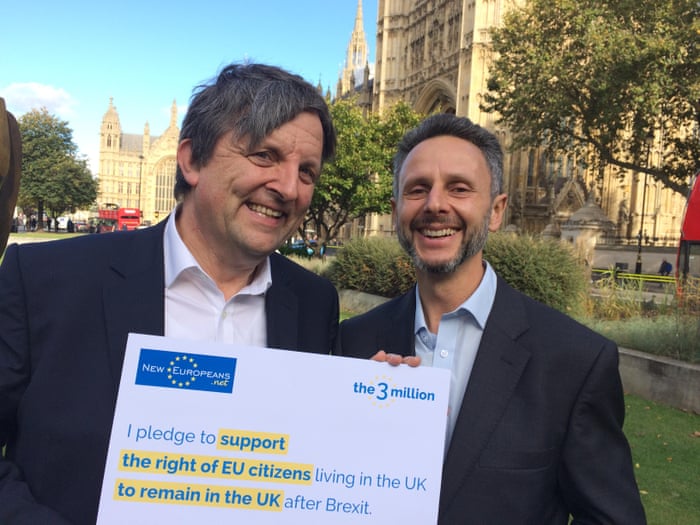
The 3 Million, a grassroots group lobbying for the rights of non-British citizens who have made the UK their home, has told the home secretary it would take the Home Office 47 years to process applications from EU citizens for permanent residency (PR). “We are people with families, children, friends and work colleagues, and we are rightly worried about a very uncertain future,” said Nicolas Hatton, chair of the 3 Million, in his letter to Amber Rudd.

“EU citizens have been feeling very anxious about their future since the referendum, and this set of data will not reassure them. We call on you to remove the threat of deportation without notice and give us, today, guarantees that all EU citizens living legally in the UK will be able to exercise their right to remain before the UK leaves the EU.”

Theresa May has consistently said that rights for EU citizens were a legitimate part of Brexit negotiations, but on Thursday night the government seemed to go one step further by indicating their rights could be removed if not reciprocated.

A Home Office spokesperson said: “The home secretary has been clear that she wants to protect the status of EU nationals already living here, and the only circumstances in which that wouldn’t be possible is if British citizens’ rights in European member states were not protected in return.”

The estimated time it would take the Home Office to deal with the 3 million EU citizens in the country is based on the latest immigration data, which shows a surge in applications for PR since the EU referendum, which has caused a backlog of 100,000 applications.

 Former Labour MP Roger Casale and 3 Million founder Nicholas Hatton. Photograph: Lisa O'Carroll

PR was designed for non-EU citizens who wished to settle in the UK and involves an 85-page application form. Applicants not only have to provide five years of council tax bills, bank statements or utility bills to demonstrate residency, but also have to document each time they have been in and out of the country since they arrived in the UK.

Monika Lutke-Daldrup from Germany, who is an executive with a large European firm and lives in Watford, told the Guardian: “I travel about 20 times a year and I have been here for 18 years. It is ridiculous.”

Paola Rizatto said: “I am an educated person, but I found the 85-page form so overwhelming that I decided to hire an immigration lawyer. I have already spent around £1,000.”

Several mothers who have British children say they are not eligible for PR because their household bills are not in their names. “Just to be married to a British person or to have British children is not enough,” said one. Another, who asked not to be named, said she had been told to get her child’s school to sign a statement that she had been picking up her child each day for the past five years.

The 3 Million said the Home Office process for PR “is totally inconsistent and depends on what Home Office adviser you get”.

Data published on Thursday shows that 30% of applications are rejected, with many EU citizens unable to pass the paperwork test despite their legal right of residence as EU citizens.

If the government requires all non-Britons to join the non-EU immigrants in the permanent residency queue, up to 1 million could face deportation the day the UK leaves the EU. 

The Home Office said there had been “no change to the rights and status of EU nationals in the UK as a result of the referendum”. Its guidance was that EU citizens did not need to apply for permanent residence. “As such there is no requirement to register for documentation to confirm their status,” a spokesperson said.
Bribery Is on the Rise Worldwide, and It Costs A Lot More Than Just Money

BY ROBBIE GRAMER-DECEMBER 1, 2016

Corruption, graft, and palm-greasing are a real and growing drag on the global economy — and they open the door to a host of evils like drug smuggling and human trafficking. Bribes to the tune of about $1.5 trillion change hands every year, according to the International Monetary Fund, or about 5 percent of global GDP.

And the true cost of corruption doesn’t just boil down to money, either. “You can’t have narco-trafficking without bribery, human trafficking without bribery, or even terrorism without bribery,” said Alexandra Wrage, president and founder of the anti-bribery organization TRACE International.

TRACE says that bribery is getting worse, with global graft on the rise, according to a new study. Some 60 percent of countries have an increased bribery risk compared with the 2014 study, while only 32 percent have a decreased bribery risk, the group says. While anti-bribery laws and enforcement are on the upswing in many countries, government transparency and capacity for civil society oversight of anti-bribery are not.

The study shows the cleanest — and most graft-prone — countries around the world, ranking countries on a scale of 1 to 100, with higher numbers indicating higher bribery risks.

See how each country stacks up here:

Screen Shot 2015-08-10 at 11.44.56 AM

Sweden comes out on top with a score of 10, followed by New Zealand at 15 and Estonia at 17. The most bribery-prone country in the world is Nigeria, with a score of 99. Russia is actually getting cleaner, TRACE says, improving from a score of 65 two years ago to 58 today.  China, despite a huge anti-corruption drive in Beijing, sits immobile with a score of 66.

Even the United States even saw a slight increase in bribery risk, going from a score of 27 in 2014 to a score of 34 in 2016, though it’s still a lot closer to Sweden than Swaziland. The United States improved anti-bribery laws, according to the study, but saw its score rise because of increased business-to-government interactions and a slight backslide in civil society oversight of bribery.

“Generally, more places have gotten worse than have gotten better,” Virna Di Palma, senior director of global strategy with TRACE, told Foreign Policy. In particular, the Americas, Africa, and East Asia are backsliding on fighting corruption, Di Palma said.

Corruption hemorrhages public trust in governments. A Transparency International study released in November found, after surveying 60,000 Europeans and Central Asians, 53 percent thought their governments handled corruption poorly, while only 23 percent thought they were doing well. One in three surveyed thought their government’s officials and lawmakers were mostly corrupt. Even in the supposedly cleaner and more advanced West, public ire at corruption — whether real or perceived — helps fuel populist political movements.

All is not necessarily lost, though, says Wrage. Corporate behavior is getting more legal scrutiny around the world. And if bribery scores are high now, it may be because bribery was simply more difficult to track in the past. “It’s not that there’s more bribery, it’s that it’s more visible,” Wrage said.

Companies are also learning that dirty business can be bad business, says Di Palma. Additionally, small and medium-sized companies — not just multinationals — are beginning to take anti-graft measures more seriously.

“We see the world trending in the right direction,” Di Palma said. “Initially companies were only interested because of increased anti-bribery enforcement, but in the last few years we’ve seen a change,” she said, adding that “companies are recognizing that bribery is a bad business strategy.”

Photo credit: DIPTENDU DUTTA/AFP/Getty Images; TRACE International, Inc.


HIV vaccine: Clinical trial begins in South Africa

Nurse takes a blood sample on March 8, 2011 in a mobile clinic set up to test students for HIV at Madwaleni high school near Mtubatuba in Kwazulu Natal, South Africa.AFPImage captionSouth Africa is battling to curb the spread of HIV/Aids
BBC30 November 2016
A new vaccine against HIV, the virus that causes Aids, is being tested in South Africa in what scientists say is the first large study of an HIV vaccine's effectiveness since 2009.
The study aims to enrol 5,400 sexually active young men and women.
About seven million people in South Africa are living with the virus, which is one reason why the trial is taking place there.
Experts hope the vaccine will be "the final nail in the coffin" for HIV.
The vaccine regime being tested is based on one used in a trial in Thailand in 2009, which had a protection rate of about 30%. Results from South Africa are expected in four years.
Since the HIV virus was identified in 1983, efforts to develop an effective vaccine have proved unsuccessful.
Researchers hope that this might come to an end with the current study, which is code-named HVTN 702.
It is being led by South Africa's Glenda Gray, a university research professor and head of South Africa's Medical Research Council.
"It will tell us whether the initial success observed [at a smaller scale] will bear fruit in the form of a safe and effective HIV vaccine designed for the people of southern Africa," Dr Gray said.
People sit in the waiting room in an anti-retroviral clinic in Emmaus hospital in Winterton, in South Africa's Kwazulu-Natal region on March 11, 2008.AFP-Image captionAids remains the biggest cause of death among young people in Africa
According to the United Nations, more than 30 million people have died from Aids since the 1980s.
Recent breakthroughs in anti-retroviral treatments have improved the lifespan of Aids patients.
However, the only effective prevention remains abstinence or the use of barrier methods such as condoms during sexual intercourse.

'Making history'

As part of the present trial, study participants will receive a total of five injections over one year, says the US National Institutes of Health (NIH), which is sponsoring the trial.
Awethu Benenengu, a 20-year-old construction worker, who is one of the participants in the trial, told the BBC's Nomsa Maseko in Johannesburg that he volunteered because he wanted to help defeat Aids.
"I decided to get involved because I don't like the way my HIV-positive cousin is treated," Mr Benenengu said.
"There is so much stigma. I want to be part of a generation that changes this and I want my children to be proud one day of their father for getting involved in making history."
Participants who become infected with HIV during the trial will be referred to local medical providers for care and treatment, NIH adds.
They will be advised on how to reduce their risk of transmitting the virus.