Peace for the World

Peace for the World
First democratic leader of Justice the Godfather of the Sri Lankan Tamil Struggle: Honourable Samuel James Veluppillai Chelvanayakam

Friday, April 1, 2016

Arrest of soldier filmed executing Palestinian was just public relation

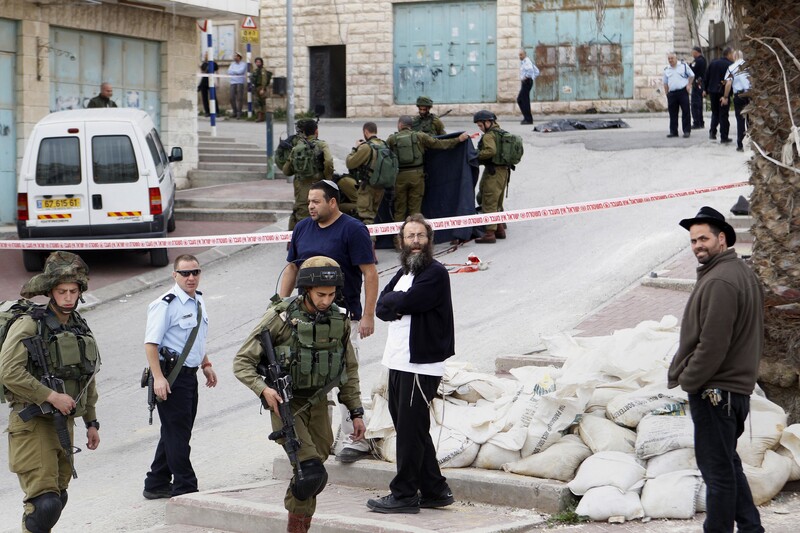
Israelis rally outside an Israeli military court in Kiryat Malakhi in support of an Israeli soldier shown on video shooting an incapacitated Palestinian in the head, 29 March.-Oren ZivActiveStills
Settlers look on as Israeli forces evacuate the body of Abd al-Fattah al-Sharif in the West Bank city of Hebron on 24 March.Wisam HashlamounAPA images

Maureen Clare Murphy-1 April 2016

An Israeli soldier shown on video executing an incapacitated Palestinian last week was arrested only “to avoid embarrassment in front of the world,” according to the human rights group Al-Haq.

The group’s investigation sheds new light on the incident in which two Palestinian youths were slain, and comes as the arrested soldier, Elor Azarya, faces manslaughter charges, rather than the murder charges previously announced by military prosecutors. He may be released within days.

Al-Haq, based in the occupied West Bank city of Ramallah, asserts that both the slaying of Abd al-Fattah al-Sharif, shown on video, and that of Ramzi al-Qasrawi, which was not recorded, constitute deliberate killings and are thus war crimes.

The group adds that statements made by Israeli leaders – including former foreign minister Avigdor Lieberman, who endorsed the videotaped killing and asserted that “the soldier carried out orders” – indicate that soldiers have been given orders to kill rather than neutralize Palestinians who pose a threat.
“The occupation authorities’ detention of the accused soldier is a cover-up of the crime, to show the occupier state as law abiding and holds violators accountable,” Al-Haq’s Arabic-language report states.

“The arrest of one soldier and not the other suggests that what the other soldier had done was not a crime because it was not captured on camera,” the group adds.

Read More

Editor accused of espionage after publishing photos of covert Turkish arm shipments to Syria spoke to MEE in his last interview before his trial 


YvoFitzherbert-Friday1 April 2016

ISTANBUL, Turkey -
 The trial against Can Dundar, the editor-in-chief of Cumhuriyet newspaper, began on Friday, in one of the most controversial cases to rock Turkey’s press industry in years.
Dundar stands accused of espionage for publishing photos of covert Turkish arms shipments to Syria. The court case against him is being conducted by a secret court with no media allowed in the courtroom.
“I knew the story was big at the time, and was fully prepared for its repercussions, but I never imagined I’d be accused of espionage,” Dundar told Middle East Eye in his last ever interview before he was due to stand trial.
If convicted Dundar faces two consecutive life sentences.
“They [the authorities] were caught trafficking arms into Syria without the knowledge of the Turkish parliament and public. This is an international war crime,” he said.
The authorities reject his account and insists that Dundar foiled key national intelligence work.
“This is spying because intelligence organisations in every country have almost infinite legal power,” President Recep Tayyip Erdogan said late last month of Dundar's alleged crime. “I cannot feel at ease when someone interferes in the aid our National Intelligence Organisation provides to the Turkmens of Bayırbucak.”
The case has brought international attention and has been front and centre of a wider uproar about media freedom in the country with the authorities accused of trying to stifle dissent and cracking down on journalists.
In recent months, the government has taken over the opposition Feza media network and arrested journalists, sparking condemnation from the Committee to Protect Journalists (CPJ) which has accused authorities of putting press freedom “under siege”.
The authorities have hit back. Earlier this week, Erdogan told CNN that he was not “at war with the press” and was not doing “anything to stop freedom of expression or freedom of press".
"On the contrary, the press in Turkey had been very critical of me and my government, attacking me very seriously. And regardless of those attacks, we have been very patient in the way we have responded to those attacks,” he said.
But battle lines appear to have been drawn with many anti-government journalists claiming that they are being directly targeted.
Dundar’s case highlights the ongoing tug-of-war. 

Security or censorship?

In January 2014, trucks belonging to the National Intelligence Agency (MIT) were stopped near the Syrian border.
The MIT officials, who were in charge of delivering the shipment of arms to groups inside Syria, reportedly pulled out guns on the gendarmerie. After a standoff, the border guards searched the trucks and found weapons and ammunition hidden under the guise of humanitarian aid. Eventually, after state officials were called to intervene, the truck was granted safe passage into Syria.
But the damage was done. The state secret, which most of the government had not been aware of, was out in the open: Turkey was arming certain rebel groups in northern Syria. At first, the government denied the charges, but later admitted that they had “helped” certain Turkmen groups fighting Syrian President Bashar Assad.
In May 2015, Dundar held a meeting in his office about a news story that was going to change his life and called in the lawyers in hopes of publishing that week.
“We sat in this very same room with our lawyers who warned us of the consequences of publishing a story the government clearly wanted to keep secret,” Dundar said.
“We were afraid they would raid our offices and seize the papers over this, so I flew to London the night before we published the story.”
For Dundar, the news piece had to be published despite the obvious dangers.
“As a journalist, I care about two things: Firstly, whether the story is true or not; secondly, is it in the public interest? We had photographic evidence, so the story was clearly true. And it was certainly in the public’s interest – the fact that I’m being prosecuted is proof of this.”

Secret exposed

For years, there had been speculation that Turkey had been directly arming certain groups inside Syria as part of an attempt to topple Assad, although Ankara vehemently denied the allegations. Dundar’s revelations, however, proved such accusations were true, and left Erdogan’s Syria policy exposed.
Erdogan was furious and, in November, authorities arrested Dundar, along with his Ankara bureau chief Erdem Gul. Three months later, the Constitutional Court ordered their release and stated that their “rights to personal liberty and their freedom of expression had been violated” but the authorities pushed back.
Erdogan announced that he wouldn’t obey or respect the Constitutional Court’s ruling, saying that the case “had nothing to do with freedom of expression” as it “was a case of espionage”. 
Dundar, however, said that Erdogan has made the affair personal and believes Dundar’s revelations were not a state secret, but more of a secret of the Presidential palace. Both the president and the head of the National Intelligence Organisation, Hakan Fidan - the President’s highly powerful but little-seen ally - are plaintiffs in the trial.
“It is a personal crusade against me. This is why I believe I didn’t expose a state secret, but more Erdogan’s secret - the transfer of weapons was something between the President and MIT,” Dundar said.
The government did not reply to MEE’s request for interview in time for publication, but scores of public statements have recently been made on press freedom helping to highlight the ongoing rift.
Since taking over as president in 2014, over 1,800 cases of “insulting the President” have been opened in Turkey, a vast number of them against journalists.
At the same time, Erdogan has expanded his reach and now directly controls many of the outlets, with Dundar claiming he is now the biggest media mogul in Turkey due to his heavy-handed approach to media.
Of the 30-odd papers on the newsstands, only four or five are critical of the government. Dundar’s paper, Cumhuriyet, is the largest of them with a daily circulation of 60,000.

'A kind of McCarthyism'

Some journalists have vowed to fight back and Dundar said that he is willing to become a champion for the cause – no matter the consequences.
“Everyone who criticises Erdogan is branded as a terrorist. We’re experiencing a kind of McCarthyism in this country.”
While awaiting his trial, Dundar headed to the Kurdish majority city of Diyarbakir to visit Kurdish reporter Beritan Canozer who had spent months behind bars before being released this week. She had been accused of “propaganda for a terrorist accusation”, but had her charges dropped earlier this week.
“Whilst I was in prison, I made a decision to support all journalists in jail. To have one journalist behind bars is like imprisoning all of us,” Dundar said. “My visit to Diyarbakir was a solidarity action as we have both been victims of the lack of press freedom. Beritan’s only offence was taking notes during a demonstration. How can this be a crime?”
“We, as critical journalists, have a higher duty as we become fewer in numbers… as we defend our rights and the last hope of democracy in Turkey” Dundar explained. “It is as if we are some kind of freedom-fighters, and our fight has only just begun.”
Last week, various European consuls attended the trial of Dundar and Gul, angering Erdogan.
“Who are you? What business do you have there? This is not your country. This is Turkey,” Erdogan said. “You can move inside the consulate building and within the boundaries of the consulate. Elsewhere is subject to permission.”
As the interview drew to a close, Dundar contemplated the prospect of facing another stint behind bars.
“Solitary confinement can be difficult to take, but in jail you feel much stronger,” Dundar said, who spent much of his three month prison sentence in solitary confinement. “As a journalist, I can take my profession with me inside. All I need is a pen and paper and I’m happy.”


U.S.-Russia Tensions Jeopardize Effort to Lock Down Loose Nukes

Obama’s sparring with Putin is hampering the push to prevent nuclear terrorism — and even raising the risk of an accidental nuclear confrontation.
U.S.-Russia Tensions Jeopardize Effort to Lock Down Loose Nukes

BY DAN DE LUCE, REID STANDISH-MARCH 31, 2016
When President Barack Obama hosts leaders from dozens of countries at a summit in Washington on Thursday to discuss nuclear security, the nation with the world’s biggest atomic arsenal — Russia — will not be at the table.

Russia’s boycott of the Nuclear Security Summit reflects a widening rift between Moscow and Washington that has undermined the U.S.-led effort to lock down radiological material, effectively destroyed prospects for arms control between the two powers, and even raised the risk of a potential nuclear confrontation not seen since the Cold War.

Russia has an indispensable role to play in any effort to prevent nuclear terrorism because it has a vast amount of nuclear material on its territory — by far the most of any country in the world. And U.S.-Russian collaboration has formed the cornerstone of groundbreaking efforts over the past two decades to secure weapons stockpiles across the former Soviet Union and prevent the theft of material that could be used to make atomic bombs or more crude “dirty bombs.”

That cooperation has come to an end, much to the alarm of many U.S. officials. The Defense Department is concerned by the threat posed by weapons of mass destruction and trafficking of radiological material, “particularly as we are no longer able to ensure that nuclear material is being controlled at the source in Russia,” Pentagon spokeswoman Lt. Col. Michelle Baldanza said in an email.

Moscow’s absence at the summit illustrates how the discord caused by its incursion into Ukraine has spilled over into the arena of nuclear arms and security. Russia’s willingness to work with the West started to decline in recent years as Moscow’s disagreements with Washington escalated over issues like U.S. plans for a missile defense shield. In 2013, Russia pulled out of a 1990s-era U.S. program called the Nunn-Lugar Act that helped track and secure tons of weapons-grade uranium and plutonium.

Under the former program, the United States had provided detection devices, security equipment, and training to help the Russians keep tabs on its radiological material. And the effort helped sustain a useful communication channel for American and Russian scientists. Now that cooperation has been abandoned, even as the threat of terrorists getting their hands on weapons of mass destruction has grown.

The Islamic State extremists who launched the deadly March 22 attacks in Brussels that killed 32 people are suspected of planning to target the country’s nuclear reactors as well as employees there, and Belgian authorities have come under criticism over reports of lax security at the sites.

Given the threat posed by the Islamic State, the nuclear summit hosted by Washington — the fourth since Obama took office — will focus on how countries can work “to prevent the world’s most dangerous networks from obtaining the world’s most dangerous weapons,” the U.S. president wrote in an op-ed published Wednesday in the Washington Post. But Obama’s commentary made no mention of Russia’s decision to skip the summit or cancel its cooperation on security efforts.

The Russian withdrawal from the U.S. effort to counter nuclear terrorism is “a disappointment,” William Courtney told Foreign Policy, the former U.S. ambassador to Georgia and Kazakhstan. “The Russians not participating doesn’t derail it, but it hinders it.”

Moscow has halted all U.S. access to so-called “closed cities” that house a significant amount of Russia’s weapons-grade material, preventing American experts from certifying whether security measures are sufficient.

“The concern is not that Russia doesn’t take its nuclear materials seriously,” Kingston Reif, the director of disarmament and threat reduction policy at the Washington-based Arms Control Association, told FP. “The concern is that it raises questions about Russia’s willingness to strengthen nuclear security and improve the architecture in place.”

Russia has insisted it does not need American assistance to keep its nuclear material safe. But the country’s growing economic woes, including plans for a 5 percent cut in the defense budget, have raised fears that funding for security and monitoring at nuclear sites could suffer, experts said.
William Tobey, a senior fellow at Harvard University’s Belfer Center for Science and International Affairs, said that “Russia’s nuclear security is not what it should be.”

“The Russians try to preserve personnel amid budget constraints, and while they have kept nuclear inspectors, the inspectors are very limited in their travel budget now,” Tobey told FP. “So they can’t go out and inspect the facilities they are in charge of regulating like before.”

Apart from the standstill on nuclear security initiatives, Russia and the United States have hit a dead end on arms control talks, marking the first time in decades that the two sides have no agenda and no negotiations underway on a new deal to reduce their vast nuclear stockpiles.

In combative rhetoric that harked back to the Soviet era, Moscow also has made frequent references to Russia’s nuclear arsenal. In March 2015, Russia’s ambassador in Copenhagen said Danish warships would be “targets for Russian nuclear missiles” if they installed advanced radar equipment. Russia has said the Iskander missiles it has placed in its territory of Kaliningrad are dual-use, meaning they could carry nuclear warheads.

NATO and U.S. officials say Russia is blurring the line between conventional and nuclear war. In a speech to the Munich Security Conference in February, NATO Secretary-General Jens Stoltenberg said Russia’s threats and exercises of its nuclear forces were “aimed at intimidating its neighbors,” while U.S. Defense Secretary Ash Carter said at a November 2015 forum that “Moscow’s nuclear saber-rattling raises questions about Russian leaders’ commitments to strategic stability.”

Against the backdrop of an escalating war of words, the prospects for communication designed to reduce the risk of a conflict between Moscow and Washington have steadily dimmed. In the wake of Russia’s armed intervention in Ukraine in 2014, Washington suspended military-to-military relations with Moscow and imposed travel bans on some officials. Moscow has responded with its own travel bans.

Some arms control advocates and former senior U.S. officials and lawmakers, including former Sen. Sam Nunn, have questioned the Obama administration’s decision to introduce travel bans on some Russian officials, saying any step that reduces the chance for dialogue is a mistake.

“Common sense would seem to tell us that it is counterproductive for both the U.S. and Russia to have sanctions on individuals and policymakers who need to talk to each other to protect the security of the citizens they represent,” Nunn said in a speech in Moscow in February.

Despite the suspension in military relations, communication between the two armed forces on essential missions related to nuclear weapons continues, Pentagon officials told FP. But the accumulative effect of the acrimony has created the worst climate between the two countries since the Cold War.

Encroachments by Russian nuclear-capable bombers near NATO countries in the Baltics and sorties into Swedish and Finnish airspace, along with Russian military exercises that simulate the use of tactical nuclear weapons, have sent alarm bells ringing in Europe. In response, Russian officials have accused NATO and the United States of behaving recklessly, citing thedeployment of more U.S. tanks and personnel to NATO states bordering Russia and the use of B-2 bombers in drills close to the Russian border.

“There is no goodwill on either side,” Alexey Arbatov, the chair of the Carnegie Moscow Center’s nonproliferation program and a former member of the Russian State Duma, told FP.

“Our militaries have stopped communicating, and they are losing understanding of each other,” said Arbatov. “There is growing mistrust and exaggeration of the other’s capabilities and intentions on both sides.”

Nunn, the former Georgia senator, was one of the architects of the Cooperative Threat Reduction program, also known as the Nunn-Lugar Act, which was launched amid warming ties between Moscow and Washington after the collapse of the Soviet Union. Designed to address fears over nuclear weapons or material falling into the hands of terrorists or rogue governments, the joint U.S.-Russian program provided improved security and detection at Russian facilities. The program also helped secure nuclear weapons from former Soviet territories such as Belarus, Kazakhstan, and Ukraine by bringing the armaments back to Russia and dismantling them. Both countries also agreed to drastically cut their weapons stockpiles and took steps to reduce the risk of losing control over nuclear arms or accidental launches.

By the early 2000s, cooperation had started to slow down. In 2002, the United States withdrew from the Anti-Ballistic Missile Treaty, a hallmark of Cold War nuclear arms control. There was a rare burst of optimism in 2010 when Washington and Moscow signed the New START Treaty, which further reduced U.S. and Russian nuclear arsenals.Still, the countries retain enormous numbers of the world’s most dangerous weapons: As of January 2015,
Russia and the United States had more than 7,000 nuclear warheads each, about 90 percent of world stocks, according to the Stockholm International Peace Research Institute. And those numbers may not go down anytime soon. Russia has made it clear that removing U.S. missile defense weaponry from Europe is a precondition for any talks on a new arms control treaty. The Obama administration has said that is out of the question.
Photo credit: AFP/Getty Images

Aung San Suu Kyi set to get PM-type role in Myanmar government

Bill to appoint Nobel laureate as powerful state counsellor, bypassing ban on her becoming president, passes upper house

Aung San Suu Kyi is blocked from becoming president as she has children with foreign nationality. Photograph: Hein Htet/EPA

Friday 1 April 2016

Aung San Suu Kyi plans to create a role for herself that will give her similar powers to that of a prime minister in the new Myanmar government, further circumventing a constitutional ban on her serving as president.
The bill to form a state counsellor role, with specific reference to the 70-year-old Nobel laureate in the text, was the first piece of legislation put to parliament on the first day of office for the democratically-elected National League for Democracy (NLD) government.

It passed the upper house on Friday but needs lower house approval and a presidential sign-off before becoming law, conditions that are likely to be met with an NLD majority in both chambers and an NLD-appointed president.

Blocked from the presidency under a junta-drafted 2008 constitution, Aung San Suu Kyi is to head four cabinet posts including foreign affairs, president’s office, education, and energy ministries.

As state counsellor, the longtime democracy campaigner would also work with political parties and organisations, effectively giving her influence in the executive and the legislative arms of government.
Importantly, the role allows her to keep a foot in parliament as her cabinet appointments had forced her to step down from the legislature. Observers have likened the position to a prime minister-type role.

“The object of the proposal from the bill committee in the upper house parliament is to fulfil the wishes and interests of people who voted on 8 November 2015,” NLD lawmaker Aung Kyi Nyun told parliament.
Before Aung San Suu Kyi won a victory in the November elections, she promised to be “above the president” – Htin Kyaw is a trusted school friend who is expected to act as a proxy.

The bill led to the first political battle Aung San Suu Kyi has fought with the military in parliament since thepresident was sworn in on Wednesday.

The army-aligned Union Solidarity and Development party (USDP) opposed it, saying it was unconstitutional. Members of the military, who are automatically given 25% of parliamentary seats, also argued against the bill, saying it should be referred to a constitutional tribunal.

Army politician Col Hla Win Aung warned that the bill could “destroy” the balance of power between the legislature, executive and judiciary.

Aung San Suu Kyi is blocked from becoming president as she has children with foreign nationality, a clause the military leaders made sure to write into the constitution. Her late husband was British.

Her government is smaller by about a third than the outgoing military-aligned administration. It includes a ministry of ethnic affairs, which will likely address issues from Myanmar’s 40% minority ethnic populations.

The seat is held by Naing Thet Lwin, an ethnic Mon born in 1940 who led an anti-government movement in 1988, according to the Myanmar Times.

The daughter of the country’s assassinated revolutionary hero, Aung San Suu Kyi is the only woman in the cabinet.

There has also been controversy in Myanmar over the appointment of Kyaw Win as planning and finance minister. The longtime civil servant told the Myanmar Times that the doctorate listed on his official party profile was fake.

The 68-year-old said he was a shocked to discover that his credentials were bogus after netizens alerted him that he had been scammed by company in Pakistan. His CV, issued by the NLD, showed he held a PhD from Brooklyn Park University, an online organisation that sold fraudulent degrees.

“I am not going to call myself Dr any more, as I know now that it is a fake university,” he said.

Thura U Aung Ko, a senior member of the outgoing USDP, is minister of religious and cultural affairs. The retired military officer was seen as close to Suu Kyi during the past five years as democratic reforms were gradually implemented.

Agence France-Presse contributed to this report

South Africa court orders Zuma to repay house costs

Court rules President Zuma "failed to uphold" constitution when he did not pay back some state funds for home upgrade.


31 Mar 2016 21
South African President Jacob Zuma failed to "uphold, defend and respect" the constitution when he ignored the order of an anti-corruption watchdog to repay some of the $16m spent to upgrade his private home, the Constitutional Court has ruled.

After delivering a stinging rebuke to the scandal-plagued leader on Thursday, the court gave Zuma 105 days to repay the "reasonable cost" of non-security-related upgrades to his sprawling rural residence at Nkandla in KwaZulu-Natal.

The unanimous ruling by the 11-judge court is the latest twist in a six-year saga over Nkandla that now adds financial damage to the political wounds it has already inflicted on Zuma.
After the ruling, the top six leaders of Zuma's ruling African National Congress said they would meet to discuss the outcome of the case, a party spokeswoman said.

The decision was a vindication of Public Protector Thuli Madonsela, a constitutionally mandated watchdog who was described by chief justice Mogoeng Mogoeng as a "Biblical David" fighting against the Goliath of corruption.

On Thursday, Madonsela said early estimates indicated Zuma might have to repay the government at least $680,000. 

The uncompromising nature of the verdict - Mogoeng described it as a "profound lesson" for South Africa's young democracy - piles more pressure on Zuma, already feeling the heat from a string of scandals.

Standing outside the court in downtown Johannesburg, opposition leader Mmusi Maimane told reporters Zuma should be removed from office and said he would table a parliamentary motion to have him impeached.

Zuma, a 73-year-old Zulu traditionalist, has been under fire since December, when his abrupt sacking of finance minister Nhlanhla Nene sent the rand into a tailspin.

Judicial independence

The rand firmed to a near-four month high against the dollar as Mogoeng delivered his ruling.

The African National Congress' majority in parliament is likely to give political cover against any attempt to impeach Zuma, but the ruling may embolden opponents within the ruling party to challenge him.

In an interview with Al Jazeera, Ayesha Kajee, a political analyst, said the ruling signalled "the beginning of the end" for the president "but not quite his deathbed yet".


Kajee also said the opposition did not have "sufficient numbers in parliament to impeach" Zuma, who she said still enjoyed support from rural voters. 

But for many South Africans, Kajee said the court's decision was a "sigh of relief that the judiciary is still independent in this country". 

The 2014 report on the upgrades to Zuma's residence made clear that he should pay for anything not security-related, in particular the cattle enclosure, amphitheatre, visitor centre, chicken run and swimming pool.

Zuma refused to comply, ordering parallel investigations by the public works and police ministries that largely exonerated him, based on declarations that included calling the swimming pool a fire-fighting reservoir.

In her report, Madonsela said the Treasury and police should work out the "reasonable cost" of the final cost of the five items she deemed non-essential.

Report: Najib spent US$15m on holidays, shopping and jewellery

  Malaysiakini
More startling allegations regarding Prime Minister Najib Abdul Razak's multi-million ringgit spending on luxury goods have emerged.

According to The Wall Street Journal, Najib spent a total of US$15 million on holidays, shopping and jewellery. The spending was done at stores in the United States, Malaysia, Italy and elsewhere.

Malaysian investigation documents, it claimed, showed that Najib's credit card was charged US$130,625 at exclusive fashion store Chanel in Honolulu, two days before he teed off with US President Barack Obama on Christmas Eve of 2014.

That trip became a controversy as parts of Malaysia's east coast were then hit by devastating floods and Najib had to fly back to visit the affected areas.

WSJ reported that a worker at a Chanel store in the upscale Ala Moana Center recalled that Najib's wife, Rosmah Mansor, shopped there just before Christmas.

"The transaction in the Chanel store was paid for with a Visa card in Najib's name, according to the Malaysian investigation documents. At first, the transaction didn't go through and Najib, who was present, had to call his bank to approve the charge, said one of the people aware of the shopping trip," the report alleged.

The documents, it claimed, revealed that the credit card was paid for with an account in Najib's name, and that account had been credited with US$9 million a few months earlier.

According to the documents,WSJ alleged that the money came from SRC International, the former unit of 1MDB that is now under the Finance Ministry, which is headed by Najib.

"On the day Najib played golf with Obama, SRC International transferred a further US$9 million to the account via 1MDB's corporate social responsibility arm. The money arrived the day after Christmas," stated the WSJ report.

According to WSJ, the documents also showed Jakel Trading Bhd, a Malaysian luxury clothing retailer, as one of the most regular recipients of funds from Najib's accounts.

"Between 2011 and 2014, Najib transferred over US$14 million (RM55 million) to Jakel, according to the documents. The company specialises in traditional Malay formal wear, suits, wedding attire and home furnishings," it said.

'Money spent at Swiss-owned jewellery store'

WSJ claimed that there was also a recorded expenditure on June 28, 2011, at Signature Exotic Cars, a car dealership in Kuala Lumpur, for US$56,000.

"Najib's credit card also incurred charges of €750,000 in August 2014 at an Italian branch of De Grisogono, a Swiss-owned jewellery store, again being financed from the same account as the expenses in Hawaii, according to bank-transfer information that forms part of the Malaysian government probe.

"A person who works for De Grisogono confirmed Rosmah, the prime minister's wife, was a client of a branch of the jewellers in Porto Cervo, a tiny Sardinian resort. De Grisogono declined to comment," it added.

The business publication said that a lawyer who had acted for Rosmah, declined to comment when contacted and 1MDB has denied any transfer of funds to the PM's accounts but refused to address questions specific to the matter at hand.

WSJ had also contacted the other companies allegedly involved in the transactions, but all did not respond to its request for comment.

Malaysiakini has also contacted the Prime Minister's Office, Najib's aides and his lawyers for their response to this report.

Najib has repeatedly denied abusing public funds for personal gain and blamed such allegations on those attempting to topple him.

Attorney-general Mohamed Apandi Ali has also cleared him of any wrongdoing with regard to the funds in his accounts, including the RM2.6 billion which is said to be a donation from a Saudi royalty.

Government leaders have also accused WSJ of being part of the campaign against the prime minister while 1MDB has criticised the publication of recycling unverified allegations.

On Tuesday, Australian Broadcasting Corporation (ABC) published a letter from a Saudi prince who pledged US$375 million for Najib.
The controversial reason tens of thousands of people just lost their food stamps

Rosalba Diaz holds the door for volunteer, Dean Swanson, while receiving food from the Manna Food Center on Thursday, March 30, 2016 in Gaithersburg, MD. (Photos by Amanda Voisard)


By Max Ehrenfreund and Roberto A. Ferdman-April 1 

As many as 1 million Americans will stop receiving food stamps over the course of this year beginning on Friday, the consequence of a controversial work mandate that has been reinstated in 22 states as the economy improves.

The 20-year-old rule — which was suspended in many states during the economic recession — requires that adults without children or disabilities must have a job in order to receive food stamps through the Supplemental Nutrition Assistance Program for more than three months, with some exceptions. Many states have begun to reimpose the federal rule as the economy recovers, with the largest group reviving it at the beginning of this year. As a result, many recipients' three-month limit expires today, April 1.

The change has reignited a fierce debate between conservative leaders, who say waiving the mandate discourages people from working, and their liberal counterparts, who say the three-month time limit ignores the reality that jobs are still hard to come by for low-skilled workers.

Ohio Gov. John Kasich, who helped author the work requirement as a U.S. congressman in 1996, is among the conservative politicians arguing that able-bodied adults should not receive SNAP benefits if they are not working. At the end of 2013, Kasich decided not to request an extension of the statewide waiver of the work mandate, enforcing the rule in all but its most economically depressed, rural counties.
A spokesman for Kasich, a candidate for the Republican presidential nomination, said reinstating the requirement would prod people to seek work in the improving economy.

“These are, again, adults — no dependents, physically and mentally capable of working,” said Rob Nichols, a spokesman for Kasich’s presidential campaign, in a recent interview. “Just as much as we believe in the social safety net, we also believe it’s a sin not to help oneself.”

For the federal work requirement to be waived, a jurisdiction must have an unemployment rate above 10 percent, a rate 20 percent higher than the national average, or the local labor market must qualify as weak by other measures. Maryland, New York and several other states automatically reinstated the rule this year as their employment numbers improved. But the economy is still weak enough to meet those conditions in three states where leaders have decided to impose the work mandate anyway — Mississippi, South Carolina and West Virginia.

Mississippi and West Virginia currently have two of the weakest economies in the country. The unemployment rate in both states is 6.5 percent, which is worse than the national rate of 5 percent and better only than Alaska's rate of 6.6 percent.

Kansas Gov. Sam Brownback, a Republican, made a decision similar to Kasich's, declining to seek an extension for the work-mandate waiver, even though the state's economy was weak enough to qualify. About 13,000 Kansans became ineligible for SNAP after the suspension ended, and according to research by the conservative group Foundation for Government Accountability, at least 64 percent found some work over the next year and a half. The average income increased from about $4,600 a year, including the food stamps, to about $5,600 a year, the organization found.

The organization has been lobbying lawmakers in state house around the country to reject waivers and enforce the strict rules for able-bodied adults, regardless of economic conditions.

“Unfortunately, many folks — with the best of intentions — sell individuals short with not thinking that they can work,” said Josh Archambault, a senior fellow at the Foundation for Government Accountability.
 No steak, no seafood, no strip clubs: There's a logical gap in the recent laws that bash the poor who receive government welfare and food stamps. Wonkblog's Emily Badger explains. (Tom LeGro/The Washington Post)

Between 500,000 and 1 million people will lose SNAP benefits over the course of 2016 as a result of the reinstated work mandate, according to an analysis by the liberal Center on Budget and Policy Priorities in Washington. Currently, about 46 million people receive the aid.

Brownback’s detractors insist that many of those former SNAP recipients likely would have found work in any case in an improving economy. In general, able-bodied adults rely on SNAP only for short periods of time during spells of unemployment. Three quarters work in the year before or the year after they receive food stamps, according to the Center on Budget and Policy Priorities.

Opponents of the work mandate say the three-month time limit is out of sync with the reality of the current job market. The average amount of time unemployed Americans spend looking for work has fallen since its peak in 2011, but is still almost 30 weeks, according to data from the U.S. Bureau of Labor Statistics — roughly two and half times longer than the work requirement allows.

“Making people hungrier isn’t going to make them find work faster,” said Rebecca Vallas, who is the managing director of the Poverty to Prosperity Program at the Center for American Progress, a left-leaning think tank. “One of the most helpful things for someone looking for work is helping them not worry about putting food on the table.”

While state officials have mailed out notices and news media covered the change, food bank staff around the country are worried that those affected by the rule will only learn about it when government assistance doesn't arrive this month.

"This is something we are watching very closely," said Margarette Purvis, who is the president and chief executive officer of the Food Bank For New York City. "I think a lot of people don't know about the rule. I'm worried a lot of people will be surprised when they don't receive their food stamps."
The map in this post has been updated

World Bank Approves US$1.5 Billion to Support India’s Universal Sanitation Initiatives

More than 500 million rural people to gain access to toilets and other sanitation facilities with a focus on behavior change

The World Bank Working for a World Free of PovertyDecember 15, 2015

WASHINGTON, December 15, 2015 - The World Bank today approved a US$1.5 billion loan for the Swachh Bharat Mission (SBM) Support Operation Project tosupport the Government of India in its efforts to ensure all citizens in rural areas have access to improved sanitation – such as a toilet or latrine with a focus on changing behaviors – in ending the practice of open defecation by 2019.

Specifically, this project will support the rural component, known as SBM – Gramin (SBM-G), over a five-year period using a new performance-based program which links funds directly to results, ensuring that benefits are delivered to the people in need – more than 60 percent of India’s rural population.
Today, of the 2.4 billion people who lack access to improved sanitation globally, more than 750 million live in India, with 80 percent living in rural areas. More than 500 million of the rural population in India continue to defecate in the open, suffering from preventable deaths, illness, stunting, harassment and economic losses.

The SBM-G program focuses on ensuring usage of toilets along with their construction. States and their implementing agencies will be given incentives for meeting performance standards. Performance will be measured against the states’ ability to reduce open defecation, sustaining their open defecation free (ODF) status and improving solid and liquid waste management in rural areas. The financing mechanism promotes the leadership of the states, which will have flexibility in innovating and adopting their own delivery models.

“One in every ten deaths in India is linked to poor sanitation. And studies show that low-income households bear the maximum brunt of poor sanitation. This project, aimed at strengthening the implementation of the Swachh Bharat Initiative of the government, will result in significant health benefits for the poor and vulnerable, especially those living in rural areas,” said Onno Ruhl, World Bank Country Director for India. “Incentivizing good performance by states and the focus on behavioral changes are two important components of this project,” he added.

The Ministry of Drinking Water and Sanitation (MDWS) will play the overseeing and coordinating role for the Program and support the participating states. Funds will also be used to develop the capacity of MDWS in program management, advocacy, monitoring and evaluation.

“India has demonstrated extraordinary leadership in pursuing the ambitious SBM campaign and embracing the focus on behavior to complement the construction of toilets,” said Annette Dixon, 

World Bank Vice President for the South Asia Region. “It is our privilege to support the Indian government in this initiative and we look forward to working side by side.”

The World Bank will also provide a parallel US$25 million technical assistance to build the capacity of select state governments in implementing community-led behavioral change programs targeting social norms to help ensure widespread usage of toilets by rural households.

“This program, built on lessons learnt from global and national sanitation projects, represents a fundamental change in approach and recognizes the importance of coupling investments in the construction of toilets to its usage. For it to succeed, large-scale social mobilization for behavior change is critical at the community level,” said Soma Ghosh Moulik, Lead Water and Sanitation Specialist and the project’s Task Team Leader.“Third party assessments and regular monitoring will provide reliable information on the project’s progress,” she added. 

Progress towards the key indicators – which will form the basis for releasing incentive grants to states – will be measured through independent verification assessments. National Annual Rural Sanitation Surveys will be carried out annually by a third party.

The project will also finance specific activities to strengthen the current monitoring and evaluation system to capture timely, relevant, and reliable information on the program’s progress. Support will be provided for systematic knowledge sharing and innovation, as well as capacity building and partnership.

The loan, from the International Bank for Reconstruction and Development (IBRD), has a maturity of 18 years including a grace period of 5 years.

Indian cigarette makers halt production over health warning rules

A shopkeeper selling cigarettes waits in his store at a market in Mumbai, India, January 6, 2016. REUTERS/Shailesh Andrade/Files
A man passes a cigarette to another while smoking as they sit on a pavement along a road in New Delhi, India, August 18, 2015. REUTERS/Adnan Abidi/Files

ReutersBY ADITYA KALRA- Fri Apr 1, 2016

Indian cigarette makers including ITC Ltd, part-owned by British American Tobacco, suspended production on Friday over what they said was ambiguity in the government's new health warning rules for packs, a leading industry body said.

Rules that mandated 85 percent of a cigarette pack's surface to be covered in health warnings, up from 20 percent, kicked in from Friday after being delayed for a year.

But cigarette makers failed to comply, with packs with smaller warnings still being sold in the capital New Delhi.

The Tobacco Institute of India (TII) said the industry was concerned over potential violation of health warning rules by continuing production, adding that the production halt would cost the industry $53 million a day.

India was last year forced to delay implementation of stringent pack warning rules as a parliamentary panel sought time to assess how the industry would be impacted.

The health ministry later decided to implement the rules from April this year, but the panel last month issued a report saying the size of warnings should be reduced to 50 percent in the interest of the industry and tobacco farmers.

Health activists have criticized the panel for favouring the industry. The World Health Organization has called the debate on reducing the warnings size in India "worrisome".

India's $10 billion cigarette market is dominated by ITC and Godfrey Phillips India Ltd, a partner of U.S.-based Philip Morris International. ITC declined to comment. Godfrey Phillips was not immediately available for comment.

TII, which has called the new rules drastic and impractical, said the industry had written to the health ministry seeking clarification. It did not elaborate on what was ambiguous about the new rules.
A senior health ministry official, who declined to be named, said the government was committed to implementing the rules.

Smoking kills about 1 million people in India each year, BMJ Global Health estimates. The Canadian Cancer Society in 2014 ranked India 136th out of 198 countries that use pack warnings to deter smokers, lagging nations such as Thailand.

"The industry is holding the government to ransom. There is no ambiguity in the rules," said Amit Yadav, director, southeast Asia region at Framework Convention Alliance for Tobacco Control, a group of more than 350 global organisations.

(Editing by Alexander Smith and David Holmes)

Reduce Your Waistline With this So-Called “SLIM BOMB”

Reduce Your Waistline With this So-Called “SLIM BOMB”

Just Natural Life's Profile Photo
 
This amazing recipe has helped a number of women to lose 1cm from their waist in just one day.
″SLIM BOMB″ has the ability to eliminate excess fat and water from the body and improve brain function at the same time.
Ingredients:
  • 1 teaspoon of honey
  • 1 cup of freshly squeezed grapefruit juice
  • 2 teaspoons of apple cider vinegar
Instructions:
Put all the ingredients in a blender and mix well. Also, you can mix them in a bowl until you get homogenous mixture.
How to use it:
Consume the resulting mixture before lunch and dinner for one week. Then, make a 7-day break and repeat the procedure if necessary.
If you don`t like the taste of grapefruit, you can use orange juice instead.